January 3, 2008
 The Book A Month Challenge theme for January is time, an excellent choice that should be easy to connect with “books on the mind.” I think the hard part will be picking out one book to read! I’d especially like to find a good book on subjective time experience, or maybe something in the anthropology of time, comparing time experiences across cultures. Here are some possibilities:
Or, already in my library waiting to be read (sometime!):
Here’s a “LibraryThing tagmash” on time, mind
and one on time, anthropology
Comments (1)
- Book A Month Challenge,culture,mind,reading,reality
January 2, 2008
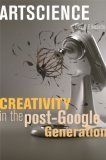 Spotted at the bookstore: Artscience: Creativity in the Post-Google Generation
 by Dave Edwards. “David Edwards describes how contemporary creators achieve breakthroughs in the arts and sciences by developing their ideas in an intermediate zone of human creativity where neither art nor science is easily defined.”
The beginning of the book has a nice list of related works…..
David Edwards and Jay Cantor also have a forthcoming novel, Niche (Idea Translation Lab Series)
Comments (1)
- culture,new books
January 1, 2008
 Thanks to LibraryThing’s Early Reviewers Program, I received an advance copy of The Age of Shiva: A Novel
 by Manil Suri, which is due to be published in Feb 2008, according to Amazon. Since it is the second volume of a trilogy, I re-read the first book, The Death of Vishnu
 , while waiting for ‘The Age of Shiva’ to arrive.
Now I’ve read both novels, and find that I much preferred ‘Vishnu’ to ‘Shiva.’
‘The Age of Shiva’ is told from the first-person perspective of one character, Meera, addressed to her son, Ashvin. Set against a background of Indian politics and history during the early years of independence, much of the story concerns the intense relationship between Meera and her child. Meera’s father is a progressive who urges his daughters to become educated and have careers. Paradoxically, Meera experiences this as paternal interference; an early marriage seems to be her way of rebelling against her father’s wishes. Jealousy of her older sister also plays a role, so that much of Meera’s life seems to be based on reactions to her relatives and other people around her. Echoes of the mythological figures of Shiva, Parvati, and their son Ganesha are also woven in.

In ‘Death of Vishnu,’ among many stories involving the residents of one apartment house, there is a compelling treatment of three characters who exemplify differing concepts of transcendence. The title character, Vishnu, at the lowest level, undergoes death and rebirth, while an upstairs neighbor, Mr. Jalal, takes a more intellectual approach. On the top level, Mr. Taneja experiences a gradual withdrawal from the world after his wife’s early death. His story seemed to me to be a beautiful depiction of a very natural kind of spiritual development, in contrast to Mr. Jalal’s deliberate efforts.
Author’s website
Comments (0)
- fiction
December 27, 2007

The Neuroscience of Fair Play: Why We (Usually) Follow the Golden Rule by Donald W. Pfaff
“Renowned neuroscientist Donald Pfaff upends our entire understanding of ethics and social contracts with an intriguing proposition: the Golden Rule is hardwired into the human brain.”
Dana Foundation book information, including Table of Contents and excerpts
Comments (2)
- cognitive science,new books
by J.W. Dunne – a classic
by Benjamin Libet
by Robin Le Poidevin
by Eviatar Zerubavel
(an exhibition catalog with essays by Umberto Eco and others)
 by Martin Kemp

 by Sian Ede
 by Keith J. Holyoak and Paul Thagard
 ed. by Fernand Hallyn
 by Susanne Richardt
 by Everett Rogers
 by Warren G. Bennis
 by Richard Florida
 by Sonja Lyubomirsky.