April 1, 2008
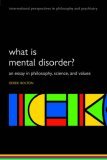 What is Mental Disorder?: An essay in philosophy, science, and values (International Perspectives in Philosophy and Psychiatry) by Derek Bolton (Oxford University Press)
From the book description:
This new book by Derek Bolton tackles the problems involved in the definition and boundaries of mental disorder. It addresses two main questions regarding mental illness. Firstly, what is the basis of the standards or norms by which we judge that a person has a mental disorder – that the person’s mind is not working as it should, that their mental functioning is abnormal? Controversies about these questions have been dominated by the contrast between norms that are medical, scientific or natural, on the one hand, and social norms on the other. The norms that define mental disorder seem to belong to psychiatry, to be medical and scientific, but are they really social norms, hijacked and disguised by the medical profession?
Secondly, what is the validity of the distinction between mental disorder and order, between abnormal and normal mental functioning? To what extent, notwithstanding appearances, does mental disorder involve meaningful reactions and problem-solving? These responses may be to normal problems of living, or to not so normal problems – to severe psycho-social challenges. Is there after all order in mental disorder?
Comments (0)
- new books,philosophy of mind,psychology
March 31, 2008
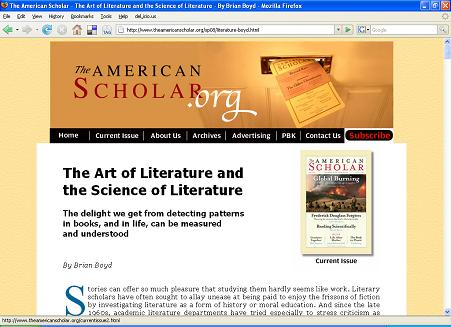
Nabokov scholar Brian Boyd (University of Auckland) in “The Art of Literature and the Science of Literature” suggests that “Art is a form of cognitive play with pattern….” (The article mentions an upcoming book called On the Origin of Stories: Evolution, Cognition and Fiction but it doesn’t appear to be in the “pre-order” stage yet.)
Comments (1)
- cognitive science,culture,fiction
March 30, 2008
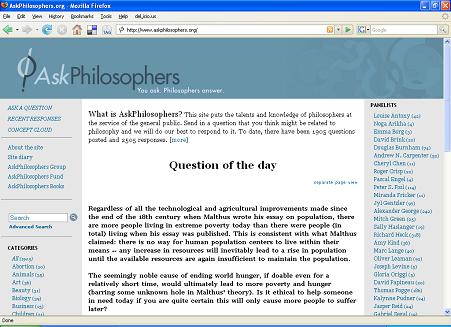
“AskPhilosophers.org” is one of the sites on the Telegraph’s “101 most useful websites,” a database of questions posed by the public with answers posted by a panel of philosophers. There is also a book based on the site; in the US the title is What Would Socrates Say?: Philosophers answer your questions about love, nothingness, and everything else.
Comments (0)
- philosophy of mind
March 27, 2008
Sue M. Halpern reviews several recent books on happiness for the New York Review of Books (4/3/08), concluding:
And so it comes back to the problem of relying on overly broad, categorical, static words like fear and happiness to describe, diagnose, predict, and expound, words that don’t get us very far, as patients, as subjects, as readers. This problem with language may explain why, though we all say we’re happy, the library of how-to-get-happy books and why-we’re-not-happy books is expanding. Anyone who spends time in that section of the stacks is likely to cheer Jerome Kagan’s transcendent (hopeful, gracious) and courageous (brave, valiant, courteous) request:
Let us agree to a moratorium on the use of single words, such as fear, anger, joy, and sad, and write about emotional processes with full sentences rather than ambiguous, naked concepts that burden readers with the task of deciding who, whom, why, and especially what.
Links for the books reviewed:
The How of Happiness: A Scientific Approach to Getting the Life You Want by Sonja Lyubomirsky
Happier: Learn the Secrets to Daily Joy and Lasting Fulfillment by Tal Ben-Shahar
Stumbling on Happiness by Daniel Gilbert
Against Happiness: In Praise of Melancholy by Eric Wilson
What Is Emotion?: History, Measures, and Meanings by Jerome Kagan
“Honorable Mention”: Character Strengths and Virtues: A Handbook and Classification by Christopher Peterson and Martin Seligman.
Sue Halpern’s forthcoming book is Can’t Remember What I Forgot: The Good News from the Front Lines of Memory Research.
Comments (0)
- happiness