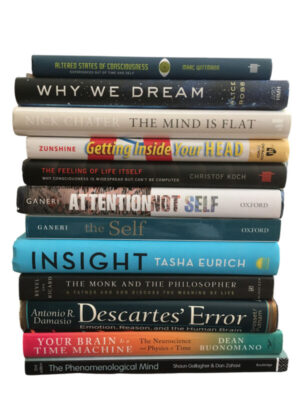
‘The Experimental Phenomena of Consciousness’ at Science & Consciousness Review
June 13, 2007
books on the mind, consciousness, cognitive science…
June 13, 2007
June 12, 2007
I caught myself looking longingly at the fiction after a spate of nonfiction, so I picked up a copy of Glasshouse
In Stross’s future, memories can be erased, personalities edited, people regularly make back-up copies of themselves, and their minds can be placed in different bodies. Problems and issues such as these arise:
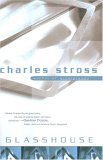 p 2 – “It’s tough, not being able to tell the difference between your own thoughts and a postsurgical identity prosthesis.”
p 15 – “Not wearing a face in public is a deliberate snub.”
The action soon moves to an experimental simulation of a ‘Dark Ages’ society (c. 1950-2040), which affords a look back at the present-day world from the future perspective.
At Stross’s website, www.accelerando.org, his earlier book Accelerando is available as a free ebook.
Author’s blog: http://www.antipope.org/charlie/blog-static/
June 10, 2007
Via Mind Hacks, Brad Pasanek’s “Mind is a metaphor” website has a blog and a database of metaphors from British 18th-century literature. Pasanek’s site has a link to the Open University’s Metaphor Analysis Project, which has collected some papers on contemporary theories of metaphor, starting with Lakoff & Johnson.
June 9, 2007
 Concepts: Where Cognitive Science Went Wrong (Oxford Cognitive Science Series)
 The Big Book of Concepts (Bradford Books)
 Wandering Significance: An Essay on Conceptual Behaviour
 Concepts: Core Readings
“Concepts” at Stanford Encyclopedia of Philosophy
“The classical theory of concepts” at Internet Encyclopedia of Philosophy
Online papers on concepts, compiled by David Chalmers (part of “Online papers on consciousness”)
June 7, 2007
 In A Whole New Mind: Why Right-Brainers Will Rule the Future
Design – not just function
Story – not just argument
Symphony – not just focus
Empathy – not just logic
Play – not just seriousness
Pink includes suggestions and resources for developing each of the six skills, and I’ve enjoyed exploring many of them. Some of the books he recommends –
Story: Substance, Structure, Style and The Principles of Screenwriting
Beethoven’s Anvil: Music in Mind and Culture
How to See: A Guide to Reading Our Man-Made Environment
The Muse Learns to Write: Reflections on Orality and Literacy from Antiquity to the Present
What Video Games Have to Teach Us About Learning and Literacy
Link to Dan Pink’s blog.
Howard Gardner recently published a book with a similar theme: Five Minds for the Future