September 1, 2007
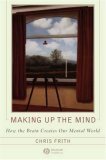 I recently started reading Making up the Mind: How the Brain Creates Our Mental World
 by Chris Frith. Here is a quote from the prologue that sets out the basic idea:
In this book I shall show that this distinction between the mental and the physical is false. It is an illusion created by the brain. Everything we know, whether it is about the physical or the mental world, comes to us through our brain. But our brain’s connection with the physical world of objects is no more direct than our brain’s
connection with the mental world of ideas. By hiding from us all the unconscious inferences that it makes, our brain creates the illusion that we have direct contact with objects in the physical world. And at the same time our brain creates the illusion that our own mental world is isolated and private. Through these two illusions
we experience ourselves as agents, acting independently upon the world….
By seeing through these illusions created by our brain, we can begin to develop a science that explains how the brain creates the mind. [p 17]
reviews at spiked review of books and Derek Bownds’ Mindblog
“limited preview” at Google Books
page for Professor Chris Frith, Wellcome Trust Centre for Neuroimaging
Comments (0)
- mind
August 29, 2007
[For this reading challenge I picked non-fiction titles that are outside the usual scope of my reading and of this website.]
River of Shadows: Eadweard Muybridge and the Technological Wild West by Rebecca Solnit
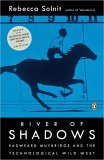
I enjoyed reading this book quite a lot, in part because many of the events take place in San Francisco, Palo Alto, and other Bay Area locations that I’m familiar with. It’s also a well written account, winner of the 2003 National Book Critics Circle Award for Criticism. The book relates the story of Muybridge’s famous motion studies, mostly concentrating on the photographer’s career leading up to and following the innovations that enabled him to capture the details of a trotting horse’s gait. His development of high-speed photographic techniques settled a debate by showing that all four hooves were off the ground at once. The Wikipedia entry for Muybridge cites this book as its source and so gives a fairly good summary of its contents, plus a nice collection of related links.
Solnit also focuses on the changes in the experience of time and space brought about by technological developments of the period such as the railroad and photography. The genealogy from Muybridge’s motion studies to Hollywood and Silicon Valley is just touched on in the last few pages of the book.
Comments (0)
- culture,Non-Fiction Five Challenge
August 28, 2007
One of the full text articles from the Journal of Consciousness Studies, “I=Awareness” is also available from the author’s web site.
…when we use introspection to search for the origin of our subjectivity, we find that the search for ‘I’ leaves the customary aspects of personhood behind and takes us closer and closer to awareness, per se. If this process of introspective observation is carried to its conclusion, even the background sense of core subjective self disappears into awareness. Thus, if we proceed phenomenologically, we find that the ‘I’ is identical to awareness: ‘I’ = awareness.
Deikman’s books include The Observing Self .
.
Comments (0)
- consciousness,self
 by Neil Levy (Cambridge U Press) and