December 5, 2007
This notice just came in an email today:
The Seventh International Conference on Neuroesthetics
Many Faces of a Face
Saturday, January 19, 2008
Berkeley Art Museum
University of California, Berkeley
When Velazquez’s portrait of Juan de Pareja was first exhibited in Rome, one art critic remarked:
“This is the truth; the other exhibits are merely paintings.” To what extent, and by which neural mechanisms, can we divine the intentions of others by studying their face? What happens to our ability to perceive faces when the brain is damaged? What attributes makes us judge a face as being beautiful?
How can we simulate faces through the computer? These are some of the questions that our distinguished speakers, from Europe and the United States, will address at this year’s meeting on neuroesthetics. at the Sixth International Conference on Neuroesthetics. The conference, which is sponsored by the Berkeley-based Minerva Foundation and the Institute of Neuroesthetics in London, is free and open to the public.
Visit http://plaisir.berkeley.edu for more information and to register.
Comments (0)
- Uncategorized
December 4, 2007
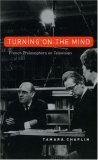 In France they watch philosophers talk on TV – as discussed in a recent book called Turning On the Mind: French Philosophers on Television
 by Tamara Chaplin (found through this blog post, see also publishers’ website)
By the end of the twentieth century, more than 3,500 programs dealing with philosophy and its practitioners—including Bachelard, Badiou, Foucault, Lyotard, and Lévy—had aired on French television. According to Tamara Chaplin, this enduring commitment to bringing the most abstract and least visual of disciplines to the French public challenges our very assumptions about the incompatibility of elite culture and mass media. Indeed, it belies the conviction that television is inevitably anti-intellectual and the quintessential archenemy of the book.
 Meanwhile in the US we take the opposite approach, issuing a spate of pop-culture-related “…and philosophy” books (such as The Simpsons and Philosophy: The D’oh! of Homer)
 , as recently discussed in Philosophy Now.
Comments (2)
- culture,new books
December 2, 2007
I’ve just been trying out online mind-mapping at mind42.com, with a map of some notes on ‘Smart World: Breakthrough Creativity And the New Science of Ideas ‘ by Richard Ogle (The map below might take awhile to load.) It was pretty easy to start mind-mapping and adding links; it looked like images could only come from flickr or Yahoo Image Search, though. I guess I would have to upload images to flickr to get them on the mind map.
You can drag the map around with your mouse to see all the parts; there are some links to click on. Controls along the bottom will increase/decrease the size of the map, expand/collapse the nodes, etc.
I expect to be adding to the map as I go further along with the book.
Comments (0)
- culture,mind
So I’ve been here doing my usual amount of web surfing and book hunting but for whatever reason I didn’t come across anything that seemed “blogworthy” in the past week. These two books came to mind when I was thinking about possible reasons/excuses for the past week of non-posting:
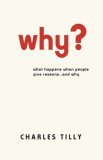
Why? by Charles Tilly and ….
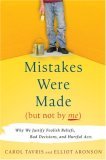
Mistakes Were Made (But Not by Me): Why We Justify Foolish Beliefs, Bad Decisions, and Hurtful Acts by Carol Tavris and Elliot Aronson.
Why? comes recommended by Malcolm Gladwell. From the book description:
“Why?” is a book about the explanations we give and how we give them–a fascinating look at the way the reasons we offer every day are dictated by, and help constitute, social relationships. … Tilly demonstrates that reasons fall into four different categories:
* Convention: “I’m sorry I spilled my coffee; I’m such a klutz.”
* Narratives: “My friend betrayed me because she was jealous of my sister.”
* Technical cause-effect accounts: “A short circuit in the ignition system caused the engine rotors to fail.”
* Codes or workplace jargon: “We can’t turn over the records. We’re bound by statute 369.”
Mistakes Were Made (But Not by Me) offers a social-psychological account of cognitive dissonance and self-justification:
Renowned social psychologists Carol Tavris and Elliot Aronson take a compelling look into how the brain is wired for self-justification. When we make mistakes, we must calm the cognitive dissonance that jars our feelings of self-worth. And so we create fictions that absolve us of responsibility, restoring our belief that we are smart, moral, and right—a belief that often keeps us on a course that is dumb, immoral, and wrong. Backed by years of research and delivered in lively, energetic prose, Mistakes Were Made (But Not by Me) offers a fascinating explanation of self-deception—how it works, the harm it can cause, and how we can overcome it.
Comments (0)
- mind
November 25, 2007
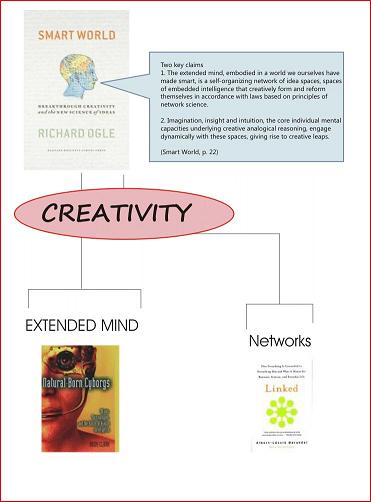 I’ve just recently started reading ‘Smart World’ by Richard Ogle and here is my first attempt at a clickable mind-map/ collage for some sources and concepts related to the book. (Clicking the image here will take you to a larger hyperlinked version.)
Comments (1)
- culture,mind