[ View menu ]

Archive

coming soon – ‘iBrain: Surviving the Technological Alteration of the Modern Mind’

October 7, 2008

iBrain: Surviving the Technological Alteration of the Modern Mind by Gary Small and Gigi Vorgan (Collins Living, 2008) is due out on Oct. 14.

Product Description

Their insights are extraordinary, their behaviors unusual. Their brains—shaped by the era of microprocessors, access to limitless information, and 24-hour news and communication—are remapping, retooling, and evolving. They’re not superhuman. They’re your twenty-something coworkers, your children, and your competition. Are you keeping up?

In iBrain, Dr. Gary Small, one of America’s leading neuroscientists and experts on brain function and behavior, explores how technology’s unstoppable march forward has altered the way young minds develop, function, and interpret information. iBrain reveals a new evolution catalyzed by technological advancement and its future implications: Where do you fit in on the evolutionary chain? What are the professional, social, and political impacts of this new brain evolution? How must you adapt and at what price?

While high-tech immersion can accelerate learning and boost creativity, it also has its glitches, among them the meteoric rise in ADD diagnoses, increased social isolation, and Internet addiction. To compete and thrive in the age of brain evolution, and to avoid these potential drawbacks, we must adapt, and iBrain—with its Technology Toolkit—equips all of us with the tools and strategies needed to close the brain gap.

See also: author’s website.

Comments (0) - Uncategorized

techniques of ‘Transformative Phenomenology’

October 5, 2008

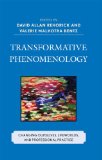
Transformative Phenomenology

I recently read Transformative Phenomenology: Changing Ourselves, Lifeworlds, and Professional Practice, hoping to find some instructions for phenomenological techniques. The book is a collection of accounts by students at Fielding Graduate University.

Most of the articles were descriptions of the results of applying phenomenological techniques to various experiences, with only a few hints on what they were actually doing, although after reading through many accounts it was possible to get a rough idea of the method. The first step is to collect written accounts (“protocols”) of experience on a certain theme, either from one’s own experience or from a group of people who share the experience being investigated. These accounts are studied to discover common themes.

In the introduction, three specific phenomenological techniques are discussed: bracketing, imaginative variations, and horizontalization:
p. 11-17

bracketing – learn “to recognize, then set aside, the myriad assumptions, filters, conceptual frameworks that structure our perceptions and experiences.” levels – (1) suspend what has been learned from scientific studies, accepted theories, legitimated sources of knowledge (2) notions from cultural milieu; third deeper level, set aside object of consciousness itself, to experience pure consciousness, the self beneath the particular content.

imaginative variations – one imaginatively changes components with the aim of discovering what must be present, what does not need to be present for the phenomenon to exist

horizontalization – making elements in a situation equal and putting that situation at a distance to better view it without assumptions or bias

One article — Intentionality in Action by David B. Haddad — did spell out a method, since his project involved teaching the process to artists:
p. 196-197

My goal was to instruct artists with no prior knowledge of phenomenology to write and think about their work using the techniques of writing protocols, and work with them using bracketing, imaginative variations, and other phenomenological techniques…

!. Initiate an act of intentionality simply by making a spontaneous choice. Participants were urged to make their choice about a future state of affairs.

2. Describe your choice in the fullest possible detail. To assist the participants, I encouraged them to base their descriptions on a range of existential categories. I asked them to describe their intentional act in terms of time, space, the body, and their relationships to others. Meditation develops most of its content by applying these existential prompts.

3. Next was the clustering phase, to cluster meanings, to identify and isolate themes. Phrases, sentences, even whole paragraphs, of rich description were brought together into concentrations of like thoughts. Then we mined their horizontal qualities. Each horizon of the meditation was an aspect of the meaning within the overall meditation. Each was considered on its own merits, in isolation from the rest, so that its full significance could be felt and explored. Once exploration of horizons begins, one quickly discovers their open-endedness. Horizons of meaning possess inexhaustible qualities.

4. Next, we inverted the contents of the meditation. By subjecting the results gained to playfully upturned, imaginative reversals and polarities, we were able to shake ourselves out of any residual linear thinking and consider the radical breadth still buried in the original act of intentionality.

5. Finally, we reassessed and condensed the entire meditation into a final synthesis. Whereas all of the above steps were carried out in writing, only the final synthesis was open to artistic rather than textual rendering.


Comments (0) - meditation

new book – ‘Enjoyment: The Moral Significance of Styles of Life’

October 4, 2008

Enjoyment: The Moral Significance of Styles of Life by John Kekes (Oxford University Press, 2008).

Product Description
In this book John Kekes examines the indispensable role enjoyment plays in a good life. The key to it is the development of a style of life that combines an attitude and a manner of living and acting that jointly express one’s deepest concerns. Since such styles vary with characters and circumstances, a reasonable understanding of them requires attending to the particular and concrete details of individual lives. Reflection on works of literature is a better guide to this kind of understanding than the futile search for general theories and principles that preoccupies much of contemporary moral thought.
Enjoyment proceeds by the detailed examination of particular cases, shows how this kind of reflection can be reasonably conducted, and how the quest for universality and impartiality is misguided in this context. Central to the argument is a practical, particular, pluralistic, and yet objective conception of reason that rejects the pervasive contemporary tendency to regard reasons as good only if they are binding on all who aspire to live reasonably and morally. Reason in morality is neither theoretical nor general. Reasons for living and acting in particular ways are individually variable and none the worse for that.
Kekes aims to reorient moral thought from deontological, contractarian, and consequentialist preoccupations toward a reasonable but pluralistic reflection on what individuals can do to make their lives better.

Comments (0) - happiness,new books

science books at ReadWriteWeb and Boldtype

October 2, 2008

5 Great Science Books to Expand Your Mind” at ReadWriteWeb picks Godel, Escher. Bach by Hofstadter, Complexity by Waldrop, At Home in the Universe by Kauffman, The User Illusion by Norretranders, and Programming the Universe by Lloyd, with more reader suggestions in the comments.

Boldtype is a monthly book review email newsletter and this month’s issue is “Science: Traffic, Chance, Mutation,” with reviews of The Drunkard’s Walk, Traffic, Bonk, and more.

Comments (0) - Uncategorized

new book: ‘Emotional Awareness’ by the Dalai Lama and Paul Ekman

October 1, 2008

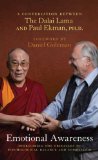
Emotional Awareness: Overcoming the Obstacles to Psychological Balance and Compassion by the Dalai Lama and Paul Ekman (Times Books, 2008) seems quite similar to the Mind and Life Institute series of books but it doesn’t appear on their list of publications.

Product Description

Two leading thinkers engage in a landmark conversation about human emotions and the pursuit of psychological fulfillment

At their first meeting, a remarkable bond was sparked between His Holiness the Dalai Lama, one of the world’s most revered spiritual leaders, and the psychologist Paul Ekman, whose groundbreaking work helped to define the science of emotions. Now these two luminaries share their thinking about science and spirituality, the bonds between East and West, and the nature and quality of our emotional lives.

In this unparalleled series of conversations, the Dalai Lama and Ekman prod and push toward answers to the central questions of emotional experience. What are the sources of hate and compassion? Should a person extend her compassion to a torturer—and would that even be biologically possible? What does science reveal about the benefits of Buddhist meditation, and can Buddhism improve through engagement with the scientific method? As they come to grips with these issues, they invite us to join them in an unfiltered view of two great traditions and two great minds.

Accompanied by commentaries on the findings of emotion research and the teachings of Buddhism, their interplay—amusing, challenging, eye-opening, and moving—guides us on a transformative journey in the understanding of emotions.

Comments (0) - meditation,mind,new books