March 16, 2009
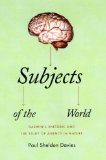
Subjects of the World: Darwin’s Rhetoric and the Study of Agency in Nature by Paul Sheldon Davies (U of Chicago Press, 2009).
Synopsis from the publisher:
Being human while trying to scientifically study human nature confronts us with our most vexing problem. Efforts to explicate the human mind are thwarted by our cultural biases and entrenched infirmities; our first-person experiences as practical agents convince us that we have capacities beyond the reach of scientific explanation. What we need to move forward in our understanding of human agency, Paul Sheldon Davies argues, is a reform in the way we study ourselves and a long overdue break with traditional humanist thinking.
Davies locates a model for change in the rhetorical strategies employed by Charles Darwin in On the Origin of Species. Darwin worked hard to anticipate and diminish the anxieties and biases that his radically historical view of life was bound to provoke. Likewise, Davies draws from the history of science and contemporary psychology and neuroscience to build a framework for the study of human agency that identifies and diminishes outdated and limiting biases. The result is a heady, philosophically wide-ranging argument in favor of recognizing that humans are, like everything else, subjects of the natural world—an acknowledgement that may free us to see the world the way it actually is.
Comments (0)
- new books,philosophy of mind,self
March 12, 2009

The Oxford Handbook of Philosophy of Mind (Oxford University Press, 2009) is available, with “Look Inside” at Amazon for a preview of the Table of Contents and part of Jaegwon Kim’s article on “Mental Causation.”
Information from the publisher:
Product Description
The study of the mind has always been one of the main preoccupations of philosophers, and has been a booming area of research in recent decades, with remarkable advances in psychology and neuroscience. Oxford University Press now presents the most authoritative and comprehensive guide ever published to the philosophy of mind.
An outstanding international team of contributors offer 45 specially written critical surveys of a wide range of topics relating to the mind. The first two sections cover the place of the mind in the natural world: its ontological status, how it fits into the causal fabric of the universe, and the nature of consciousness. The third section focuses on the much-debated subjects of content and intentionality. The fourth section examines a variety of mental capacities, including memory, imagination, and emotion. The fifth section looks at epistemic issues, in particular regarding knowledge of one’s own and other minds. The volume concludes with a section on self, personhood, and agency.
The Oxford Handbook of Philosophy of Mind will be an invaluable resource for advanced students and scholars of philosophy, and also for researchers in neighboring disciplines seeking a high-level survey of the state of the art in this flourishing field.
Comments (2)
- new books,philosophy of mind
March 11, 2009
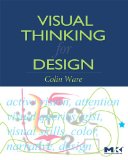
Visual Thinking for Design by Colin Ware (Morgan Kauffman-Elsevier, 2008)
p. 12 “What we end up actually perceiving is the result of information about the world strongly biased according to what we are attempting to accomplish.”
Ware discusses aspects of visual perception as they relate to design, based on a model of visual thinking as an active process.
According to this new view, visual thinking is a process that has the allocation of attention as its very essence. … This new understanding leads to a revision of our thinking about the nature of visual consciousness. It is more accurate to say that we are conscious of the field of information to which we have rapid access rather than that we are immediately conscious of the world. (p. 3)
An implication for graphic design is that information display should be designed to support visual queries.
I was interested in the contrast drawn between design for narrative vs design for information seeking:
Information seekers have highly individual cognitive threads that are shaped moment-to-moment by the specific demands of the cognitive process of solving a problem. This process is internally driven. Conversely, the audience of a narrative presentation will, if they are attending, have cognitive threads that are much more similar to each other, although still far from identical because of the variety of their prior experiences. (p. 138)
Summing up near the end of the book (p. 172):
The active vision model has four broad implications for design.
1. To support the pattern-finding capability of the brain; that is, to turn information structures into patterns.
2. To optimize the cognitive process as a nested set of activities.
3. To take the economics of cognition into account, considering the cost of learning new tools and ways of seeing.
4. To think about attention at many levels and design for the cognitive thread.
A review at EagerEyes.org has a more detailed chapter-by-chapter summary.
See also: Author’s website
Comments (0)
- cognitive science
March 8, 2009

I recently started a new full time job after being laid off for eight months. The job offer came along about the time that the Kindle 2 was announced, so I decided to treat myself (….for the commute, of course….). I’ve had the Kindle for a little over a week now, coinciding with my first week of work.
I find reading on the Kindle very comfortable; plus, those times when I don’t get a seat on the BART train, I can easily read with one hand. Also the basic web browsing with 3G wireless seems like a great feature for those times when there isn’t a handy WiFi hotspot. Anyone who’s traveled with a heavy suitcase stuffed with reading material might appreciate being able to load up a lightweight Kindle instead.
Some recent books that have Kindle editions include:
How We Decide
Why We Make Mistakes: How We Look Without Seeing, Forget Things in Seconds, and Are All Pretty Sure We Are Way Above Average
Kindle resources that I’ve found so far (please let me know of others in the comments):
Kindle Boards
Joe Wikert’s Kindleville Blog
The Kindle Reader blog
Comments (1)
- reading