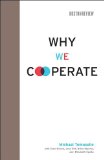
Drop something in front of a two-year-old, and she’s likely to pick it up for you. This is not a learned behavior, psychologist Michael Tomasello argues. Through observations of young children in experiments he himself has designed, Tomasello shows that children are naturally—and uniquely—cooperative. Put through similar experiments, for example, apes demonstrate the ability to work together and share, but choose not to.
As children grow, their almost reflexive desire to help—without expectation of reward—becomes shaped by culture. They become more aware of being a member of a group. Groups convey mutual expectations, and thus may either encourage or discourage altruism and collaboration. Either way, cooperation emerges as a distinctly human combination of innate and learned behavior.
In Why We Cooperate, Tomasello’s studies of young children and great apes help identify the underlying psychological processes that very likely supported humans’ earliest forms of complex collaboration and, ultimately, our unique forms of cultural organization, from the evolution of tolerance and trust to the creation of such group-level structures as cultural norms and institutions.
Scholars Carol Dweck, Joan Silk, Brian Skyrms, and Elizabeth Spelke respond to Tomasello’s findings and explore the implications.
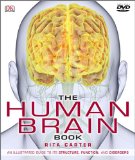
DK Publishing produces beautifully illustrated books on a variety of subjects, now including the coffeetable-worthy Human Brain Book (+ DVD) by Rita Carter.
The Human Brain Book is a complete guide to the one organ in the body that makes each of us what we are – unique individuals. It combines the latest findings from the field of neuroscience with expert text and state-of-the-art illustrations and imaging techniques to provide an incomparable insight into every facet of the brain. Layer by layer, it reveals the fascinating details of this remarkable structure, covering all the key anatomy and delving into the inner workings of the mind, unlocking its many mysteries, and helping you to understand what’s going on in those millions of little gray and white cells.
Tricky concepts are illustrated and explained with clarity and precision, as The Human Brain Book looks at how the brain sends messages to the rest of the body, how we think and feel, how we perform unconscious actions (for example breathing), explores the nature of genius, asks why we behave the way we do, explains how we see and hear things, and how and why we dream. Physical and psychological disorders affecting the brain and nervous system are clearly illustrated and summarized in easy-to-understand terms.
The unique DVD brings the subject to life with interactive elements. These include a clickable model of the brain’s structure that allows the user to zoom in and discover deeper layers of detail, while complex processes, such as the journey of a nerve impulse, are broken down and simplified through intuitive animations.
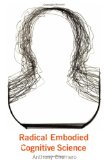
While philosophers of mind have been arguing over the status of mental representations in cognitive science, cognitive scientists have been quietly engaged in studying perception, action, and cognition without explaining them in terms of mental representation. In this book, Anthony Chemero describes this nonrepresentational approach (which he terms radical embodied cognitive science), puts it in historical and conceptual context, and applies it to traditional problems in the philosophy of mind. Radical embodied cognitive science is a direct descendant of the American naturalist psychology of William James and John Dewey, and it follows them in viewing perception and cognition to be understandable only in terms of action in the environment. Chemero argues that cognition should be described in terms of agent-environment dynamics rather than in terms of computation and representation. After outlining this orientation to cognition, Chemero proposes a methodology: dynamical systems theory, which would explain things dynamically and without reference to representation. He also advances a background theory: Gibsonian ecological psychology, “shored up” and clarified. Chemero then looks at some traditional philosophical problems (reductionism, epistemological skepticism, metaphysical realism, consciousness) through the lens of radical embodied cognitive science and concludes that the comparative ease with which it resolves these problems, combined with its empirical promise, makes this approach to cognitive science a rewarding one. “Jerry Fodor is my favorite philosopher,” Chemero writes in his preface, adding, “I think that Jerry Fodor is wrong about nearly everything.” With this book, Chemero explains nonrepresentational, dynamical, ecological cognitive science as clearly and as rigorously as Jerry Fodor explained computational cognitive science in his classic work The Language of Thought. A Bradford Book
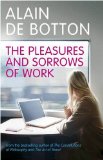
We spend most of our waking lives at work—in occupations often chosen by our unthinking younger selves. And yet we rarely ask ourselves how we got there or what our occupations mean to us.
The Pleasures and Sorrows of Work is an exploration of the joys and perils of the modern workplace, beautifully evoking what other people wake up to do each day—and night—to make the frenzied contemporary world function. With a philosophical eye and his signature combination of wit and wisdom, Alain de Botton leads us on a journey around a deliberately eclectic range of occupations, from rocket science to biscuit manufacture, accountancy to art—in search of what make jobs either fulfilling or soul-destroying.
Along the way he tries to answer some of the most urgent questions we can ask about work: Why do we do it? What makes it pleasurable? What is its meaning? And why do we daily exhaust not only ourselves but also the planet? Characteristically lucid, witty and inventive, Alain de Botton’s “song for occupations” is a celebration and exploration of an aspect of life which is all too often ignored and a book that shines a revealing light on the essential meaning of work in our lives.
This volume investigates the neglected topic of mental action, and shows its importance for the metaphysics, epistemology, and phenomenology of mind. Twelve specially written essays address such questions as the following: Which phenomena should we count as mental actions–imagining, remembering, judging, for instance? How should we explain our knowledge of our mental actions, and what light does that throw on self-knowledge in general? What contributions do mental actions make to our consciousness? What is the relationship between the voluntary and the active, in the mental sphere? What are the similarities and differences between mental and physical action, and what can we learn about each from the other?
Table of Contents
Chapter 1 Introduction, Matthew Soteriou (Warwick University)
Chapter 2 Mental Action: A Case Study, Al Mele (Florida State University)
Chapter 3 Judging and the Scope of Mental Agency, Fabian Dorsch (University of Fribourg, Switzerland)
Chapter 4 Reason in Action, John Gibbons (Manchester Metropolitan University)
Chapter 5 Reason, Voluntariness and Moral Responsibility, Thomas Pink (King’s College London)
Chapter 6 Freedom and Practical Judgement, David Owens (University of Sheffield)
Chapter 7 Two Kinds of Agency, Pamela Hieronymi (University of California, Los Angeles)
Chapter 8 Trying and Acting, Brian O’Shaughnessy (King’s College London)
Chapter 9 Perceptual Activity and the Will, Thomas Crowther (Heythrop College, University of London)
Chapter 10 Mental Action and Self-Awareness (II): Epistemology, Christopher Peacocke (Columbia University)
Chapter 11 Mental Actions and the No-Content Problem, Lucy O’Brien (University College London)
Chapter 12 Mental Agency, Conscious Thinking and Phenomenal Character, Matthew Soteriou (Warwick University)
Chapter 13 Is There a Sense of Agency for Thought? Joelle Proust (Institut Nicod)
See also: Mental Action section of MindPapers – includes a link to the article by Christopher Peacocke