[ View menu ]

Archive

new book – ‘Being Wrong: Adventures in the Margin of Error’

June 8, 2010
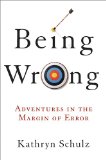
Being Wrong
A new book out today, Being Wrong: Adventures in the Margin of Error by journalist Kathryn Schulz (published by Ecco) received a starred review from Publisher’s Weekly. (link for UK)

Product description from the publisher:

To err is human. Yet most of us go through life assuming (and sometimes insisting) that we are right about nearly everything, from the origins of the universe to how to load the dishwasher. If being wrong is so natural, why are we all so bad at imagining that our beliefs could be mistaken, and why do we react to our errors with surprise, denial, defensiveness, and shame?

In Being Wrong, journalist Kathryn Schulz explores why we find it so gratifying to be right and so maddening to be mistaken, and how this attitude toward error corrodes relationships—whether between family members, colleagues, neighbors, or nations. Along the way, she takes us on a fascinating tour of human fallibility, from wrongful convictions to no-fault divorce; medical mistakes to misadventures at sea; failed prophecies to false memories; “I told you so!” to “Mistakes were made.” Drawing on thinkers as varied as Augustine, Darwin, Freud, Gertrude Stein, Alan Greenspan, and Groucho Marx, she proposes a new way of looking at wrongness. In this view, error is both a given and a gift—one that can transform our worldviews, our relationships, and, most profoundly, ourselves.
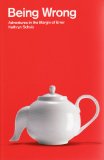
Being Wrong (UK edition)

In the end, Being Wrong is not just an account of human error but a tribute to human creativity—the way we generate and revise our beliefs about ourselves and the world. At a moment when economic, political, and religious dogmatism increasingly divide us, Schulz explores with uncommon humor and eloquence the seduction of certainty and the crises occasioned by error. A brilliant debut from a new voice in nonfiction, this book calls on us to ask one of life’s most challenging questions: what if I’m wrong?

See also: Website for the book, NPR interview
Comments (0) - new books,psychology

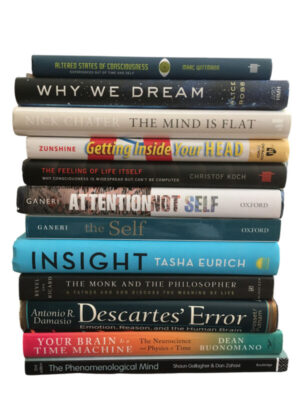
consciousness books 2010

June 6, 2010

I see it’s been awhile since I’ve updated some of the book lists here, so maybe now near the middle of the year is a good time to look at the books published so far and those still to come this year.

Following is a list of books on consciousness published or to be published during 2010, based on a search of WorldCat.

Aesthetic Genesis: The Origin of Consciousness in the Intentional Being of Nature by Jeffrey Anthony Mitscherling (Lanham, Md.: University Press of America) Mar 2010. (link for UK)

The Book of Not Knowing: Exploring the True Nature of Self, Mind, and Consciousness by Peter Ralston (Berkeley, Calif.: North Atlantic Books) Jan 2010 (link for UK)

Brain, Mind, and the Structure of Reality by Paul L Nunez (New York: Oxford University Press) Apr 2010. (link for UK)

The Character of Consciousness (Philosophy of Mind Series) by David John Chalmers (New York; Oxford: Oxford University Press) forthcoming Aug 2010. (link for UK)

Cognition, Brain, and Consciousness, Second Edition: Introduction to Cognitive Neuroscience by Bernard J Baars and Nicole M Gage (Burlington, MA: Academic Press/Elsevier) Mar 2010. (link for UK)

Consciousness (A Brief Insight) by Susan Blackmore (New York: Sterling) May 2010. (link for UK)

Consciousness, Attention and Meaning by Giorgio Marchetti (Hauppauge, N.Y.: Nova Science Publishers) forthcoming Oct 2010. (link for UK)

Consciousness, Awareness and Anesthesia

Consciousness, Awareness, and Anesthesia by George A Mashour (Cambridge; New York: Cambridge University Press) Jan 2010. (link for UK)

Consciousness, Theatre, Literature and the Arts 2009 ed by Daniel Meyer-Dinkgräfe (Newcastle: Cambridge Scholars) Jan 2010. (link for UK)

Embodiment and the Inner Life: Cognition and Consciousness in the Space of Possible Minds by Murray Shanahan (New York: Oxford University Press) forthcoming July 2010. (link for UK)

Free Will and Consciousness: How Might They Work? ed. by Roy F Baumeister; Alfred R Mele; Kathleen D Vohs; (New York: Oxford University Press) forthcoming July 2010. (link for UK)

Landscape of the Mind: Human Evolution and the Archeology of Thought by John F Hoffecker (New York; Chichester: Columbia University Press) forthcoming Aug 2010. (link for UK)

The Origin of Cultures by John Lin (Los Angeles, Calif.: Prometheus Press) forthcoming Sept 2010.

Our Own Minds: Sociocultural Grounds for Self-Consciousness (Bradford Books) by Radu J Bogdan (Cambridge, MA: MIT Press) forthcoming Oct 2010. (link for UK)

Performing Consciousness

Performing Consciousness by Per K Brask; Daniel Meyer-Dinkgräfe; (Newcastle upon Tyne: Cambridge Scholars) Jan 2010. (link for UK)

Process Approaches to Consciousness in Psychology, Neuroscience, and Philosophy of Mind (S U N Y Series in Philosophy) ed. by Michel Weber; Anderson Weekes (Albany, N.Y. : SUNY Press ; Bristol: University Presses Marketing [distributor]) Jan 2010. (link for UK)

Self Comes to Mind: Constructing the Conscious Brain by Antonio R Damasio (New York: Pantheon Books) forthcoming Nov 2010. (link for UK)

Social Structure and Forms of Consciousness, Volume 1: The Social Determination of Method by István Mészáros (New York : Monthly Review Press) Feb 2010. (link for UK)

Thinking Twice: Two Minds in One Brain by Jonathan St B T Evans (New York: Oxford University Press) forthcoming Jul 2010. (link for UK)

Visions of Discovery: New Light on Physics, Cosmology, and Consciousness ed. by Raymond Y Chiao; et al (Cambridge; New York: Cambridge University Press) forthcoming Oct 2010. (link for UK)

Comments (0) - consciousness,new books

‘The Upside of Irrationality’ by Dan Ariely – available 6/1/10

May 31, 2010

The Upside of Irrationality

The Upside of Irrationality: The Unexpected Benefits of Defying Logic at Work and at Home by Dan Ariely (Harper, 2010) has a release date of June 1, according to Amazon.

(kindle ed)

(already available at amazon.co.uk)

Product description from the publisher:

The provocative follow-up to the New York Times bestseller Predictably Irrational

  • Why can large bonuses make CEOs less productive?
  • How can confusing directions actually help us?
  • Why is revenge so important to us?
  • Why is there such a big difference between what we think will make us happy and what really makes us happy?

In his groundbreaking book Predictably Irrational, social scientist Dan Ariely revealed the multiple biases that lead us into making unwise decisions. Now, in The Upside of Irrationality, he exposes the surprising negative and positive effects irrationality can have on our lives. Focusing on our behaviors at work and in relationships, he offers new insights and eye-opening truths about what really motivates us on the job, how one unwise action can become a long-term habit, how we learn to love the ones we’re with, and more.

Drawing on the same experimental methods that made Predictably Irrational one of the most talked-about bestsellers of the past few years, Ariely uses data from his own original and entertaining experiments to draw arresting conclusions about how—and why—we behave the way we do. From our office attitudes, to our romantic relationships, to our search for purpose in life, Ariely explains how to break through our negative patterns of thought and behavior to make better decisions. The Upside of Irrationality will change the way we see ourselves at work and at home—and cast our irrational behaviors in a more nuanced light.

See also: author’s website

video intro for the book:

Comments (0) - cognitive science,new books,psychology

new book – ‘The Shallows: What the Internet Is Doing to Our Brains’

May 29, 2010

The Shallows

The Shallows: What the Internet Is Doing to Our Brains by Nicholas Carr (W.W. Norton, 2010)

(link for UK)

Product description from the publisher:

The best-selling author of The Big Switch returns with an explosive look at technology’s effect on the mind. “Is Google making us stupid?” When Nicholas Carr posed that question, in a celebrated Atlantic Monthly cover story, he tapped into a well of anxiety about how the Internet is changing us. He also crystallized one of the most important debates of our time: As we enjoy the Net’s bounties, are we sacrificing our ability to read and think deeply?

Now, Carr expands his argument into the most compelling exploration of the Internet’s intellectual and cultural consequences yet published. As he describes how human thought has been shaped through the centuries by “tools of the mind”—from the alphabet to maps, to the printing press, the clock, and the computer—Carr interweaves a fascinating account of recent discoveries in neuroscience by such pioneers as Michael Merzenich and Eric Kandel. Our brains, the historical and scientific evidence reveals, change in response to our experiences. The technologies we use to find, store, and share information can literally reroute our neural pathways.

Building on the insights of thinkers from Plato to McLuhan, Carr makes a convincing case that every information technology carries an intellectual ethic—a set of assumptions about the nature of knowledge and intelligence. He explains how the printed book served to focus our attention, promoting deep and creative thought. In stark contrast, the Internet encourages the rapid, distracted sampling of small bits of information from many sources. Its ethic is that of the industrialist, an ethic of speed and efficiency, of optimized production and consumption—and now the Net is remaking us in its own image. We are becoming ever more adept at scanning and skimming, but what we are losing is our capacity for concentration, contemplation, and reflection.

Part intellectual history, part popular science, and part cultural criticism, The Shallows sparkles with memorable vignettes—Friedrich Nietzsche wrestling with a typewriter, Sigmund Freud dissecting the brains of sea creatures, Nathaniel Hawthorne contemplating the thunderous approach of a steam locomotive—even as it plumbs profound questions about the state of our modern psyche. This is a book that will forever alter the way we think about media and our minds.

See also: Excerpt at Wired.com, Website for the book, “Is Google Making Us Stupid?” at theatlantic.com

Comments (0) - cognitive science,culture,reading

on the “stochastic arts” – excerpt from ‘Shop Class as Soulcraft: An Inquiry into the Value of Work’

May 28, 2010

Shop Class as Soulcraft

Shop Class as Soulcraft: An Inquiry into the Value of Work by Matthew B. Crawford (Penguin, 2009)

(‘The Case for Working with Your Hands’ at Amazon.co.uk)

excerpt, pp 81-82

Some arts reliably attain their object—for example, the art of building. If the building falls down, one can say in retrospect that the builder didn’t know what he was doing. But there is another class of arts that Aristotle calls “stochastic.” An example is medicine. Mastery of a stochastic art is compatible with failure to achieve its end (health). As Aristotle writes, “It does not belong to medicine to produce health, but only to promote it as much as is possible….” (Aristotle, Rhetoric, 1355b12) Fixing things, whether cars or human bodies, is very different from building things from scratch. The mechanic and the doctor deal with failure every day, even if they are expert, whereas the builder does not. This is because the things they fix are not of their own making, and are therefore never known in a comprehensive or absolute way. This experience of failure tempers the conceit of mastery; the doctor and mechanic have daily intercourse with the world as something independent, and a vivid awareness of the difference between self and nonself. Fixing things may be a cure for narcissism.

Because the stochastic arts diagnose and fix things that are variable, complex, and not of our own making, and therefore not fully knowable, they require a certain disposition toward the thing you are trying to fix. This disposition is at once cognitive and moral. Getting it right demands that you be attentive in the way of a conversation rather than assertive in the way of a demonstration. I believe the mechanical arts have a special significance for our time because they cultivate not creativity, but the less glamorous virtue of attentiveness. Things need fixing and tending no less than creating.

See also: Author’s website

video book talk from fora.tv:

Comments (0) - culture,happiness