[ View menu ]

Archive

upcoming titles from Oliver Sacks and Antonio Damasio

July 16, 2010

Besides new books by David Chalmers and Douglas Hofstadter mentioned in an earlier post, there are also new books coming later this year by Oliver Sacks and Antonio Damasio.

The Mind's Eye

Coming in October – The Mind’s Eye by Oliver Sacks (Knopf, 2010). (link for amazon.co.uk)

Product description from the publisher:

From the author of the best-selling Musicophilia (hailed as “luminous, original, and indispensable” by The American Scholar), an exploration of vision through the case histories of six individuals—including a renowned pianist who continues to give concerts despite losing the ability to read the score, and a neurobiologist born with crossed eyes who, late in life, suddenly acquires binocular vision, and how her brain adapts to that new skill. Most dramatically, Sacks gives us a riveting account of the appearance of a tumor in his own eye, the strange visual symptoms he observed, an experience that left him unable to perceive depth.

In The Mind’s Eye, Oliver Sacks explores some of the most fundamental facets of human experience—how we see in three dimensions, how we represent the world internally when our eyes are closed, and the remarkable, unpredictable ways that our brains find new ways of perceiving that create worlds as complete and rich as the no-longer-visible world.

Damasio’s book is coming in November from Pantheon: Self Comes to Mind: Constructing the Conscious Brain. (link for amazon.co.uk)

Product description from the publisher:

One of the most important and original neuroscientists at work today tackles a question that has confounded neurologists, philosophers, cognitive scientists, and psychologists for centuries: how consciousness is created.

Antonio Damasio has spent the past thirty years studying and writing about how the brain operates, and his work has garnered acclaim for its singular melding of the scientific and the humanistic. In this revelatory work, he debunks the long-standing idea that consciousness is somehow separate from the body, presenting astounding new scientific evidence that consciousness—what we think of as “self”—is in fact a biological process created by the brain. Besides the three traditional perspectives used to study the mind (the personal, the behavioral, and the neurological), Damasio introduces the evolutionary perspective, which entails a radical change in the way the history of conscious minds is viewed and told.

Self Comes to Mind is a groundbreaking investigation of consciousness as a dynamic, unpredictable faculty that is instrumental in defining and explaining who we understand ourselves to be.

Comments (0) - cognitive science,consciousness,new books,psychology,self

new book – ‘Hamlet’s BlackBerry: A Practical Philosophy for Building a Good Life in the Digital Age’

July 11, 2010

Hamlet's BlackBerry

Hamlet’s BlackBerry: A Practical Philosophy for Building a Good Life in the Digital Age by William Powers (Harper, 2010). (Kindle ed), (link for amazon.co.uk)

A crisp, passionately argued answer to the question that everyone who’s grown dependent on digital devices is asking: “Where’s the rest of my life?”

At a time when we’re all trying to make sense of our relentlessly connected lives, this revelatory book presents a bold new approach to the digital age. Part intellectual journey, part memoir, Hamlet’s BlackBerry sets out to solve what William Powers calls the conundrum of connectedness. Our computers and mobile devices do wonderful things for us. But they also impose an enormous burden, making it harder for us to focus, do our best work, build strong relationships, and find the depth and fulfillment we crave.

Hamlet’s BlackBerry argues that we need a new way of thinking, an everyday philosophy for life with screens. To find it, Powers reaches into the past, uncovering a rich trove of ideas that have helped people manage and enjoy their connected lives for thousands of years. New technologies have always brought the mix of excitement and stress that we feel today. Drawing on some of history’s most brilliant thinkers, from Plato to Shakespeare to Thoreau, he shows that digital connectedness serves us best when it’s balanced by its opposite, disconnectedness.

Using his own life as laboratory and object lesson, Powers demonstrates why this is the moment to revisit our relationship to screens and mobile technologies, and how profound the rewards of doing so can be. Lively, original, and entertaining, Hamlet’s BlackBerry will challenge you to rethink your digital life.

See also: Author’s website

Comments (0) - culture,new books

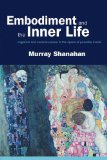
coming soon – ‘Embodiment and the Inner Life: Cognition and Consciousness in the Space of Possible Minds’

July 9, 2010

Embodiment and the Inner Life

Coming soon from Oxford University Press (US release scheduled for July 15, already available at amazon.co.uk):
Embodiment and the Inner Life: Cognition and Consciousness in the Space of Possible Minds by Murray Shanahan.

Product description from the publisher:

To understand the mind and its place in Nature is one of the great intellectual challenges of our time, a challenge that is both scientific and philosophical. How does cognition influence an animal’s behaviour? What are its neural underpinnings? How is the inner life of a human being constituted? What are the neural underpinnings of the conscious condition?

Embodiment and the Inner Life approaches each of these questions from a scientific standpoint. But it contends that, before we can make progress on them, we have to give up the habit of thinking metaphysically, a habit that creates a fog of philosophical confusion. From this post-reflective point of view, the book argues for an intimate relationship between cognition, sensorimotor embodiment, and the integrative character of the conscious condition.

Drawing on insights from psychology, neuroscience, and dynamical systems, it proposes an empirical theory of this three-way relationship whose principles, not being tied to the contingencies of biology or physics, are applicable to the whole space of possible minds in which humans and other animals are included. Embodiment and the Inner Life is one of very few books that provides a properly joined-up theory of consciousness, and will be essential reading for all psychologists, philosophers, and neuroscientists with an interest in the enduring puzzle of consciousness.

See also: Author’s website

Comments (0) - cognitive science,consciousness,new books

Extended mind – books & resources

June 24, 2010

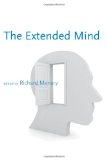
The Extended Mind

A new book from MIT Press reflects the current state of debate on the extended mind concept & I’ve collected some related titles and links below: The Extended Mind (Life and Mind: Philosophical Issues in Biology and Psychology), ed. by Richard Menary (MIT Press, 2010) (link for UK)

Product description from the publisher:

Where does the mind stop and the rest of the world begin? In their famous 1998 paper “The Extended Mind,” philosophers Andy Clark and David Chalmers posed this question and answered it provocatively: cognitive processes “ain’t all in the head.” The environment has an active role in driving cognition; cognition is sometimes made up of neural, bodily, and environmental processes. Their argument excited a vigorous debate among philosophers, both supporters and detractors. This volume brings together for the first time the best responses to Clark and Chalmers’s bold proposal. These responses, together with the original paper by Clark and Chalmers, offer a valuable overview of the latest research on the extended mind thesis. The contributors first discuss (and answer) objections raised to Clark and Chalmers’s thesis. Andy Clark himself responds to critics in an essay that uses the movie Memento’s amnesia-aiding notes and tattoos to illustrate the workings of the extended mind. Contributors then consider the different directions in which the extended mind project might be taken, including the need for an approach that focuses on cognitive activity and practice.

Contributors: Fred Adams, Ken Aizawa, David Chalmers, Andy Clark, Stephen Cowley, Susan Hurley, James Ladyman, Richard Menary, John Preston, Don Ross, Mark Rowlands, Rob Rupert, David Spurrett, John Sutton, Michael Wheeler, Rob Wilson

Table of contents & sample chapter (Introduction) at MIT Press

  • link to original 1998 paper by Clark & Chalmers
  • two related books by Andy Clark: (1) My introduction to the idea was in Natural-Born Cyborgs: Minds, Technologies, and the Future of Human Intelligence (Oxford University Press, 2003, 2004). (link for UK)

    Product description from the publisher:

    From Robocop to the Terminator to Eve 8, no image better captures our deepest fears about technology than the cyborg, the person who is both flesh and metal, brain and electronics. But philosopher and cognitive scientist Andy Clark sees it differently. Cyborgs, he writes, are not something to be feared–we already are cyborgs. In Natural-Born Cyborgs, Clark argues that what makes humans so different from other species is our capacity to fully incorporate tools and supporting cultural practices into our existence. Technology as simple as writing on a sketchpad, as familiar as Google or a cellular phone, and as potentially revolutionary as mind-extending neural implants–all exploit our brains’ astonishingly plastic nature. Our minds are primed to seek out and incorporate non-biological resources, so that we actually think and feel through our best technologies. Drawing on his expertise in cognitive science, Clark demonstrates that our sense of self and of physical presence can be expanded to a remarkable extent, placing the long-existing telephone and the emerging technology of telepresence on the same continuum. He explores ways in which we have adapted our lives to make use of technology (the measurement of time, for example, has wrought enormous changes in human existence), as well as ways in which increasingly fluid technologies can adapt to individual users during normal use. Bio-technological unions, Clark argues, are evolving with a speed never seen before in history. As we enter an age of wearable computers, sensory augmentation, wireless devices, intelligent environments, thought-controlled prosthetics, and rapid-fire information search and retrieval, the line between the user and her tools grows thinner day by day. “”This double whammy of plastic brains and increasingly responsive and well-fitted tools creates an unprecedented opportunity for ever-closer kinds of human-machine merger,”” he writes, arguing that such a merger is entirely natural. A stunning new look at the human brain and the human self, Natural Born Cyborgs reveals how our technology is indeed inseparable from who we are and how we think.


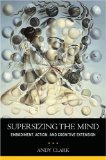
    (2) Clark’s more recent book – Supersizing the Mind: Embodiment, Action, and Cognitive Extension (Philosophy of the Mind) (Oxford University Press, 2008) (link for UK)

    When historian Charles Weiner found pages of Nobel Prize-winning physicist Richard Feynman’s notes, he saw it as a “record” of Feynman’s work. Feynman himself, however, insisted that the notes were not a record but the work itself. In Supersizing the Mind, Andy Clark argues that our thinking doesn’t happen only in our heads but that “certain forms of human cognizing include inextricable tangles of feedback, feed-forward and feed-around loops: loops that promiscuously criss-cross the boundaries of brain, body and world.” The pen and paper of Feynman’s thought are just such feedback loops, physical machinery that shape the flow of thought and enlarge the boundaries of mind. Drawing upon recent work in psychology, linguistics, neuroscience, artificial intelligence, robotics, human-computer systems, and beyond, Supersizing the Mind offers both a tour of the emerging cognitive landscape and a sustained argument in favor of a conception of mind that is extended rather than “brain-bound.” The importance of this new perspective is profound. If our minds themselves can include aspects of our social and physical environments, then the kinds of social and physical environments we create can reconfigure our minds and our capacity for thought and reason.

  • two more books on the extended mind:
    The Extended Mind: The Emergence of Language, the Human Mind, and Culture (Toronto Studies in Semiotics and Communication) by Robert K. Logan (U of Toronto Press, 2008) (link for UK)
    Cognitive Systems and the Extended Mind (Philosophy of Mind) by Robert D. Rupert (Oxford University Press, 2009) (link for UK)
  • Plus a forthcoming book (Oct) by philosopher Mark Rowlands: The New Science of the Mind: From Extended Mind to Embodied Phenomenology (Bradford Books) (link for UK)
  • additional links –

    Extended Mind at PhilPapers

    “Extended Mind” at Wikipedia

    [added 6/27] “Extended mind hypothesis” at Brain Hammer (from Key Terms in Philosophy of Mind)

Comments (3) - cognitive science,mind,philosophy of mind

psychological essentialism – 4 books

June 19, 2010

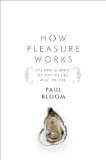
How Pleasure Works

Psychological essentialism has been getting some attention lately as a result of Paul Bloom’s recent book How Pleasure Works. See, for example, Jonah Lehrer on essentialism in ‘How Pleasure Works’ at the Frontal Cortex, or the discussion between Bloom and Peter D. Kramer at Slate.
(How Pleasure Works at amazon.co.uk)

When I saw Lehrer’s review I happened to be reading another book that draws on essentialism, this time to explain irrational beliefs: SuperSense: Why We Believe in the Unbelievable by Bruce M. Hood. (Supersense at amazon.co.uk) A paperback edition is to be issued later this month with the title The Science of Superstition: How the Developing Brain Creates Supernatural Beliefs.
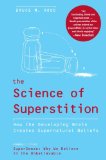
The Science of Superstition

Here is an excerpt from SuperSense (p246-247):

Throughout this book I have been arguing that beliefs in the supernatural are a consequence of reasoning processes about natural properties and events in our world. This includes a mind design for detecting patterns and inferring structures where there may be none. Our naive theories form the basis of our supernatural beliefs, and culture and experience simply work to reinforce what we intuitively hold to be correct. This is why the sense of being stared at is such an interesting model for the origin and development of supernaturalism. Children are not told that humans can detect unseen gaze. In fact, it’s not something they readily report that they can do. Nevertheless, young children and many adults think that vision works by something leaving the eyes. So when they experience episodes of seeming to detect unseen gaze, this belief simply emerges naturally as an unquestioned ability. It is not even considered supernatural by most people. Children were not told to think this. This model shows how the combination of intuitive theories, pattern detecting, and eventual support from culture produces a universal supernatural belief.
I think that something very similar may be going on for other supernatural beliefs. The notion of psychological contamination we examined in earlier chapters emerges naturally out of psychological essentialism, which has its roots in our naive biological reasoning. Again, this way of thinking is not something that we teach our children. Intuitive dualism and the idea that the mind can exist independently of the body is another. All of these ways of thinking are both naturally emerging and yet supernatural in their explanations of the world.
… We may put away childish things, as Corinthians suggests, but we never entirely get rid of them. Education can give us a new understanding and even progress to a scientific viewpoint, but development, distress, damage, and disease show that we keep many skeletons in our mental closet. If those misconceptions involve our understanding of the properties and limits of the material world, the living world, and the mental world, there is a good chance that they can form the basis of adult supernatural beliefs.

Bloom’s earlier book is Descartes’ Baby: How the Science of Child Development Explains What Makes Us Human, originally published by Basic Books in 2004. (Descartes’ Baby at amazon.co.uk)
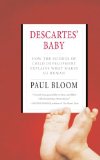
Descartes' Baby

Product description from the publisher:

All humans see the world in two fundamentally different ways: even babies have a rich understanding of both the physical and social worlds. They expect objects to obey principles of physics, and they’re startled when things disappear or defy gravity. Yet they can also read emotions and respond with anger, sympathy, and joy.

In Descartes’ Baby, Bloom draws on a wealth of scientific discoveries to show how these two ways of knowing give rise to such uniquely human traits as humor, disgust, religion, art, and morality. How our dualist perspective, developed throughout our lives, profoundly influences our thoughts, feelings, and actions is the subject of this richly rewarding book.

Another book on psychological essentialism is The Essential Child: Origins of Essentialism in Everyday Thought (Oxford in Cognitive Development) by Susan Gelman (Oxford University Press, 2005). (The Essential Child at amazon.co.uk)
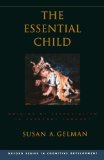
Essential Child

Product description from the publisher:

Essentialism is the idea that certain categories, such as “dog,” “man,” or “intelligence,” have an underlying reality or true nature that gives objects their identity. Where does this idea come from? In this book, Susan Gelman argues that essentialism is an early cognitive bias. Young children’s concepts reflect a deep commitment to essentialism, and this commitment leads children to look beyond the obvious in many converging ways: when learning words, generalizing knowledge to new category members, reasoning about the insides of things, contemplating the role of nature versus nurture, and constructing causal explanations. Gelman argues against the standard view of children as concrete or focused on the obvious, instead claiming that children have an early, powerful tendency to search for hidden, non-obvious features of things. She also attacks claims that children build up their knowledge of the world based on simple, associative learning strategies, arguing that children’s concepts are embedded in rich folk theories. Parents don’t explicitly teach children to essentialize; instead, during the preschool years, children spontaneously construct concepts and beliefs that reflect an essentialist bias. Essentialist accounts have been offered, in one form or another, for thousands of years, extending back at least to Aristotle and Plato. Yet this book is the first to address the issues surrounding essentialism from a psychological perspective. Gelman synthesizes over 15 years of empirical research on essentialism into a unified framework and explores the broader lessons that the research imparts concerning, among other things, human concepts, children’s thinking, and the ways in which language influences thought. This volume will appeal to developmental, cognitive, and social psychologists, as well as to scholars in cognitive science and philosophy.
Comments (0) - cognitive science,mind,psychology