January 17, 2011
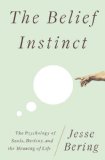
The Belief Instinct: The Psychology of Souls, Destiny, and the Meaning of Life by Jesse Bering (W.W. Norton, 2011)
(kindle)
(UK ed. ‘The God Instinct’ at amazon.co.uk)
Product description from the publisher:
A surprising new take on why we believe in God—and how this belief ensured the survival of the human species.
God is not merely an idea to be entertained or discarded based on the evidence. Nor is God a cultural invention, an existential Band-Aid, or an opiate of the masses. Instead, Jesse Bering argues, belief in God evolved in the human species as an “adaptive illusion.” Drawing on groundbreaking research in cognitive science, The Belief Instinct unravels the evolutionary mystery of why we grapple for meaning, purpose, and destiny in our everyday lives. Bering argues that the strangely deep-rooted sense that some intentional agent created us as individuals, wants us to behave in particular ways, observes our otherwise private actions, and intends to meet us after we die would also have been felt by our ancestors, leading them to behave in ways that favored their reputations—and thus saved their genes. But in today’s world, these psychological illusions have outlasted their evolutionary purpose, and Bering draws our attention to a whole new challenge: escaping them.
See also: Author’s website
Comments (0)
- culture,new books,psychology
January 16, 2011
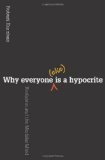
Why Everyone (Else) Is a Hypocrite: Evolution and the Modular Mind by Robert Kurzban (Princeton University Press, 2011)
(kindle)
(at amazon.co.uk)
We’re all hypocrites. Why? Hypocrisy is the natural state of the human mind.
Robert Kurzban shows us that the key to understanding our behavioral inconsistencies lies in understanding the mind’s design. The human mind consists of many specialized units designed by the process of evolution by natural selection. While these modules sometimes work together seamlessly, they don’t always, resulting in impossibly contradictory beliefs, vacillations between patience and impulsiveness, violations of our supposed moral principles, and overinflated views of ourselves.
This modular, evolutionary psychological view of the mind undermines deeply held intuitions about ourselves, as well as a range of scientific theories that require a “self” with consistent beliefs and preferences. Modularity suggests that there is no “I.” Instead, each of us is a contentious “we”–a collection of discrete but interacting systems whose constant conflicts shape our interactions with one another and our experience of the world.
In clear language, full of wit and rich in examples, Kurzban explains the roots and implications of our inconsistent minds, and why it is perfectly natural to believe that everyone else is a hypocrite.
See also: Author’s webpage, “Modularity of mind” at Wikipedia
Comments (0)
- mind,new books,psychology
January 9, 2011
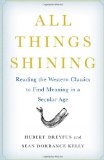
All Things Shining: Reading the Western Classics to Find Meaning in a Secular Age by Herbert Dreyfus & Sean Dorrance Kelly (Free Press, 2011)
(kindle ed.)
(link for amazon.co.uk)
Product description from the publisher:
An unrelenting flow of choices confronts us at nearly every moment of our lives, and yet our culture offers us no clear way to choose. This predicament seems inevitable, but in fact it’s quite new. In medieval Europe, God’s calling was a grounding force. In ancient Greece, a whole pantheon of shining gods stood ready to draw an appropriate action out of you. Like an athlete in “the zone,” you were called to a harmonious attunement with the world, so absorbed in it that you couldn’t make a “wrong” choice. If our culture no longer takes for granted a belief in God, can we nevertheless get in touch with the Homeric moods of wonder and gratitude, and be guided by the meanings they reveal? All Things Shining says we can. Hubert Dreyfus and Sean Dorrance Kelly illuminate some of the greatest works of the West to reveal how we have lost our passionate engagement with and responsiveness to the world. Their journey takes us from the wonder and openness of Homer’s polytheism to the monotheism of Dante; from the autonomy of Kant to the multiple worlds of Melville; and, finally, to the spiritual difficulties evoked by modern authors such as David Foster Wallace and Elizabeth Gilbert. Dreyfus, a philosopher at the University of California, Berkeley, for forty years, is an original thinker who finds in the classic texts of our culture a new relevance for people’s everyday lives. His lively, thought-provoking lectures have earned him a podcast audience that often reaches the iTunesU Top 40. Kelly, chair of the philosophy department at Harvard University, is an eloquent new voice whose sensitivity to the sadness of the culture—and to what remains of the wonder and gratitude that could chase it away—captures a generation adrift. Re-envisioning modern spiritual life through their examination of literature, philosophy, and religious testimony, Dreyfus and Kelly unearth ancient sources of meaning, and teach us how to rediscover the sacred, shining things that surround us every day. This book will change the way we understand our culture, our history, our sacred practices, and ourselves. It offers a new—and very old—way to celebrate and be grateful for our existence in the modern world.
See also: Book website & blog
Comments (1)
- culture,new books
January 8, 2011
Something I haven’t experienced in awhile…
Attention Is Cognitive Unison: An Essay in Philosophical Psychology (Philosophy of Mind Series) by Christopher Mole (Oxford University Press, USA, 2011)
(kindle),
(amazon.co.uk)
Product description from the publisher:
Some psychological phenomena can be explained by identifying and describing the processes that constitute them. Others cannot be explained in that way. In Attention is Cognitive Unison Christopher Mole gives a precise account of the metaphysical difference that divides these two categories and shows that, when current psychologists attempt to explain attention, they assign it to the wrong one.
Having rejected the metaphysical approach taken by our existing theories of attention Mole then develops a new theory. According to this theory the question of whether someone is paying attention is not settled by the facts about which processes are taking place. It is settled by the facts about whether the processes that serve that person’s task– whichever processes those happen to be–are processes that operate in unison. This theory gives us a new account of the problems that have dogged debates about the psychology of attention since the middle of the twentieth century. It also gives us a new way to understand the explanatory importance of cognitive psychology’s empirical findings. The book as whole shows that metaphysical questions have a foundational role to play in the explanatory project of cognitive psychology.
This volume is of interest to anyone engaged in current debates in the philosophy of mind and perception, and in cognitive science generally.
See also: Author’s homepage
Preview via Google Books:
Comments (0)
- cognitive science,philosophy of mind,psychology
December 31, 2010
The Tell-Tale Brain: A Neuroscientist’s Quest for What Makes Us Human by V.S. Ramachandran (W.W. Norton & Co, 2011)
(link for amazon.co.uk)
Product description from the publisher:
Drawing on strange and thought-provoking case studies, an eminent neurologist offers unprecedented insight into the evolution of the uniquely human brain. V. S. Ramachandran is at the forefront of his field-so much so that Richard Dawkins dubbed him the “Marco Polo of neuroscience.” Now, in a major new work, Ramachandran sets his sights on the mystery of human uniqueness. Taking us to the frontiers of neurology, he reveals what baffling and extreme case studies can teach us about normal brain function and how it evolved. Synesthesia becomes a window into the brain mechanisms that make some of us more creative than others. And autism—for which Ramachandran opens a new direction for treatment—gives us a glimpse of the aspect of being human that we understand least: self-awareness. Ramachandran tackles the most exciting and controversial topics in neurology with a storyteller’s eye for compelling case studies and a researcher’s flair for new approaches to age-old questions. Tracing the strange links between neurology and behavior, this book unveils a wealth of clues into the deepest mysteries of the human brain. 15 black-and-white illustrations.
See also: Author’s Wikipedia article
Comments (0)
- cognitive science,new books