September 9, 2007
[Update 9/14 – The personal development list just grew and grew and became a wiki, created by Isabella Mori of change therapy]
Comments (49)
- consciousness,happiness,self
September 8, 2007
 The Infinite Gift: How Children Learn and Unlearn the Languages of the World
 by Charles Yang
principles and parameters theory –
“First, there is a set of universal principles, like the principle of structure dependence, that all languages obey. These principles lay out the bounds on how words are put together into phrases, phrases into sentences, and how phrases can (and cannot) move around in sentences. The principles are innate and don’t have to be learned: they explain the absence of the impossible errors like the linear rules that all children steer clear of…..
Second, the differences among languages can be very compactly described by about a few dozen parameters. Learning a language becomes a problem of “twenty questions”: the child needs only to fix the values of the parameters, and that’s it. Now the main thesis, and the subtitle of the book, will make sense. The process of picking parameter values for grammar learning can be given a familiar name: natural selection. The child tries out various options in the parameter system, which turn up as “errors” in her speech: these imperfections actually belong to perfect languages in universal grammar, just not the one she eventually learns. These wrong options, however, cannot last forever; a Bostonian child trying out the parameter values for Japanese will not generally understand English or be understood. Only the grammar actually used in the child’s linguistic environment will not be contradicted, and only the fittest survives. In other words, children learn a language by unlearning all other possible languages.” (p. 31)
categorical perception – the ability to distill a continuous range of signals into discrete units. (p 41) (ex. color perception, speech perception)
variational learning – start with all possible grammars, only the target language persists (p 157)
“parameters that are expressed by more sentences in the environment will be learned faster, because their competitors will be punished more often” (p 171)
Comments (1)
- cognitive science,culture
September 7, 2007
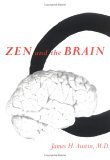
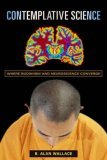
 Continuing the “mind alphabet”… The intersection between Buddhism and Western brain/mind science is a burgeoning field…
Other titles:

Comments (1)
- alphabet,mind
September 5, 2007

Abstract: The concept of attention is defined by multiple inconsistent metaphors that scientists use to identify relevant phenomena, frame hypotheses, construct experiments, and interpret data. (1) The Filter metaphor shapes debates about partial vs. complete filtering, early vs. late selection, and information filtering vs. enhancement. (2) The Spotlight metaphor raises the issue of space- vs. object-based selection, and it guides research on the size, shape, and movement of the attentional focus. (3) The Spotlight-in-the-Brain metaphor is frequently used to interpret imaging studies of attention. (4) The debate between supramodal and pre-motor theories of attention replays the dichotomy between the Spotlight and the Vision metaphors of attention. Our analysis reveals the central role of metaphor in scientific theory and research on attention, exposes hidden assumptions behind various research strategies, and shows the need for flexibility in the use of current metaphors.
also by the same authors:
“Cause and Effect Theories of Attention: The Role of Conceptual Metaphors” Citation: Review of General Psychology. Vol. 6, No.2, June 2002 (139-152)
Abstract: In everyday discourse, as well as in science, concepts of attention are defined by metaphors. In scientific theories these metaphors determine what attention is and what count as adequate explanations of the phenomena. We analyze these metaphors in the context of three types of attention theories: (1)’Cause’ theories, in which attention is presumed to modulate information-processing (e .g., Attention as a Spotlight ; Attention as a Limited Resource), (2 )`effect’ theories, in which attention is considered to be the by-product of information-processing (e.g., the Competition metaphor), and (3) hybrid theories that combine `cause’ and `effect’ aspects (e .g., Biased-Competition models). Our analysis reveals the crucial role of metaphors in cognitive psychology, neuroscience, and the efforts of scientists to find a resolution to the classic problem of `cause’ versus `effect’ interpretations.
Comments (0)
- alphabet,mind
September 3, 2007
A Mind Alphabet – I got this idea from Bella Dia’s “Encyclopedia of Me Meme” but will be adapting it to the “mind on books” theme. It seems like a good way to explore some different mind-related topics. I may do more than one topic for each letter & intersperse them among other posts.
*****
Attention – a collection of notes & resources
What is the ideal form of attention – the ability to stay in focus, or the ability to shift, strengthen and loosen focus at will?
Without attention, information that our senses take in – what we see and hear, feel, smell, and taste – literally does not register in the mind. It may not be stored even briefly in memory. What you see is determined by what you pay attention to. …
Paying attention physically damps down activity in neurons other than those involved in focusing on the target of your attention. … Attention, then, pumps up neuronal activity. Attention is real, in the sense that it takes a physical form capable of affecting the physical activity of the brain. [p. 158]
Begley goes on to discuss the relationship between attention and neuroplasticity, based on some experiments with monkeys in which cortical areas expanded in response to attention paid to corresponding sensory inputs.
More on A is for Attention – a mind alphabet
Comments (0)
- alphabet,mind

 and
and  by James H. Austin
 by Christopher deCharms
 by B. Alan Wallace