June 28, 2013
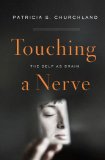
Touching a Nerve: The Self as Brain by Patricia S. Churchland (W.W. Norton & Co., 2013)
(kindle ed.), (amazon.co.uk)
Book description from the publisher:
A trailblazing philosopher’s exploration of the latest brain science—and its ethical and practical implications.
What happens when we accept that everything we feel and think stems not from an immaterial spirit but from electrical and chemical activity in our brains? In this thought-provoking narrative—drawn from professional expertise as well as personal life experiences—trailblazing neurophilosopher Patricia S. Churchland grounds the philosophy of mind in the essential ingredients of biology. She reflects with humor on how she came to harmonize science and philosophy, the mind and the brain, abstract ideals and daily life. Offering lucid explanations of the neural workings that underlie identity, she reveals how the latest research into consciousness, memory, and free will can help us reexamine enduring philosophical, ethical, and spiritual questions: What shapes our personalities? How do we account for near-death experiences? How do we make decisions? And why do we feel empathy for others? Recent scientific discoveries also provide insights into a fascinating range of real-world dilemmas—for example, whether an adolescent can be held responsible for his actions and whether a patient in a coma can be considered a self.
Churchland appreciates that the brain-based understanding of the mind can unnerve even our greatest thinkers. At a conference she attended, a prominent philosopher cried out, “I hate the brain; I hate the brain!” But as Churchland shows, he need not feel this way. Accepting that our brains are the basis of who we are liberates us from the shackles of superstition. It allows us to take ourselves seriously as a product of evolved mechanisms, past experiences, and social influences. And it gives us hope that we can fix some grievous conditions, and when we cannot, we can at least understand them with compassion.
Google Books preview:
Comments (0)
- cognitive science,consciousness,new books,self
June 24, 2013
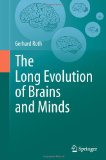
The Long Evolution of Brains and Minds by Gerhard Roth (Springer, 2013)
(kindle ed.), (amazon.co.uk)
Book description from the publisher:
On the basis of evolutionary and behavioral biology, neuroscience and anthropology, this book investigates to which extent it is possible to reconstruct the evolution of nervous systems and brains as well as of mental-cognitive abilities, in short “intelligence”, and to which extent we can correlate the one with the other. One central question is, whether or not abilities exist that make humans truly unique, or whether the evolution of the human mind was a gradual process. Exactly which neural features make animals and humans intelligent and creative? Is it absolute or relative brain size or the size of “intelligence centers” inside the brains, the number of nerve cells inside the brain in total or in such “intelligence centers” decisive for the degree of intelligence, of mind and eventually consciousness? Which are the driving forces behind these processes?
Here, many different answers exist. For some experts the driving force for brains and minds are the conditions for biological survival: the more complex these conditions, the more effective need to be sense organs, nervous systems and brains, and the stronger is the tendency to an increase in learning abilities, behavioral flexibility and innovation power of animals. This is the ecological intelligence hypothesis. Other authors believe that the true driving force is the challenge from social life of an animal: the more complex the social conditions, the more sophisticated are abilities such as social learning, imitation, empathy, knowledge transfer, consciousness and the development of a theory of mind and meta-cognition. This, again, needs progressive changes inside the brains. This is the social intelligence hypothesis. Again other authors distinguish physical intelligence as a third form of cognitive functions mostly related to tool use, tool fabrication and understanding of the principles of how things work. Finally, some experts believe that the decisive factor in the evolution of brains and minds consisted in an increase in the speed and efficacy of information processing in cognitive brain centers. This is the general intelligence or information processing hypothesis. It is discussed, which of these hypotheses is the most convincing one. At its end, the book deals with the eminent question of whether we can arrive at a naturalistic concept of mind and consciousness. Is it possible to explain mind and intelligence within the framework of the natural science, or do mind and intelligence as found in humans, transcend nature?
See also: Table of Contents with more information at publisher’s website
Comments (0)
- human evolution,mind