[ View menu ]

Archive

The Ghost Map by Steven Johnson (Non-Fiction Five)

May 3, 2007

nff109×108.jpg21fy97qew6l_aa_.jpg

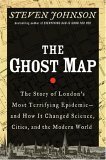
The Ghost Map by Steven Johnson is my May selection for the Non-Fiction Five Challenge. The subtitle is “The Story of London’s Most Terrifying Epidemic – and How It Changed Science, Cities, and the Modern World.” The epidemic in question is the cholera epidemic of 1854, but the book is not morbid. It focuses on the efforts of two men, Dr. John Snow and Rev. Henry Whitehead, as they put their local knowledge to work to investigate the cause of the disease.

The miasma theory of disease predominated at the time, and the organism that causes cholera, Vibrio cholerae, had not yet been identified (except by one Italian researcher whose findings were not widely known at the time). Johnson traces in detail the evidence and reasoning that led Snow to conclude that the disease is waterborne, rather than a result of “bad air” according to the miasma theory.

One result of Snow’s investigation was the creation of a famous map that showed the spread of the disease in relation to the water from a particular pump. The map was often reproduced and this helped promote the waterborne theory.

Johnson also suggests that this episode marked a turning point in urban history, from a time when the viability of large cities seemed doubtful to a time when city living has become healthier and more sustainable than rural living.

In an appendix “Notes on Further Reading,” Johnson points to an extensive website devoted to John Snow, hosted by the UCLA Dept. of Epidemiology. Among the suggested books, one that I might want to look at is Cartographies of Disease: Maps, Mapping, and Medicine by Tom Koch.

The author’s blog: stevenberlinjohnson.com

His other books are Everything Bad is Good for You,

Mind Wide Open: Your Brain and the Neuroscience of Everyday Life,

Emergence: The Connected Lives of Ants, Brains, Cities, and Software,

and Interface Culture : How New Technology Transforms the Way We Create and Communicate.

I’ll look forward to his next title.

Comments (4) - Non-Fiction Five Challenge

Self-theories by Carol S. Dweck

April 28, 2007

Self-theories: Their Role in Motivation, Personality, and Development (Essays in Social Psychology) by Carol S. Dweck.

Dweck contrasts two different theories of intelligence – an entity theory versus an incremental theory, showing that the entity theory leads to maladaptive responses. The entity theory involves the belief that intelligence is a fixed trait, leading to avoidance of challenge and effort, a decrease in ability to handle setbacks. The incremental theory views intelligence as something that can be increased, and this orients students more toward learning and challenge.

I’m sure I grew up with an entity theory of intelligence; intelligence seemed to be equated with less effort, plus social alienation.

Dweck’s more recent book is Mindset: The New Psychology of Success.

Guy Kawasaki’s blog post includes a link to a video interview and a nice diagram of the fixed versus incremental/growth mindsets.

See also – IT Conversations interview

Comments (6) - cognitive science,self

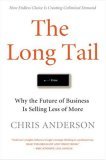
notes on “The Long Tail” by Chris Anderson

April 23, 2007

“six themes of the Long Tail age” p. 53:

1. there are far more niche goods than hits

2. costs of reaching those niches is falling dramatically, possible to offer a massively expanded variety of products

3. “filters” can drive demand down the tail (“filters” = recommendations, rankings)

4. demand curve flattens, less distance between hits and niches

5. niche products collectively comprise a market rivaling the hits

6. the natural shape of demand is revealed (without distortion created by distribution bottlenecks, scarcity of information, limited choice of shelf space)

“A Long Tail is just culture unfiltered by economic scarcity.”

p. 54-56 three forces: 1. democratize tools of production – lengthens Tail; 2. democratize tools of distribution (through aggregation) – fattens Tail; 3. connect supply and demand (through filters) – drives business from hits to niches

p. 172-174 Paradox of Choice (Barry Schwartz) – pointed to negative aspects of too many options, but people want choice, along with order to provide help, information, guidance

p. 184 shifting from mass culture to “massively parallel culture” with thousands of overlapping/interacting “tribes of interest”

visit author Chris Anderson’s Long Tail blog

140130237801_aa_scmzzzzzzz_.jpg

Comments (3) - culture

joining the Non-Fiction Five Challenge

April 21, 2007

nff109×108.jpg The Non-Fiction Five Challenge from “Thoughts of Joy”

Since I already read a lot of non-fiction I looked for books in areas I don’t normally read or at least that I would not have read except for this challenge (but that still look interesting). Usually I like to read books about ideas, so for the challenge I’m selecting some history and memoirs. Participants are also asked to select a variety, not all one genre, so I hope the list I’ve come up with is ok. My five books are these:

1. The Ghost Map by Steven Johnson, about a cholera epidemic in London

2. From Counterculture to Cyberculture: Stewart Brand, the Whole Earth Network, and the Rise of Digital Utopianism by Fred Turner

3. The Cincinnati Arch: Learning From Nature In The City by John Tallmadge (I had not heard of this but it looks interesting, and adds a nature component to the list, something else I haven’t been reading much of)

4. River of Shadows: Eadweard Muybridge and the Technological Wild West by Rebecca Solnit

5. A Year in Japan by Kate T. Williamson (not sure how much reading will be involved in this one, possibly supplemented by another book on Japan, such as Japanland: A Year in Search of Wa or Millennial Monsters: Japanese Toys and the Global Imagination (Asia: Local Studies / Global Themes))

alternates: History in English Words by Owen Barfield, Reading Like a Writer: A Guide for People Who Love Books and for Those Who Want to Write Them by Francine Prose, Story: Substance, Structure, Style and The Principles of Screenwriting by Robert McKee.
Everything Is Miscellaneous: The Power of the New Digital Disorder is scheduled to come out on May 1 and I’m looking forward to reading it, but didn’t want to count it for the challenge since I would have picked it up anyway.

Now that I have the list finalized, more or less, I’m looking forward to starting! Thanks, Joy, for the challenge.

Comments (1) - Non-Fiction Five Challenge

Paul Broks on Nicholas Humphrey’s ‘Seeing Red’ – Prospect Magazine April 2007

April 14, 2007

‘The mystery of consciousness’ by Paul Broks

Seeing Red: A Study in Consciousness (Mind/Brain/Behavior Initiative) by Nicholas Humphrey

Nicholas Humphrey’s home page includes links to a nice collection of papers available online.

Comments (0) - consciousness