[ View menu ]

Archive

“Behindology” at Language Log

February 17, 2008

An excellent post by Mark Liberman at Language Log on “Behindology” (Italian “dietrologia” “the attempt to trump even the most fanciful and contorted conspiracy theory) is jam-packed with ideas about reasoning and interpretations in everyday life.

An excerpt:

The mode of reasoning in dietrologia is abduction: inference to the best explanation. Abduction is a good thing — it’s a key component of the machinery of science — so why does abduction here lead to “fanciful and contorted” theories? There seem to be two problems: a lack of effective coupling to the friction and inertia of fact, and an excessive value placed on indirect and even counter-intuitive explanations.

Later on:

But our inferences about the beliefs, goals and intentions of others are seriously underdetermined by their actions and statements. And those of us who think we’re more insightful than average may just be more imaginative.

Powered by ScribeFire.
Comments (0) - mind

Evolutionary psychology bibliographic resources

February 16, 2008

Comments (0) - psychology

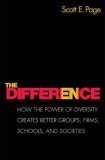
‘The Difference: How the Power of Diversity Creates Better Groups, Firms, Schools, and Societies’

February 15, 2008

Thanks to The Frontal Cortex for posting on this book: The Difference: How the Power of Diversity Creates Better Groups, Firms, Schools, and Societies by Scott E. Page (Princeton University Press, 2007)

The Difference

Here is a podcast with Page at “Invisible Handwriting”,

a recent New York Times article,

and a long review at Crooked Timber.

Comments (0) - culture

Blogcritics review of ‘The Progress Paradox: How Life Gets Better While People Feel Worse’

February 13, 2008

Link to the review

author (of the book) Gregg Easterbrook’s webpage

Comments (0) - culture,happiness

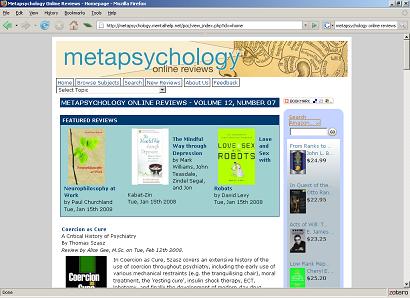
‘Biology of Freedom’ & ‘Concepts of Consciousness’ at Metapsychology Online Reviews

February 12, 2008

New reviews come out on Tuesdays at Metapsychology Online Reviews, and today’s batch includes reviews of The Biology of Freedom: Neural Plasticity, Experience and the Unconscious, an “attempt to synthesize psychoanalysis and neurobiology,” and The Concepts of Consciousness: Integrating an Emerging Science, which, according to the review, failed to realize the hoped-for conceptual integration, although the individual chapters are deemed worthwhile.

Metapsychology Online Reviews

Comments (0) - consciousness