‘What Are We?’ at Metapsychology Online Reviews
February 26, 2008
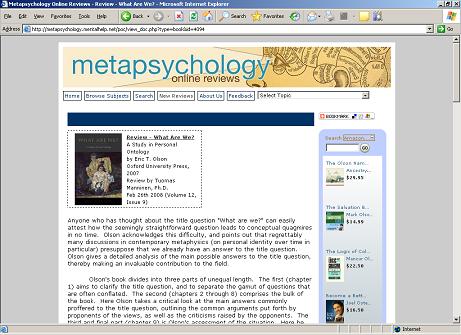
One of the new reviews at Metapsychology Online Reviews looks at ‘What Are We? A Study in Personal Ontology’ by Eric T. Olson (Oxford University Press, 2007)
books on the mind, consciousness, cognitive science…
February 26, 2008
One of the new reviews at Metapsychology Online Reviews looks at ‘What Are We? A Study in Personal Ontology’ by Eric T. Olson (Oxford University Press, 2007)
An interesting post at the Language Log on the Whorfian hypothesis: “Poor, arid, and, in appearance, deformed”
At least in lexicographic terms, the Indo-European languages do not, contrary to what Whorf says, share a linguistic history that predisposes their speakers unconsciously to a particular physics of time, distance, velocity and so on. In particular, the English words for those abstract physical concepts developed rather late, mostly as part of a conscious effort to import or develop explicit physical theories. And the terms used were figurative or metaphorical extensions of much juicier and more concrete words for things like “strength” and “discord” and “being alive”.
February 23, 2008
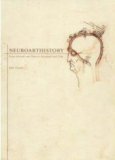
Neuroarthistory: From Aristotle and Pliny to Baxandall and Zeki by John Onians (Yale University Press, 2008)
Book description:
This provocative book offers a fascinating account of neuroarthistory, one of the newest and most exciting fields in the human sciences. In recent decades there has been a dramatic increase in our knowledge of the visual brain. Knowledge of phenomena such as neural plasticity and neural mirroring is making it possible to answer with a new level of precision some of the most challenging questions about both the creative process and the response to art.
Exploring the writings of major thinkers (among them Montesquieu, Burke, Kant, Marx and Freud), and leading art historians (including Pliny, Winckelmann, Ruskin, Pater, Gombrich and Baxandall), as well as artists such as Alberti and Leonardo and scientists from Aristotle to Zeki, John Onians shows how an understanding of the neural basis of the mind contributes to an understanding of all human behaviors—including art.
Neuroarthistory at Wikipedia
February 21, 2008
I’m (still) reading ‘The Concealed Art of the Soul: Theories of the Self and Practices of Truth in Indian Ethics and Epistemology‘ by Jonardon Ganeri; here is an excerpt from the conclusion of a chapter on Buddhism:
The definitive truth, as extracted from the Buddha’s own words by a Madhyamika
hermeneutical procedure, is that concepts purport to represent (but fail actually to do so), that the conventional is the domain in which concepts are treated as if they do represent (although in fact they do not), and that although it is impossible to eliminate the purport unless one ceases altogether to be, it is possible to recognize it for what it is and thereby achieve an attitude of circumspection and cognitive distance. This is neither transcendence nor acquiescence, but an internal exile of the mind. (p. 123)