My incredible growing brain!
May 6, 2008
This was my garage sale find from last weekend. I thought a spare brain might come in handy, and it was a bargain at 25¢!
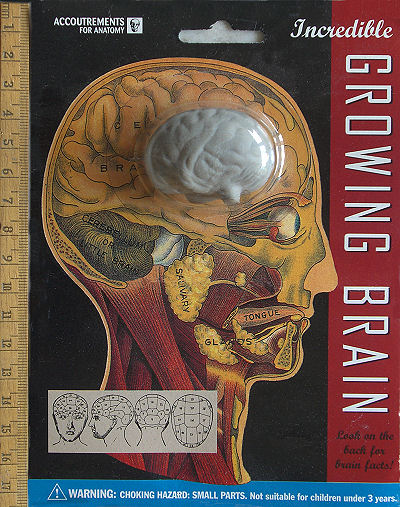

Soon I will put it in its vat to see how it grows….
books on the mind, consciousness, cognitive science…
May 6, 2008
This was my garage sale find from last weekend. I thought a spare brain might come in handy, and it was a bargain at 25¢!
Soon I will put it in its vat to see how it grows….
May 5, 2008

A donkey doesn’t so much accept its cruel fate as bears it, lets it pass over them. They’re the most philosophical of all animals, much more philosophical about their fate than human beings. And it’s an instinctive philosophy, a stoic acceptance, a kind of beautiful strength, passive rather than aggressive, not an ugly violent power. Needless to say, their philosophy isn’t academic, isn’t read in books or taught in a privileged classroom: it’s everyday, a simple disposition that’s lived out and practised, in an open field. We might say, if we used philosophical-speak, that a donkey’s philosophy is ontological, that it’s all about Being, the philosophy of permanent reverie, of daydreaming in the open air.
That’s a snippet from a longish book excerpt included in The Times article on The Wisdom of Donkeys: Finding Tranquility in a Chaotic World by Andy Merrifield (Walker and Co., 2008).
See also “Donkeys and wisdom” at hermit’s thatch.
May 3, 2008

This is the second part of a series on Clay Shirky’s Here Comes Everybody: The Power of Organizing Without Organizations; I’m going through the bibliography and posting links to the cited books and webpages. This post covers Chapters 3 and 4. It’s turning out to be an interesting exercise, a nice collection of resources, and it might save someone else some typing! The post with the first two chapters is here. [Added 5/8–part 3 is now up; 5/13 – link to complete “webibliography”]
p. 58 Bureaucracy: What Government Agencies Do And Why They Do It by James Q. Wilson (Basic Books, 1991)
p. 60 mass amateurization
“Weblogs and the Mass Amateurization of Publishing” by Clay Shirky
“The Pro-Am Revolution” by Charlie Leadbeater (misspelled “Leadbetter” in the book)
We-think: the book by Charles Leadbeater
p. 61 Trent Lott
“Parking Lott” article at Gnovis (links to the pdf)
“‘Big Media’ Meets the ‘Bloggers'” (26 p pdf)
Ed Sebesta’s blog and articles
p. 66 In Praise of Scribes
The Printing Press as an Agent of Change (Volumes 1 and 2 in One) by Elizabeth L. Eisenstein (Columbia University Press, 1979, 1980)
The Printing Revolution in Early Modern Europe by Elizabeth L. Eisenstein (Columbia University Press, 2005)
p. 75 Crowdsourcing
2006 Wired article by Jeff Howe
Crowdsourcing blog (includes excerpts from the upcoming book, Crowdsourcing: Why the Power of the Crowd Is Driving the Future of Business, available for pre-order at Amazon)
p. 84 social networking site
Social Networking Meta List (2005)
“Identity Production in a Networked Culture: Why Youth Heart MySpace” by danah boyd
p. 94 Email is such a funny thing
“The strange allure (and false hope) of email bankruptcy” by Merlin Mann
p. 99 “Conversation is king. Content is just something to talk about.”
BoingBoing post by Cory Doctorow (10/10/06)
p. 100 community of practice
Communities of Practice: Learning, Meaning, and Identity by Etienne Wenger (Cambridge University Press, 1998, 1999)
Etienne Wenger’s website: www.ewenger.com
May 2, 2008
 Freakonomics is collecting questions for primatologist Frans de Waal —45 questions have already been posted as I’m writing this.
Books by de Waal include Primates and Philosophers: How Morality Evolved (Princeton University Press, 2006) and Our Inner Ape: A Leading Primatologist Explains Why We Are Who We Are (Riverhead, 2005, 2006).
Google Video has a recent video of de Waal and Daniel Batson at the 2007 Autonomy, Singularity, Creativity conference hosted by the National Humanities Center.
[update – here are the answers posted on 5/7 at Freakonomics]
April 30, 2008

I recently read Here Comes Everybody by Clay Shirky and thought instead of a review it might be more useful to post the links from the bibliography (first two chapters in this part) plus a few links related to the book in general. [5/13 – link to the complete “webibliography”]
Here Comes Everybody Blog – with this transcript of Shirky’s speech on “cognitive surplus” at the Web 2.0 Expo
Videos
Clay Shirky’s Harvard talk linked at boingboing
Authors@Google: Clay Shirky video
bibliography & links p. 309-319
p. 1: Ivanna’s phone http://evanwashere.com/StolenSidekick
“stolen sidekick” google search
p.7 We the Media: Grassroots Journalism By the People, For the People by Dan Gillmor (O’Reilly Media, 2004)
Center for Citizen Media www.citmedia.org
p. 17: an architecture of participation
www.oreillynet.com/pub/a/oreilly/tim/articles/architecture_of_participation.html
p.18 a plausible promise Eric Raymond, “The Cathedral and the Bazaar”
p. 22 Within the Context of No Context, George W.S. Trow (Atlantic Monthly Press, 1997)
p. 25: Birthday Paradox at Wikipedia
p. 28 “More is Different” by Philip Anderson Science 177 (4047) Aug. 4, 1972, pp. 393-96.
p. 29 The Mythical Man-Month: Essays on Software Engineering by Frederick P. Brooks, Jr. (Addison Wesley, 1975)
p. 30 “The Nature of the Firm” by R.H. Coase, Economica, 4(16), Nov. 1937, p. 386-405
p. 31 Leading Teams: Setting the Stage for Great Performances by J. Richard Hackman (Harvard Business School Press, 2002)
p. 31 The Mermaid Parade (at Flickr)
p. 33 tagging “Ontology is Overrated”
p. 40 The Visible Hand: The Managerial Revolution in American Business by Alfred D. Chandler, Jr. (Harvard University Press, 1977) (pbk new ed. 1993)
p. 47 cooperation
The Origin of Wealth: Evolution, Complexity, and the Radical Remaking of Economics by Eric D. Beinhocker (Harvard Business School Press, 2006)
Small Groups as Complex Systems: Formation, Coordination, Development, and Adaptation by Holly Arrow, Joseph E. McGrath, and Jennifer L. Berdahl (Sage, 2000)
Why Humans Cooperate: A Cultural and Evolutionary Explanation by Natalie Henrich and Joseph Henrich (Oxford University Press, 2007)
p. 51 “The Tragedy of the Commons” by Garrett Hardin, Science 162 (3859) Dec. 13, 1968, pp. 682-83).
The Logic of Collective Action Public Goods and the Theory of Groups by Mancur Olson (Harvard University Press, 1965) (rev. ed., 1971)
p. 54 ridiculously easy group-forming – Seb Paquet, “Making Group-Forming Ridiculously Easy”
David Reed, “That Sneaky Exponential”