[ View menu ]

Archive

coming soon: ‘Brainstorming’ by Shaun Gallagher

May 12, 2008

Brainstorming: Views and Interviews on the Mind by Shaun Gallagher (Imprint Academic, 2008). Brainstorming According to Amazon, this book is due out on June 1.
From the publisher:

Shaun Gallagher is a philosopher of mind who has made it his business to study and meet with leading neuroscientists, including Michael Gazzaniga, Marc Jeannerod and Chris Frith.
The result is this unique introduction to the study of the mind, with topics ranging over consciousness, emotion, language, movement, free will and moral responsibility. The discussion throughout is illustrated by lengthy extracts from the author’s many interviews with his scientist colleagues on the relation between the mind and the brain.

Shaun Gallagher is Professor of Philosophy and Cognitive Sciences at the University of Central Florida and the University of Hertfordshire.

Shaun Gallagher at Wikipedia

Comments (0) - mind,new books,philosophy of mind

“Webibliography” part 4 – more links for ‘Here Comes Everybody’ by Clay Shirky

May 11, 2008

This is the fourth and final part of the “webibliography” for Clay Shirky’s book Here Comes Everybody: The Power of Organizing Without Organizations, covering Chapter 9 through the Epilogue.

links to part 1, part 2, part 3
[update 5/13 – link to complete “webibliography”]

Ch. 9: Fitting Our Tools to a Small World

p. 215 Small Worlds: The Dynamics of Networks between Order and Randomness (Princeton Studies in Complexity) by Duncan Watts (Princeton University Press, 1999, 2003)

Six Degrees: The Science of a Connected Age (W.W. Norton and Co., 2003)

p. 217 The Tipping Point: How Little Things Can Make a Big Difference by Malcolm Gladwell (pbk. ed. Back Bay Books, 2002)

p. 222 Howard Dean’s presidential campaign
“Is social software bad for the Dean campaign?”
“Exiting Deanspace”

p. 224 bonding and bridging social capital
Better Together: Restoring the American Community by Robert D. Putnam, Lewis Feldstein, Donald J. Cohen (Simon & Schuster, 2003, 2004)

p. 224 social networks and divisions in American class structure
“Viewing American Class Divisions through Facebook and MySpace” by danah boyd

p. 225-228 #joiito and #winprog
joi.ito.com
winprog.org

p. 229 “The Social Origins of Good Ideas” by Ronald S. Burt (58 p. pdf)

Ch. 10: Failure for Free

p. 233 Failure for Free
“In Defense of ‘Ready. Fire. Aim'” (Harvard Business Review, Feb. 2007, p. 52-54, part of the HBR List: Breakthrough Ideas for 2007) [subscription required; full text available in EBSCO Business Source Premier database; check your local library]

p. 240 Open source software
The Success of Open Source by Steven Weber (Harvard University Press, 2004, 2005)

p. 242 “The Cathedral and the Bazaar” ; other writings by Eric Raymond

p. 244 Sourceforgeprojects sorted by activity

p. 247 Wikinomics: How Mass Collaboration Changes Everything by Don Tapscott and Anthony D. Williams (Portfolio, 2006, expanded ed. 2008)

p. 250 Nick McGrath

Linux security is a ‘myth,’ claims Microsoft” by Robert Jaques

p. 253 Groklaw mission statement

“Letter to the Editor: No IBM-Groklaw Connection”

p. 254 SARS – “Chinese Scientists Say SARS Efforts Stymied by Organizational Obstacles”

“SARS in China: China’s Missed Chance,” by Martin Enserink, Science 301.5631 (July 18, 2003): 294(3) [subscription required; full text available in Gale/InfoTrac OneFile – check your library]

Ch. 11: Promise, Tool, Bargain

p. 267 The Wisdom of Crowds by James Surowiecki (Anchor, 2005, pbk ed.)

p. 276 equality matching
Structures of Social Life by Alan Page Fiske (Free Press, 1991, 1993)
“Human Sociality”

(p. 281 – “Sluggy Freelance” no link)

p. 281 Usenetgroups.google.com

p. 282 civic bicycle programsibike antitheft instructions

p. 287-288 sending nuts and flowers
Jericho Lives
NutsOnline Jericho page
“Flowers Used to Protest War”
“Say It with Flowers: Gandhigiri for US Green Cards”

p. 290 Digg Revolt
“Digg This: 09-f9-11-02-9d-74-e3-5b-d8-41-56-c5-63-56-88-c0” by Kevin Rose

Epilogue

p. 296 lump of labor fallacy
“The Accidental Theorist” by Paul Krugman

p. 300 Sicko audience
Sicko Spurs Audiences into Action” by Josh Tyler

Comments (0) - culture

new book: ‘Mirroring People’

May 10, 2008

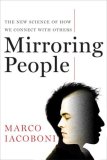
Mirroring People: The New Science of How We Connect with Others by Marco Iacoboni (Farrar, Straus and Giroux, 2008).Mirroring People Amazon still has this listed as a pre-order, with a publication date of May 13, but I saw this book on the shelves at my local bookstore yesterday.

From the product description:

What accounts for the remarkable ability to get inside another person’s head—to know what they’re thinking and feeling? “Mind reading” is the very heart of what it means to be human, creating a bridge between self and others that is fundamental to the development of culture and society. But until recently, scientists didn’t understand what in the brain makes it possible. This has all changed in the last decade. Marco Iacoboni, a leading neuroscientist whose work has been covered in The New York Times, the Los Angeles Times, and The Wall Street Journal, explains the groundbreaking research into mirror neurons, the “smart cells” in our brain that allow us to understand others. From imitation to morality, from learning to addiction, from political affiliations to consumer choices, mirror neurons seem to have properties that are relevant to all these aspects of social cognition. As The New York Times reports: “The discovery is shaking up numerous scientific disciplines, shifting the understanding of culture, empathy, philosophy, language, imitation, autism and psychotherapy.” Mirroring People is the first book for the general reader on this revolutionary new science.

Comments (0) - cognitive science,new books

new book: ‘Midbrain Mutiny’

May 7, 2008

Midbrain Mutiny
Midbrain Mutiny: The Picoeconomics and Neuroeconomics of Disordered Gambling: Economic Theory and Cognitive Science (Bradford Books) by Don Ross, Carla Sharp, Rudy E. Vuchenich and David Spurrett (MIT Press, 2008)

from the product description:

The explanatory power of economic theory is tested by the phenomenon of irrational consumption, examples of which include such addictive behaviors as disordered and pathological gambling. Midbrain Mutiny examines different economic models of disordered gambling, using the frameworks of neuroeconomics (which analyzes decision making in the brain) and picoeconomics (which analyzes patterns of consumption behavior), and drawing on empirical evidence about behavior and the brain. The authors argue that pathological gambling is a true addiction and that addictive gambling is the basic form of addiction, revealing the core character of all addiction.

The book describes addiction in neuroeconomic terms as chronic disruption of the balance between the midbrain dopamine system and the prefrontal and frontal serotonergic system, and reviews recent evidence from trials testing the effectiveness of antiaddiction drugs. The authors argue that the best way to understand disordered and addictive gambling is with a hybrid picoeconomic-neuroeconomic model, and their demonstration of this framework’s applicability to gambling provides a concrete case study for the more abstract description of picoeconomic-neuroeconomic complementarity in Don Ross’s earlier book Economic Theory and Cognitive Science: Microexplanation (MIT Press, 2005).

MIT Press information, including sample chapters

More on “picoeconomics” (micro-micro-economics)

newspaper article: “UAB researchers find gambling addiction’s wild card” (Birmingham News, May 6, 2008)

Dr. Don Ross’s webpage at UAB

Comments (0) - cognitive science,new books

“Webibliography” links for ‘Here Comes Everybody’ by Clay Shirky (part 3)

This is the third part in the series of links for Clay Shirky’s book Here Comes Everybody: The Power of Organizing Without Organizations, covering Chapters 5-8 with links to the books, articles and websites from the bibliography. (Here are links to parts 1 and 2). There should be one more part and then I’ll join all the pieces together into one page. [update – link to complete “webibliography“]

Here Comes Everybody at LibraryThing

Here Comes Everybody

Ch.5: Personal Motivation Meets Collaborative Production

p.111 wikis

Ward Cunningham’s original wiki

Wikimedia Foundation

“The Hive” by Marshall Poe, Atlantic Monthly, Sept. 2006

(p. 118 – no links)

p. 122 “Worse is Better”

Richard P. Gabriel’s essay “Lisp: Good News, Bad News”

(p. 123 – no links)

p. 124 power law distribution
Linked: The New Science of Networks by Albert-Laszlo Barabasi (Perseus, 2002) (pbk ed, 2003)

p. 126 The Long Tail: Why the Future of Business is Selling Less of More by Chris Anderson (Hyperion, 2006)
Long Tail blog

p. 129 fame“Communities, Audiences, and Scale” essay by Shirky

“Why Oprah will never talk to you. Ever.” Wired 12.8 (August 2004) p. 52-55 [reprinted here]

p. 133 The Wealth of Networks: How Social Production Transforms Markets and Freedom by Yochai Benkler (Yale University Press, 2006) (pbk ed. 2007)

p. 136 Wikipedia deletion and restoration

“History Flow” by Martin Wattenberg and Fernanda B. Viégas

p. 138 Siegenthaler and essjay controversies

Wikipedia on John Siegenthaler entry controversy

Wikipedia on essjay controversy

“Wikipedia’s credentialism crisis” by Nicholas Carr

p. 140 Ise Shrine
The Same Ax, Twice: Restoration and Renewal in a Throwaway Age by Howard Mansfield (University Press of New England, 2000)

Ch. 6: Collective Action and Institutional Challenges

p.143 Boston Globe – “Spotlight Investigation: Abuse in the Catholic Church”

p. 144 Voice of the Faithful

Keep The Faith, Change The Church: The Battle By Catholics For The Soul Of Their Church by James Muller and Charles Kenney (Rodale, 2004)

p. 150 Survivors Network of those Abused by Priests

p. 157 end-to-end communication

“End-to-End Arguments in System Design” (10 p. pdf) by Jerome Saltzer, David Reed, and David Clark
“Rise of the Stupid Network” by David Isenberg
“World of Ends” by Doc Searls and David Weinberger

p. 157 the phone company fought bitter legal battles

NPR timeline on Carterfone decision

Ch. 7: Faster and Faster

p. 161 Conspiracies are punished separately

U.S. v. Wei Min Shi at Project Posner

p. 162 information cascade

“The Dynamics of Informational Cascades: The Monday Demonstrations in Leipzig , East Germany, 1989-91” by Susanne Lohmann, World Politics 47(1) Oct. 1994, pp. 42-101 [note: links to JSTOR, abstract; fulltext also available in Gale/Infotrac OneFile — check your library for access]

p. 164 Flash Mobs

“My Crowd” by Bill Wasik [subscription required at Harper’s; fulltext available in Gale/Infotrac OneFile —check your library]

Belarusian flash mobs [book has this link, which I found hard to navigate, but here are some pictures]

Nasha Niva protest

Belarus: Ice-Cream Eating Flash-Mobbers Detained” by Veronica Khokhlov, Global Voices

p. 171 Brave New War: The Next Stage of Terrorism and the End of Globalization by John Robb (Wiley, 2007); Robb’s Global Guerrillas blog

The Pentagon’s New Map: War and Peace in the Twenty-first Century by Thomas P.M. Barnett (Putnam Adult, 2004); Barnett’s blog

p. 174 Smart Mobs: The Next Social Revolution by Howard Rheingold (Basic Books, 2002, 2003)

p. 177 Kate Hanni
Coalition for an Airline Passengers’ Bill of Rights blog and website

p. 180 HSBC/Facebook standoff
Now It’s Facebook vs. HSBC
“Facebook Campaign Forces HSBC U-turn”

Ch. 8: Solving Social Dilemmas

p. 190 The Evolution of Cooperation: Revised Edition by Robert Axelrod (Basic Books, 1984, 2006)
The Complexity of Cooperation: Agent-Based Models of Competition and Collaboration (Princeton University Press, 1997)

p. 192 Bowling Alone : The Collapse and Revival of American Community by Robert D. Putnam (Simon & Schuster, 2000, 2001)

p. 195 Meetup browse

p. 200 Club Nexus
“A social network caught in the Web” by Lada A. Adamic, Orkut Buyukkokten, and Eytan Adar
Bernardo A. Huberman at Hewlett Packard

Comments (3) - culture