[ View menu ]

Archive

new book: ‘Snoop: What Your Stuff Says About You’

May 26, 2008

I saw this at the bookstore today, started reading and was already jotting things down within the first few pages, a sure sign of a good book:
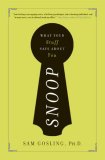
Snoop: What Your Stuff Says About You by Sam Gosling (Basic Books, 2008)

From the product description:

Does what’s on your desk reveal what’s on your mind? Do those pictures on your walls tell true tales about you? And is your favorite outfit about to give you away? For the last ten years psychologist Sam Gosling has been studying how people project (and protect) their inner selves. By exploring our private worlds (desks, bedrooms, even our clothes and our cars), he shows not only how we showcase our personalities in unexpected—and unplanned—ways, but also how we create personality in the first place, communicate it others, and interpret the world around us. Gosling, one of the field’s most innovative researchers, dispatches teams of scientific snoops to poke around dorm rooms and offices, to see what can be learned about people simply from looking at their stuff. What he has discovered is astonishing: when it comes to the most essential components of our personalities—from friendliness to flexibility—the things we own and the way we arrange them often say more about us than even our most intimate conversations. If you know what to look for, you can figure out how reliable a new boyfriend is by peeking into his medicine cabinet or whether an employee is committed to her job by analyzing her cubicle. Bottom line: The insights we gain can boost our understanding of ourselves and sharpen our perceptions of others. Packed with original research and fascinating stories, Snoop is a captivating guidebook to our not-so-secret lives.
Website for the book

Comments (1) - new books,psychology,self

recent book: ‘Beyond Revenge: The Evolution of the Forgiveness Instinct’ by

May 25, 2008

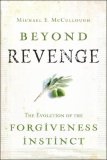
Beyond Revenge: The Evolution of the Forgiveness Instinct by Michael McCullough (Jossey-Bass, 2008)
From the product description:

Why is revenge such a pervasive and destructive problem? How can we create a future in which revenge is less common and forgiveness is more common? Psychologist Michael McCullough argues that the key to a more forgiving, less vengeful world is to understand the evolutionary forces that gave rise to these intimately human instincts and the social forces that activate them in human minds today. Drawing on exciting breakthroughs from the social and biological sciences, McCullough dispenses surprising and practical advice for making the world a more forgiving place.


Website for the book

Comments (0) - culture,new books

‘Painting Chinese’ by Herbert Kohl

May 24, 2008

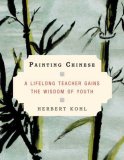
Painting ChineseNoted educator Herbert Kohl writes a short, sweet memoir about his study of Chinese painting in Painting Chinese: A Lifelong Teacher Gains the Wisdom of Youth.
Nearing the age of seventy, during a time of transition in his life, Kohl decides to take up the study of Chinese painting, seemingly on a whim, and finds himself in a class at the Joseph Fine Arts School working alongside five- to seven-year-old Chinese and Chinese American children. Kohl’s background as an educator informs his observations of himself as a pupil as well as his appreciation of the traditional pedagogical method of the school, based on “creative copying” of classical paintings. The students work individually, all copying different paintings under the guidance of the teacher, so there is no sense of competition. Kohl observes:

As my lessons went on and I had a chance to observe the children over time, I could see that they were developing self-discipline, confidence, pleasure in their own achievements, and, most of all, patience with their own learning. Ironically, by abandoning competition in this gentle and encouraging environment, they were acquiring strengths and skills that would serve them well in a competitive learning environment, where self-discipline and focused work are the essence of academic success. It even occurred to me that Joseph’s way of teaching, if was widespread through informal learning experiences in the Chinese community, might partially account for the amazing success of Chinese and Chinese American students in schools. (p. 30)

Kohl’s painting lessons also prompt some forays into Chinese culture, as he explores legends of the Monkey King and the meaning of bamboo. Later he discovers “…how much my perception of nature had been transformed by painting Chinese. I looked at the ocean as a force, alive and active. Trees had become individual beings…. I let the environment take hold of me rather than just walk through it.” (p. 143)

Adjusting to old age by “growing up again” is a frequent theme, as Kohl reflects on the experience:

Painting Chinese provided me with a condensed second childhood, one I could grow through painlessly, stage by stage… to become settled into old age. Traveling from monkeys to hermit landscapes led me to understand the contradictions that drove my life…. The sensibility of the Chinese painting and poetry that moves me enhances those contradictions: water versus rock, storm versus calm, war versus tranquility, solitude versus companionship, love versus enmity. One landscape can hold all those opposites in tension, explicitly or by implication. … Painting Chinese and my brush with the Tao has taught me that these contradictions are necessary and welcome. There is no final resolution to the contradictions, to the balance between the positive and the negative and the striving toward wholeness. As Monkey King said, the holy books and all the sacred documents are and will forever remain incomplete. (p. 158)

Comments (0) - culture,happiness

a tempting batch of new Metapsychology reviews

May 22, 2008

Lots of enticing new reviews at Metapsychology Online Reviews this week, including these:

Comments (0) - consciousness,philosophy of mind,psychology

new book: ‘Better Than Conscious?’

May 20, 2008

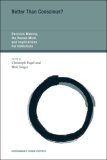
Better Than Conscious?: Decision Making, the Human Mind, and Implications For Institutions (Strüngmann Forum Reports) ed. by Christoph Engel and Wolf Singer (MIT Press, 2008)

Better Than Conscious?
From the product description:

Conscious control enables human decision makers to override routines, to exercise willpower, to find innovative solutions, to learn by instruction, to decide collectively, and to justify their choices. These and many more advantages, however, come at a price: the ability to process information consciously is severely limited and conscious decision makers are liable to hundreds of biases. Measured against the norms of rational choice theory, conscious decision makers perform poorly. But if people forgo conscious control, in appropriate tasks, they perform surprisingly better: they handle vast amounts of information; they update prior information; they find appropriate solutions to ill-defined problems.

This inaugural Strüngmann Forum Report explores the human ability to make decisions, consciously as well as without conscious control. It explores decision-making strategies, including deliberate and intuitive; explicit and implicit; processing information serially and in parallel, with a general-purpose apparatus, or with task-specific neural subsystems. The analysis is at four levels–neural, psychological, evolutionary, and institutional–and the discussion is extended to the definition of social problems and the design of better institutional interventions. The results presented differ greatly from what could be expected under standard rational choice theory and deviate even more from the alternate behavioral view of institutions. New challenges emerge (for example, the issue of free will) and some purported social problems almost disappear if one adopts a more adequate model of human decision making.

Preprint of the Max Planck Institute for Research on Collective Goods (22 p. pdf by Engel and Singer)

Ernst Strüngmann Forum information

Comments (0) - cognitive science,consciousness,new books