“A Chronology for the History of the Book” at dipity
July 9, 2008
books on the mind, consciousness, cognitive science…
July 9, 2008
July 8, 2008
Awhile ago I posted a list of cognitive science books for 2008, based on a search of Worldcat. The Library of Congress also has closely related headings for “cognitive psychology” and “cognition” — so below are selected “cognitive psychology” books, with “cognition” coming soon.
The LC scope note for “cognitive science”: “Here are entered works on the interdisciplinary study of the mind and computers as information processing systems.”
“Cognitive psychology”: “Here are entered works on the general approach to psychology that emphasizes the role of internal, mental processes in behavior.”
“Cognition”: “Here are entered works on mental processes in general.”
Cognitive psychology books 2008
Artificial Psychology: The Quest for What It Means to Be Human by Jay Friedenberg (Psychology Press, 2008)
Brain-Based Teaching for All Subjects: Patterns to Promote Learning by Madlon T Laster (Rowman & Littlefield Education, 2008)
Cognition and Emotion: From Order to Disorder by Michael J Power; Tim Dalgleish (Psychology Press, 2008)
Emotion Science: Cognitive and Neuroscientific Approaches to Understanding Human Emotions by Elaine Fox (Palgrave Macmillan, 2008) forthcoming
Music, Language, and the Brain by Aniruddh D Patel (Oxford University Press, 2008)
Social Cognition: Development, Neuroscience and Autism ed. by Tricia Striano and Vincent Reid (Wiley-Blackwell, 2008) forthcoming
July 7, 2008
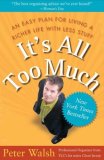
I know it sounds strange, but if you start by focusing on the clutter, you will never get organized. Getting truly organized is rarely about “the stuff.”
This is the bottom line: If your stuff and the way it is organized is getting you to your goals… fantastic. But if it’s impeding your vision for the the life you want, then why is it in your home? Why is it in your life? Why do you cling to it? For me, this is the only starting point in dealing with clutter.
(excerpt from It’s All Too Much)
When Kevin Kelly and Merlin Mann both rave about a book, it must be worth checking out, so as long as there’s still room to squeeze in one more book onto those overcrowded shelves, we’ll need to take a look at It’s All Too Much: How to Declutter Your Life by Peter Walsh.
Kevin Kelly’s Cool Tools review of ‘It’s All Too Much: How To Declutter Your Life‘ by Peter Walsh
Merlin Mann at 43folders: “My war on clutter” and “Review of It’s All Too Much…”
Peter Walsh interview at Unclutterer
The Only 127 Things You Need: A Guide To Life’s Essentials, the book excerpted in a recent post here, includes advice on controlling clutter from Peter Walsh.
Walsh also appears on Clean Sweep cable TV program.
July 5, 2008
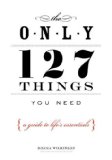
The Only 127 Things You Need: A Guide To Life’s Essentials by Donna Wilkinson (Tarcher/Penguin, 2008) lists the following essentials for a healthy mind, each further broken down into “essential components”:
(extracted from p. 245-308)
July 4, 2008
Describing Ourselves: Wittgenstein and Autobiographical Consciousness by Garry Hagberg (Oxford University Press, 2008) (in stock at Amazon UK, coming July 15 in the US)
Product description:
The voluminous writings of Ludwig Wittgenstein contain some of the most profound reflections of recent times on the nature of the human subject and self-understanding – the human condition, philosophically speaking. Describing Ourselves mines those extensive writings for a conception of the self that stands in striking contrast to its predecessors as well as its more recent alternatives. More specifically, the book offers a detailed discussion of Wittgenstein’s later writings on language and mind as they hold special significance for the understanding and clarification of the distinctive character of self-descriptive or autobiographical language.
Garry L. Hagberg undertakes a ground-breaking philosophical investigation of selected autobiographical writings – among the best examples we have of human selves exploring themselves – as they cast new and special light on the critique of mind-body dualism and its undercurrents in particular and on the nature of autobiographical consciousness more generally. The chapters take up in turn the topics of self-consciousness, what Wittgenstein calls ‘the inner picture’, mental privacy and the picture of metaphysical seclusion, the very idea of our observation of the contents of consciousness, first-person expressive speech, reflexive or self-directed thought and competing pictures of introspection, the nuances of retrospective self-understanding, person-perception and the corollary issues of self-perception (itself an interestingly dangerous phrase), self-defining memory, and the therapeutic conception of philosophical progress as it applies to all of these issues.
The cast of characters interwoven throughout this rich discussion include, in addition to Wittgenstein centrally, Augustine, Goethe, Dostoevsky, Kierkegaard, Iris Murdoch, Donald Davidson, and Stanley Cavell, among others. Throughout, conceptual clarifications concerning mind and language are put to work in the investigation of issues relating to self-description and in novel philosophical readings of autobiographical texts.