July 30, 2008
In case anyone would like to contact me without leaving a public comment on the website, there is now a contact form over in the sidebar, just under the “About” page. I’d love to hear from you, if you have any suggestions or just want to say hi.

Comments (1)
- Uncategorized
July 29, 2008
 I thought this was “coming soon” but it’s already available: The Continuity of Mind (Oxford Psychology) by Michael Spivey (Oxford University Press, 2008)
Product description:
The cognitive and neural sciences have been on the brink of a paradigm shift for over a decade now. The traditional information-processing framework in psychology, with its computer metaphor of the mind, is still considered to be the mainstream approach. However, the dynamical-systems perspective on mental activity is now receiving a more rigorous treatment, allowing it to move beyond the trendy buzzwords that have become associated with it. The Continuity of Mind will help to galvanize the forces of dynamical systems theory, cognitive and computational neuroscience, connectionism, and ecological psychology that are needed to complete this paradigm shift.
In this book, Michael Spivey lays bare the fact that comprehending a spoken sentence, understanding a visual scene, or just thinking about the day’s events involves the coalescing of different neuronal activation patterns over time, i.e., a continuous state-space trajectory that flirts with a series of point attractors. As a result, the brain cannot help but spend most of its time instantiating patterns of activity that are in between identifiable mental states rather than in them. When this scenario is combined with the fact that most cognitive processes are richly embedded in their environmental context in real time, the state space (in which brief visitations of attractor basins are your ‘thoughts’) suddenly encompasses not just neuronal dimensions, but extends to biomechanical and environmental dimensions as well. As a result, your moment-by-moment experience of the world around you, even right now, can be described as a continuous trajectory through a high-dimensional state space that comprises diverse mental states.
Spivey has organized The Continuity of Mind to present a systematic overview of how perception, cognition, and action are partially overlapping segments of one continuous mental flow, rather than three distinct mental systems. As a result, the apparent partitions that were once thought to separate mental constructs inevitably turn out, upon closer inspection, to be fuzzy graded transitions. The initial chapters provide first-hand demonstrations of the ‘gray areas’ in mental activity that happen in between discretely labeled mental events, as well as geometric visualizations of attractors in state space that make the dynamical-systems framework seem less mathematically abstract. The middle chapters present scores of behavioral and neurophysiological studies that portray the continuous temporal dynamics inherent in categorization, language comprehension, visual perception, as well as attention, action, and reasoning. The final chapters discuss what the mind itself must look like if its activity is continuous in time and its contents are distributed in state space. The Continuity of Mind is essential reading for those in the cognitive and neural sciences who want to see where the Dynamical Cognition movement is taking us.
Comments (0)
- mind,new books
July 27, 2008
Jesse Prinz, author of The Emotional Construction of Morals talks to Will Wilkinson at Bloggingheads.tv.
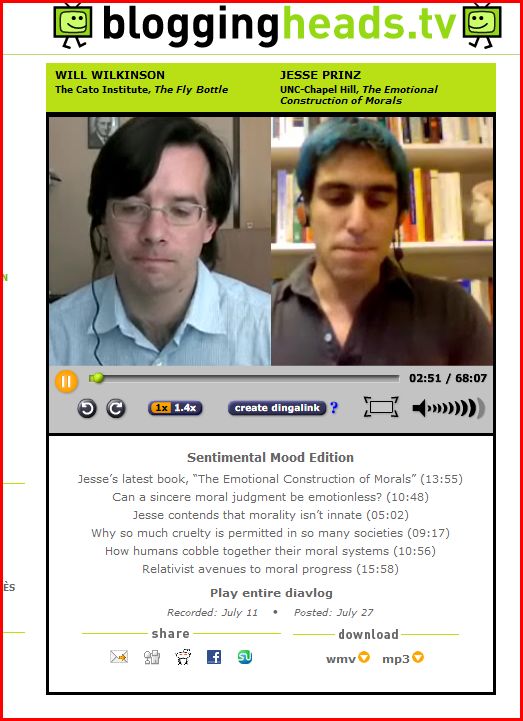
It takes them a few minutes to get rolling…
More on Jesse Prinz (with links to papers)
Comments (0)
- mind,philosophy of mind,psychology
July 25, 2008
 Real Materialism: and Other Essays by Galen Strawson (Oxford University Press, 2008). Amazon claims to have it in stock, while Oxford says it hasn’t been published yet. Product description:
Real Materialism draws together papers written over twenty years by Galen Strawson in philosophy of mind and metaphysics. Strawson focuses on five main areas of enquiry: [1] the nature of the physical, consciousness, the “mind-body problem”, and the prospects for panpsychism; [2] the self, the subject of experience, self-consciousness, and the “narrative” self; [3] free will and moral responsibility; [4] the nature of thought and intentionality and their connection with consciousness; [5] the problem of causation with particular reference to the philosophy of David Hume.
Table of Contents from the publisher:
Introduction
1. Real Materialism
2. Realistic monism: why physicalism entails panpsychism
3. Can we know the nature of reality as it is in itself?
4. Red and ‘red’
5. Self, body, and experience
6. What is the relation between an experience, the subject of the experience, and the content of the experience?
7. Against narrativity
8. Episodic ethics
9. Mental ballistics: the involuntariness of spontaneity
10. Intentionality and experience: terminological preliminaries
11. Real intentionality: why intentionality entails consciousness
12. On the inevitability of freedom (from the compatibilist point of view)
13. The impossibility of moral responsibility
14. Consciousness, free will, and the unimportance of determinism
15. Free agents
16. Realism and causation
17. The contingent reality of natural necessity
18. David Hume: objects and power
19. Epistemology, semantics, ontology, and David Hume
Bibliography
Index
“Against Narrativity” is available online (probably an earlier version than the one in the book). Strawson argues against the narrative view of the self in both descriptive and normative versions based on a distinction between Diachronic and Episodic forms of self-experience. The Episodic “has little or no sense that the self that one is was there in the (further) past and will be there in the future, although one is perfectly well aware that one has long-term continuity considered as a whole human being. Episodics are likely to have no particular tendency to see their life in Narrative terms.”
Comments (0)
- new books,philosophy of mind
By chance I’ve just read two novels that deal with issues of identity, coming from opposite directions: 
 Atmospheric Disturbances: A Novel by Rivka Galchen and The Soul Thief: A Novel by Charles Baxter.
In Atmospheric Disturbances, a first novel written by a younger woman, the narrator is an older man, a psychiatrist, who believes his wife has been replaced by an impostor. In The Soul Thief, the author’s fourth novel, the narrator is a graduate student who suspects another character is stealing or trying to steal his identity.
How much change or discontinuity can the concept of identity accommodate? What if the people you know suddenly don’t recognize you? What if the past you thought was yours is told to you as someone else’s story?
Charles Baxter on “questions of identity”
‘Atmospheric Disturbances’ website
Comments (0)
- fiction,self