August 11, 2008
This is an 85-min discussion on moral realism & I have to admit my mind wandered a bit while listening…
The bloggingheads page has related links, including one to a book by Peter Railton.
Comments (0)
- mind,reality
August 10, 2008

Daniel J. Levitin, author of This Is Your Brain on Music: The Science of a Human Obsession, has a new book coming out this month (Aug. 19 from Dutton) —The World in Six Songs: How the Musical Brain Created Human Nature, one of Amazon’s Best Books of August in nonfiction.
From the book website:
“What was the first song that humans sang and why did music become an integral part of human life from the beginning? Levitin tells the story of the co-evolution of music and of the human brain, how each one influenced the development of the other over tens of thousands of years. An unprecedented blend of science and art, Daniel Levitin’s best-selling debut, This Is Your Brain on Music (translated into 8 languages), changed the way we think about how music gets in our heads. Now in what is being called a tour de force by leading scientists, he shows how six specific forms of music played a pivotal role in creating human culture and society as we know it. Levitin masterfully weaves together the story of human evolution, music, anthropology, psychology and biology from the dawn of homo sapiens to the present.”
Comments (0)
- cognitive science,culture,new books
“Toward the end of the Sakuntala, the most famous of the three surviving plays by Kalidasa–the poet usually considered the finest in ancient India–the hero Dushyanta offers this poignant self-analysis:
Like someone staring at an elephant
who says, “There is no elephant here,”
and who then, as it moves away,
feels a certain doubt
and later, seeing its footprints,
is certain: “An elephant
has been here”–
such are the subtle
workings of my mind.
Or of any mind–the rueful king speaks for all of us. We almost always miss the elephant in front of us. By the time we make our retrospective deduction from the footprints, it’s usually too late.”
From “The Arrow and the Poem,” David Shulman on the Clay Sanskrit Library, The New Republic
Comments (0)
- mind
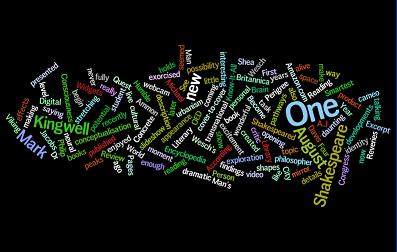
Wordle creates word clouds from text. You can paste in a block of text or provide a url that will generate a word cloud from the feed. Above is the word cloud from mymindonbooks.com (click the image for a more readable view); since it comes from the feed it has just the last few posts. So “snapshots” could be taken of a blog or website over time.
Comments (0)
- Uncategorized