[ View menu ]

Archive

‘The Pages,’ a philosophical novel by Murray Bail

August 26, 2008

Reviewed in The Telegraph: “The Pages is a nicely written, wonderfully entertaining novel with optional depths about the discoveries of an Australian who devotes his adult life to an introspective search for truth.”

\'The Pages\' by Murray Bail
The Pages is coming next month in the US (Sept. 28).

Comments (0) - fiction,new books

Buddhism and psychotherapy bibliography from Jack Kornfield’s ‘Wise Heart’

August 22, 2008

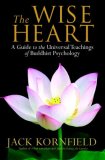
Among its many virtues, Jack Kornfield’s new book The Wise Heart: A Guide to the Universal Teachings of Buddhist Psychology has a “related readings” section (p. 402-407) that provides a good comprehensive bibliography of the intersection of Buddhism and psychotherapy. I hope the author doesn’t mind that I’ve copied it here with links to Amazon for further book information. (Probably the link doesn’t always match the edition given in the bibliography.)

Aronson, Harvey.  Buddhist Practice on Western Ground: Reconciling Eastern Ideals and Western Psychology Boston: Shambhala Publications, 2004.

Baer, Ruth A. Mindfulness-Based Treatment Approaches: Clinician’s Guide to Evidence Base and Applications Burlington, Mass.: Academic Press, 2006.

Begley, Sharon. Train Your Mind, Change Your Brain: How a New Science Reveals Our Extraordinary Potential to Transform Ourselves New York: Random House, 2007.

Bennett-Goleman, Tara. Emotional Alchemy: How the Mind Can Heal the Heart New York: Harmony Books, 2001.

Bien, Thomas, and Bien, Beverly. Mindful Recovery: A Spiritual Path to Healing from Addiction New York: John Wiley, 2002.

Brach, Tara. Radical Acceptance: Embracing Your Life With the Heart of a Buddha. New York: Bantam Dell, 2003.

Brazier, David. Zen Therapy: Transcending the Sorrows of the Human Mind New York: John Wiley, 1995.

Csikszentmihalyi, Mihaly. Flow: The Psychology of Optimal Experience. New York: HarperCollins, 1990/2002.

Davidson, Richard J. and Harrington, Anne. Visions of Compassion: Western Scientists and Tibetan Buddhists Examine Human Nature Oxford: Oxford University Press, 2002.

Epstein, Mark. Thoughts Without A Thinker: Psychotherapy from a Buddhist Perspective New York: Basic Books, 1995.

Epstein, Mark. Psychotherapy without the Self: A Buddhist Perspective New Haven: Yale University, 2007.

Fishman, Barbara Miller. Emotional Healing through Mindfulness Meditation: Stories and Meditations for Women Seeking Wholeness. Rochester, Vermont: Inner Traditions, 2002.

Germer, Christopher; Siegel, Ronald D.; Fulton, Paul R., eds. Mindfulness and Psychotherapy New York: Guilford Press, 2005.

Gilbert, Paul. Compassion: Conceptualisations, Research and Use in Psychotherapy. London: Routledge, 2005.

Glaser, Aura. A Call to Compassion: Bringing Buddhist Practices of the Heart into the Soul of Psychology Berwick, Maine: Nicolas-Hays, 2005.

Goleman, Daniel. Destructive Emotions: A Scientific Dialogue with the Dalai Lama New York: Bantam Dell, 2003.

Goleman, Daniel. The Meditative Mind New York: Tarcher/Putnam, 1988.

Kabat-Zinn, Jon. Full Catastrophe Living: Using the Wisdom of Your Body and Mind to Face Stress, Pain, and Illness New York: Dell, 1990.

Kornfield, Jack. A Path with Heart: A Guide Through the Perils and Promises of Spiritual Life New York: Bantam, 1993.

Kumar, Sameet M. Grieving Mindfully: A Compassionate And Spiritual Guide To Coping With Loss Oakland, Calif.: New Harbinger, 2005.

More on Buddhism and psychotherapy bibliography from Jack Kornfield’s ‘Wise Heart’

Comments (1) - psychology

forthcoming book: ‘What Should We Do with Our Brain?’

August 21, 2008

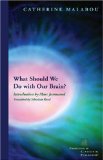
Too bad we’ll have to wait until October to find out What Should We Do with Our Brain? by Catherine Malabou.

Product description:

Recent neuroscience, in replacing the old model of the brain as a single centralized locus of control, has emphasized a feature of the brain called plasticity, whereby our brain develops and changes throughout an entire lifetime. Through this plasticity, our brain exists as a historical product; it develops in interaction with the environment, through human experience. Hence there is a thin frontier between the organization of the nervous system and the political and social organization conditioning and conditioned by that experience. The new way of speaking about the brain is a mirror image of the capitalist world in which we now live. “Plasticity,” in connection with such an image, can have two meanings. In its neo-liberal meaning, “plasticity” amounts to “flexibility” — in economics and management theory, “flexible” has become a buzzword. The plastic brain might thus represent just another style of power which, although less centralized, is still a means of control. But in this book, Catherine Malabou proposes a more radical meaning for plasticity, one that not only adapts itself to existing circumstances, but forms a margin of freedom to intervene, to change the circumstances. Such an understanding of this concept opens up a transformative aspect of the neurosciences, opposed to their aspect of domination and control. In insisting on this proximity between the neurosciences and the social sciences, Malabou applies to the brain Marx’s well-known phrase about history: people make their own brain, but they do not know it. This book is a call to such knowledge.

Comments (0) - cognitive science,new books

BookMooch book sharing site

August 20, 2008

BookMooch.com

I’ve been trying out BookMooch over the past few days and having a good time with it. It seems to be a fairly active community of sharers. LibraryThing has integrated with BookMooch and other book sharing sites so you can check from a book’s LibraryThing page to see if copies are available or if people have it on their wishlists. I decided to give it a try after reading some discussion about BookMooch at LibraryThing. Of course, donating books to the local library is a good way to recycle them too!

As of this writing, I have a copy of The Creative Attitude by Roger Schank available in case anyone wants to “mooch” it (if you don’t mind “ex-library, no dust jacket”). I’m “D.A. Foster” at BookMooch, so let me know if you join up.

Comments (0) - book search

“The Other Darwin”: article on evolutionary psychology at The Walrus

August 19, 2008

The Walrus has a review article on evolutionary psychology, discussing or citing a number of books starting with Darwin’s The Expression of the Emotions in Man and Animals and including What Science Offers the Humanities: Integrating Body and Culture by Edward Slingerland (Cambridge University Press, 2008), plus The Literary Animal: Evolution and the Nature of Narrative ed. by Jonathan Gottschall and David Sloan Wilson (Northwestern University Press, 2005).

The Walrus article concludes by citing recent research by Takahiko Masuda:

When presented with a smiling face against a background of contrary expressions, the Japanese, unlike the North Americans, had significant doubts about whether the face truly represented “happiness.” Much more than the North Americans, the Japanese took context into account and concluded that, despite the smiley face, an individual surrounded by unhappy people might not feel all that happy. Like the display rules Ekman had formulated from his own analysis of American and Japanese cultures, Masuda’s work points to what might be termed “context rules” that affect the actual experiencing of emotion.

Comments (1) - cognitive science,culture