[ View menu ]

Archive

new book – ‘Consequential Strangers’

August 8, 2009

Consequential Strangers

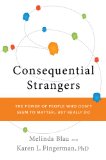
Consequential Strangers: The Power of People Who Don’t Seem to Matter. . . But Really Do by Melinda Blau and Karen L. Fingerman (W.W. Norton & Co., 2009)

Product description from the publisher:

Our barista, our mechanic, our coworker—they populate our days, but we often take them for granted. Yet these are the people who bring novelty and information into our lives, allow us to exercise different parts of ourselves, and open us up to new opportunities. In their unprecedented examination of people on the periphery, psychologist Karen Fingerman, who coined the term “consequential strangers,” collaborates with journalist Melinda Blau to expand on and make her own groundbreaking research come alive. Drawing as well from Blau’s more than two hundred interviews with specialists in psychology, sociology, marketing, and communication, the book presents compelling stories of individuals and institutions, past and present. A rich portrait of our social landscape—on and off the Internet—it presents the science of casual connection and chronicles the surprising impact that consequential strangers have on business, creativity, the work environment, our physical and mental health, and the strength of our communities.

See also: Website for the book

Comments (0) - culture,new books

new book – ‘Pleasures of the Brain’

August 6, 2009

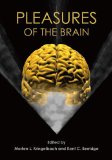
Pleasures of the Brain

Pleasures of the Brain (Series in Affective Science) ed. by Morten L. Kringelbach and Kent C. Berridge (Oxford University Press, 2009)

Product description from the publisher:

Pleasure is fundamental to well-being and the quality of life, but until recently, was barely explored by science. Current research on pleasure has brought about ground-breaking developments on several fronts, and new data on pleasure and the brain have begun to converge from many disparate fields. The time is ripe to present these important findings in a single volume, and so Morten Kringelbach and Kent Berridge have brought together the leading researchers to provides a comprehensive review of our current scientific understanding of pleasure. The authors present their latest neuroscientific research into pleasure, describing studies on the brain’s role in pleasure and reward in animals and humans, including brain mechanisms, neuroimaging data, and psychological analyses, as well as how their findings have been applied to clinical problems, such as depression and other disorders of hedonic well-being. To clarify the differences between their views, the researchers also provide short answers to a set of fundamental questions about pleasure and its relation to the brain. This book is intended to serve as both a starting point for readers new to the field, and as a reference for more experienced graduate students and scientists from fields such as neuroscience, psychology, psychiatry, neurology, and neurosurgery.

See also: Morten Kringelbach’s website

Kent Berridge’s website at U of Michigan

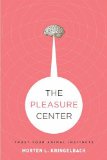
Morten Kringelback’s previous book: The Pleasure Center: Trust Your Animal Instincts (Oxford University Press, 2008)

The Pleasure Center

Product description from the publisher:

Many people believe that pleasure and desire are obstacles to reasonable and intelligent behavior. In The Pleasure Center, Morten Kringelbach reveals that what we desire, what pleases us–in fact, our most base, animalistic tendencies–are actually very important sources of information. They motivate us for a good reason. And understanding that reason, taking that reason into account, and harnessing and directing that reason, can make us much more rational and effective people. In exploring the many facets of pleasure, desire and emotion, Kringelbach takes us through the whole spectrum of human experience, such as how emotion fuels our interest in things, allowing us to pay attention and learn. He investigates the reward systems of the brain and sheds light on some of the most interesting new discoveries about pleasure and desire. Kringelbach concludes that if we understand and accept how pleasure and desire arise in the complex interaction between the brain’s activity and our own experiences, we can discover what helps us enjoy life, enabling us to make better decisions and, ultimately, lead happier lives.

Comments (0) - new books,psychology

new book – ‘The Liar in Your Life’ by Robert Feldman

August 5, 2009

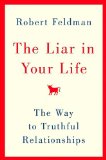
While waiting for new episodes of Lie to Me (returning 9/28/09), fans of that show might be interested in The Liar in Your Life: The Way to Truthful Relationships by Robert Feldman (Twelve, Aug 3, 2009). [“Look Inside the Book” available at Amazon.]

The Liar in Your Life

Product description from the publisher:

Product Description
In The Liar in Your Life, psychology professor Robert Feldman, one of the world’s leading authorities on deception, draws on his immense body of knowledge to give fresh insights into how and why we lie, how our culture has become increasingly tolerant of deception, the cost it exacts on us, and what to do about it. His work is at once surprising and sobering, full of corrections for common myths and explanations of pervasive oversimplifications.

Feldman examines marital infidelity, little white lies, career-driven resumé lies, and how we teach children to lie. Along the way, he reveals-despite our beliefs to the contrary- how it is nearly impossible to spot a liar (studies have shown no relationship between nervousness, lack of eye contact, or a trembling voice, and acts of deception). He also provides startling evidence of just how integral lying is to our culture; indeed, his research shows that two people, meeting for the first time, will lie to each other an average of three times in the first ten minutes of a conversation.

Feldman uses this discussion of deception to explore ways we can cope with infidelity, betrayal, and mistrust, in our friends and family. He also describes the lies we tell ourselves: Sometimes, the liar in your life is the person you see in the mirror. With incisive clarity and wry wit, Feldman has written a truthful book for anyone who whose life has been touched by deception.

For more information:

An excerpt is available at ABC News.

Author interview at NPR

Author’s website

Related reading: The Philosophy of Deception ed. by Clancy Martin (Oxford University Press, July 10, 2009).

Product description from the publisher:

Product Description
This volume gathers together new essays on deception and self-deception by leading thinkers on the subject. The contributors discuss topics including the nature and the definition of deception; whether deception is morally blameworthy or not; attacks against and defenses of self-deception; and the most famous philosophical account of lying by Immanuel Kant. Deception of others and self-deception share many more interconnections than is normally recognized, and these essays reveal the benefits of considering them together.
The Philosophy of Deception will be of interest to philosophers across the spectrum including those interested in philosophy of mind, philosophy of psychology, and metaphysics.

Comments (0) - new books,psychology

free fiction – ‘Let the Great World Spin’ from Oprah.com

August 3, 2009

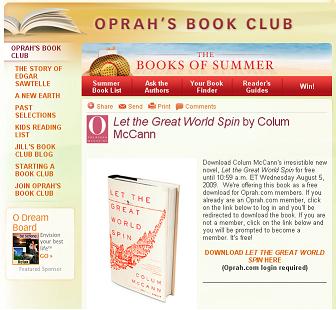
Let the Great World Spin by Colum McCann is available as a free download in pdf format from Oprah.com until 10:59 a.m. ET Wednesday August 5, 2009. (Site registration is required.)
Oprah download link
More on Let the Great World Spin:

New York Times review

Author’s website

Let the Great World Spin at Amazon.com

Comments (0) - fiction

books on the self – 2009

August 2, 2009

Narcissus by Caravaggio

Here are some recent & forthcoming books on the philosophy of the self:

Philosophy of Personal Identity and Multiple Personality (Routledge Studies in Contemporary Philosophy) by Logi Gunnarsson
Product description from the publisher:

As witnessed by recent films such as Fight Club and Identity, our culture is obsessed with multiple personality—a phenomenon raising intriguing questions about personal identity. This study offers both a full-fledged philosophical theory of personal identity and a systematic account of multiple personality. Gunnarsson combines the methods of analytic philosophy with close hermeneutic and phenomenological readings of cases from different fields, focusing on psychiatric and psychological treatises, self-help books, biographies, and fiction. He develops an original account of personal identity (the authorial correlate theory) and offers a provocative interpretation of multiple personality: in brief, “multiples” are right about the metaphysics but wrong about the facts.

Rethinking the Western Understanding of the Self by Ulrich Steinvorth

Product Description
In this book, Ulrich Steinvorth offers a fresh analysis and critique of rationality as a defining element in Western thinking. Criticizing revelation, tradition, and collectivism, Western thinking champions rationality, human rights, and individualism, and culminates in a unique understanding of the self. The prevailing understanding of the self was formed by the Lockean conception and utilitarianism. Compatible with classical physics, it does not, however, explain the cataclysms that occurred in the twentieth century. Steinvorth argues that Descartes’ understanding of the self offers a more plausible and realistic alternative. When freed from the dualism in which Descartes conceived it, such a conceptualization enables us to distinguish between self and subject. Moreover, it enables us to understand why individualism – one of the hallmarks of modernity in the West – became a universal ideal to be granted to every member of society; how acceptance of this notion could peak in the seventeenth century; and why it is now in decline, though not irreversibly so. Most importantly, as Steinvorth demonstrates, the Cartesian concept of the self presents a way of saving modernity from the dangers that it now encounters.

Who One Is: Book 1: Meontology of the “I”: A Transcendental Phenomenology by James G. Hart

coming in Sept 2009

The Impertinent Self: A Heroic History of Modernity (Cultural Memory in the Present) by Josef Früchtl (tr Sarah Kirkby)

Product Description
The Impertinent Self provides a philosophical and cultural theory of modernity by constructing a parallel between the philosophical self and the hero figure found in certain cinematic genres. Früchtl argues that modernity is not unified and should be conceived as a phenomenon consisting of three strata: the classical, the agonist, and the hybrid. He demonstrates this by following a dual trajectory: the shift in the concept of the self from German idealism to Romanticism and so-called postmodernism, and the evolution of the hero figure in the Western and in crime and science fiction movies. Früchtl takes a clear position within the ongoing discussion in the humanities and social sciences about modernity, a discussion that, in light of the work of Foucault, Lyotard, and Habermas, has too often neglected the importance of Romanticism. Similarly, he embraces the role of film and popular culture in modern society.

coming in Oct 2009

Personal Identity and Fractured Selves: Perspectives from Philosophy, Ethics, and Neuroscience
From the publisher’s description:

This book brings together some of the best minds in neurology and philosophy to discuss the concept of personal identity and the moral dimensions of treating brain disease and injury. The contributors engage a crucial question: When an individual’s personality changes radically because of disease or injury, should this changed individual be treated as the same person?

Titles featured in previous posts:

The Ego Tunnel by Thomas Metzinger

Virtual Selves, Real Persons by Richard S Hallam

Me (Art of Living) by Mel Thompson

Relational Being by Kenneth Gergen
Comments (0) - self