[ View menu ]

Archive

new book – ‘My Brain Made Me Do It’

March 17, 2010
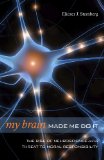
My Brain Made Me

My Brain Made Me Do It: The Rise of Neuroscience and the Threat to Moral Responsibility by Eliezer J. Sternberg (Prometheus Books, 2010).

(link for UK)

Product description from the publisher:

As scientists continue to explore how the brain works, using ever more sophisticated technology, it seems likely that new findings will radically alter the traditional understanding of human nature. One aspect of human nature that is already being questioned by recent developments in neuroscience is free will. Do our decisions arise from purely mechanistic processes? Is our feeling of self-control merely an illusion created by our brains? If so, what will become of free will and moral responsibility?

These thorny questions and many more are examined with great clarity and insight in this engaging exploration of neuroscience’s potential impact on moral responsibility. Author Eliezer J. Sternberg delves into a host of fascinating topics, including:

-the parts of the brain that scientists believe are involved in the exercise of will

-what Parkinson’s, Tourette’s, and schizophrenia reveal about our ability to control our actions

-whether a future of criminal behavior is determined by brain chemistry

-how self-reflective consciousness may have evolved from a largely deterministic brain

Using illustrative examples from philosophy, mythology, history, and criminology, and with thorough discussions of actual scientific experiments, Eliezer J. Sternberg explores the threat of neuroscience to moral responsibility as he attempts to answer the question: Are we truly in control of our actions?

Comments (0) - cognitive science,consciousness,philosophy of mind
new book – ‘The Genius in All of Us’

March 14, 2010

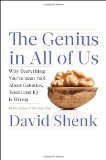
The Genius in All of Us

The Genius in All of Us: Why Everything You’ve Been Told About Genetics, Talent, and IQ Is Wrong by David Shenk (Doubleday, 2010)

(link for UK)

Product description from the publisher:

With irresistibly persuasive vigor, David Shenk debunks the long-standing notion of genetic “giftedness,” and presents dazzling new scientific research showing how greatness is in the reach of every individual.

DNA does not make us who we are. “Forget everything you think you know about genes, talent, and intelligence,” he writes. “In recent years, a mountain of scientific evidence has emerged suggesting a completely new paradigm: not talent scarcity, but latent talent abundance.”

Integrating cutting-edge research from a wide swath of disciplines—cognitive science, genetics, biology, child development—Shenk offers a highly optimistic new view of human potential. The problem isn’t our inadequate genetic assets, but our inability, so far, to tap into what we already have. IQ testing and widespread acceptance of “innate” abilities have created an unnecessarily pessimistic view of humanity—and fostered much misdirected public policy, especially in education.

Genius in All of Us - UK ed

The truth is much more exciting. Genes are not a “blueprint” that bless some with greatness and doom most of us to mediocrity or worse. Rather our individual destinies are a product of the complex interplay between genes and outside stimuli-a dynamic that we, as people and as parents, can influence.

This is a revolutionary and optimistic message. We are not prisoners of our DNA. We all have the potential for greatness.

See also: Author’s website

Comments (0) - cognitive science,new books

links from ‘The Twitter Book’

March 12, 2010

I’ve just recently started using Twitter, so naturally turned to some books to help me get up to speed. The Twitter Book

The Twitter Book by Tim O’Reilly and Sarah Milstein (link for UK) seems to have just the right amount of information & tips to help “Twitter novitiates,” as they say (p. 123), get started.

Here are links to the sites mentioned in the book –

authors on Twitter – @timoreilly, @SarahM
hashtag for the book – #TwitterBook

140 characters? – 140it

shorten urls – Bit.ly (tracks clickthroughs),Is.gd, Twi.bz

hashtags – Hashtags.org – popular hashtags & usage stats, Tagalus, What the Trend

tweetup – Twtvite

help – Twitter help pages, Get Satisfaction

trends – What the Trend, follow @TweetingTrends, TwitScoop, Twopular

Twitter’s advanced search , for older tweets try Google search with site:twitter.com

TweetGrid, Monitter – monitor several topics at once in real time

TweetBeep – email search results hourly or daily

BackTweets – search for links to domain or specific webpage

popular links – Twitt(url)y, TweetMeme, MicroPlaza

third-party Twitter clients – PeopleBrowsr, Twhirl, TweetDeck

mobile clients – Twitter mobile, iPhone: Twitterific, Tweetie, BlackBerry: TwitterBerry, TinyTwitter

who to follow – We Follow, Twellow, Mr Tweet, Who Should I Follow?

who’s influential –Twitterholic, Retweetist, Retweet Radar, TwitterCounter, Twitalyzer

Q & A – TweetBrain

group chat – TweetGrid, TweetChat

followers – Twimailer, DoesFollow, FriendOrFollow, Twittersheep tag cloud, TweepDiff

posting pictures – TwitPic

preschedule messages – TweetLater, RSS feed TwitterFeed

fundraising – Charity: water, TipJoy

#FollowFriday – find cool people to follow (or recommend)

background – TwitterGallery, TwitBacks

business use – TrackingTwitter, Twibs, ExecTweets

internal micromessaging – Yammer, Present.ly

track your tweet stats – TweetStats

track click-throughs with URL shorteners – Bit.ly, Tr.im, Cli.gs

TweetReach – shows how many people may have seen a post

key tools for business – Twist, TweepDiff, CoTweet

Comments (0) - Uncategorized

new book – ‘Wisdom: From Philosophy to Neuroscience’

March 10, 2010

Wisdom: From Philosophy to Neuroscience

Wisdom: From Philosophy to Neuroscience by Stephen S. Hall (Knopf, 2010)

(link for UK)

Product description from the publisher:

A compelling investigation into one of our most coveted and cherished ideals, and the efforts of modern science to penetrate the mysterious nature of this timeless virtue.

We all recognize wisdom, but defining it is more elusive. In this fascinating journey from philosophy to science, Stephen S. Hall gives us a dramatic history of wisdom, from its sudden emergence in four different locations (Greece, China, Israel, and India) in the fifth century B.C. to its modern manifestations in education, politics, and the workplace. We learn how wisdom became the provenance of philosophy and religion through its embodiment in individuals such as Buddha, Confucius, and Jesus; how it has consistently been a catalyst for social change; and how revelatory work in the last fifty years by psychologists, economists, and neuroscientists has begun to shed light on the biology of cognitive traits long associated with wisdom—and, in doing so, begun to suggest how we might cultivate it.

Hall explores the neural mechanisms for wise decision making; the conflict between the emotional and cognitive parts of the brain; the development of compassion, humility, and empathy; the effect of adversity and the impact of early-life stress on the development of wisdom; and how we can learn to optimize our future choices and future selves.

Hall’s bracing exploration of the science of wisdom allows us to see this ancient virtue with fresh eyes, yet also makes clear that despite modern science’s most powerful efforts, wisdom continues to elude easy understanding.

See also: “Ten Fascinating Facts About Wisdom” & “Eight Neural Pillars of Wisdom” (at publisher’s website)

Author’s website

[added 4/24/10: authors@google video:]

Comments (0) - cognitive science,new books

new book – ‘See What I’m Saying: The Extraordinary Powers of Our Five Senses’

March 6, 2010

See What I'm Saying

See What I’m Saying: The Extraordinary Powers of Our Five Senses by psychologist Lawrence D. Rosenblum (W.W. Norton, 2010).

(link for UK)

Product description from the publisher:

An in-depth look at the science that explains the hidden powers of the five senses and how to harness their potential. In this revealing romp through the mysteries of human perception, University of California psychologist and researcher Lawrence Rosenblum explores the astonishing abilities of the five senses–skills of which most of us are remarkably unaware. Drawing on groundbreaking insights into the brain’s plasticity and integrative powers, including findings from his own research, Rosenblum examines how our brains use the subtlest information to perceive the world. A blind person, for example, can “see” through batlike echolocation; a Master Sommelier can actually taste the grape variety, region, and vintage of an obscure wine; and pheromones can subliminally signal a lover’s compatibility.

To illustrate these implicit perceptual skills, Rosenblum takes us from the “beep” baseball fields where blind players swing at beeping balls, to a pitch-black restaurant where diners experience taste without the aid of sight. We accompany him on a visit to an Oscar-winning animator who explains how the public’s expertise in perceiving faces has made his job so difficult; and a visit with a supermodel to discuss why beautiful faces are irresistible.

New studies have shed light on the surprising power and reach of our senses. It turns out that our brains use entire forms of perceptual information of which we are largely unaware. We can hear things that don’t make sounds, feel things without touching them, see things with no form, and smell things that have no discernible odor. Throughout the book, Rosenblum not only illuminates the fascinating science behind our hidden perceptual powers, but demonstrates how increased awareness of these abilities can actually lead us to enhance how we use them.

See also: Website for the book

Comments (3) - new books,psychology