[ View menu ]

Archive

new book – ‘Jokes and the Linguistic Mind’

August 22, 2011
Jokes and the Linguistic Mind

Jokes and the Linguistic Mind by Debra Aarons (Routledge, 2011)

(amazon.co.uk – 30 Sep)

Book description from the publisher:

Through the lens of cognitive science, Jokes and the Linguistic Mind investigates jokes that play on some aspect of the structure and function of language. In so doing, Debra Aarons shows that these “linguistic jokes” can evoke our tacit knowledge of the language we use. Analyzing hilarious examples from movies, plays and books, Jokes and the Linguistic Mind demonstrates that tacit linguistic knowledge must become conscious for linguistic jokes to be understood. The book examines jokes that exploit pragmatic, semantic, morphological, phonological and semantic features of language, as well as jokes that use more than one language and jokes that are about language itself. Additionally, the text explores the relationship between cryptic crossword clues and linguistic jokes in order to demonstrate the difference between tacit knowledge of language and rules of language use that are articulated for a particular purpose. With its use of jokes as data and its highly accessible explanations of complex linguistic concepts, this book is an engaging supplementary text for introductory courses in linguistics, psycholinguistics and cognitive science. It will also be of interest to scholars in translation studies, applied linguistics and philosophy of language.
Comments (0) - cognitive science,language,new books

new book – ‘Redirect: The Surprising New Science of Psychological Change’

August 21, 2011

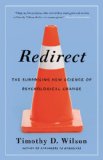
Redirect

Redirect: The Surprising New Science of Psychological Change by Timothy D. Wilson (Little, Brown, 2011)

(kindle ed.), (amazon.co.uk – 1 Sep)

Book description from the publisher:

What if there were a magic pill that could make you happier, turn you into a better parent, solve a number of your teenager’s behavior problems, reduce racial prejudice, and close the achievement gap in education? Well, there is no such magic pill-but there is a new scientifically based approach called story editing that can accomplish all of this. It works by redirecting the stories we tell about ourselves and the world around us, with subtle prompts, in ways that lead to lasting change. In Redirect, world-renowned psychologist Timothy Wilson shows how story-editing works and how you can use it in your everyday life.

The other surprising news is that many existing approaches-from the multi-billion dollar self-help industry to programs that discourage drug use and drinking-don’t work at all. In fact, some even have the opposite effect. Most programs are not adequately tested, many do not work, and some even do harm. For example, there are programs that have inadvertently made people unhappy, raised the crime rate, increased teen pregnancy, and even hastened people’s deaths-in part by failing to redirect people’s stories in healthy ways.

In short, Wilson shows us what works, what doesn’t, and why. Fascinating, groundbreaking, and practical, Redirect demonstrates the remarkable power small changes can have on the ways we see ourselves and the world around us, and how we can use this in our everyday lives. In the words of David G. Myers, “With wit and wisdom, Wilson shows us how to spare ourselves worthless (or worse) interventions, think smarter, and live well.”

See also: Author’s webpage, blog, book on Facebook

RSA event Sep 1 – Listen live

Comments (0) - new books,psychology

new book – ‘A Dream Interpreted Within a Dream: Oneiropoiesis and the Prism of Imagination’

August 20, 2011

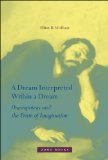
A Dream Interpreted Within a Dream

A Dream Interpreted Within a Dream: Oneiropoiesis and the Prism of Imagination by Elliot R. Wolfson (Zone Books, 2011)

(amazon.co.uk – 28 Oct)

Book description from the publisher:

Dreams have attracted the curiosity of humankind for millennia. In A Dream Interpreted Within a Dream, Elliot Wolfson guides the reader through contemporary philosophical and scientific models to the archaic wisdom that the dream state and waking reality are on an equal phenomenal footing–that the phenomenal world is the dream from which one must awaken by waking to the dream that one is merely dreaming that one is awake. By interpreting the dream within the dream, one ascertains the wakeful character of the dream and the dreamful character of wakefulness. Assuming that the manner in which the act of dreaming is interpreted may illuminate the way the interpreter comprehends human nature more generally, Wolfson draws on psychoanalysis, phenomenology, and neuroscience to elucidate the phenomenon of dreaming in a vast array of biblical, rabbinic, philosophical, and kabbalistic texts. To understand the dream, Wolfson writes, it is necessary to embrace the paradox of the fictional truth–a truth whose authenticity can be gauged only from the standpoint of its artificiality. The dream, on this score, may be considered the semblance of the simulacrum, wherein truth is not opposed to deception because the appearance of truthfulness cannot be determined independently of the truthfulness of appearance.

Comments (0) - mind,new books,reality

new book – ‘Now You See It: How the Brain Science of Attention Will Transform the Way We Live, Work, and Learn’

August 18, 2011

Now You See It

Now You See It: How the Brain Science of Attention Will Transform the Way We Live, Work, and Learn by Cathy N. Davidson (Viking, 2011)

(kindle ed.), (amazon.co.uk)

Book description from the publisher:

A digital innovator shows how we can thrive in the new technological age.

When Cathy Davidson and Duke University gave free iPods to the freshman class in 2003, critics said they were wasting their money. Yet when students in practically every discipline invented academic uses for their music players, suddenly the idea could be seen in a new light-as an innovative way to turn learning on its head.

This radical experiment is at the heart of Davidson’s inspiring new book. Using cutting-edge research on the brain, she shows how “attention blindness” has produced one of our society’s greatest challenges: while we’ve all acknowledged the great changes of the digital age, most of us still toil in schools and workplaces designed for the last century. Davidson introduces us to visionaries whose groundbreaking ideas-from schools with curriculums built around video games to companies that train workers using virtual environments-will open the doors to new ways of working and learning. A lively hybrid of Thomas Friedman and Norman Doidge, Now You See It is a refreshingly optimistic argument for a bold embrace of our connected, collaborative future.

See also: Author’s website

Comments (0) - cognitive science,new books

new book – ‘The Bodhisattva’s Brain: Buddhism Naturalized’ by Owen Flanagan

The Bodhisattva's Brain

The Bodhisattva’s Brain: Buddhism Naturalized by Owen Flanagan (MIT Press)

(amazon.co.uk – 21 Oct)

Product description from the publisher:

If we are material beings living in a material world–and all the scientific evidence suggests that we are–then we must find existential meaning, if there is such a thing, in this physical world. We must cast our lot with the natural rather than the supernatural. Many Westerners with spiritual (but not religious) inclinations are attracted to Buddhism–almost as a kind of moral-mental hygiene. But, as Owen Flanagan points out in The Bodhisattva’s Brain, Buddhism is hardly naturalistic. Atheistic when it comes to a creator god, Buddhism is otherwise opulently polytheistic, with spirits, protector deities, ghosts, and evil spirits. Its beliefs include karma, rebirth, nirvana, and nonphysical states of mind. What is a nonreligious, materially grounded spiritual seeker to do? In The Bodhisattva’s Brain, Flanagan argues that it is possible to subtract the “hocus pocus” from Buddhism and discover a rich, empirically responsible philosophy that could point us to one path of human flourishing. “Buddhism naturalized,” as Flanagan constructs it, contains a metaphysics, epistemology, and ethics; it is a fully naturalistic and comprehensive philosophy, compatible with the rest of knowledge. Some claim that neuroscience is in the process of validating Buddhism empirically, but Flanagan’s naturalized Buddhism does not reduce itself to a brain scan showing happiness patterns. Buddhism naturalized offers instead a tool for achieving happiness and human flourishing–a way of conceiving of the human predicament, of thinking about meaning for finite material beings living in a material world.

See also: Author’s website, “Bodhisattva’s Brain” podcast

Comments (0) - happiness,new books,psychology