[ View menu ]

Archive

new book – ‘The Thinking Life: How to Thrive in the Age of Distraction’

September 13, 2011

Today’s featured new release received a starred review from Kirkus Reviews:
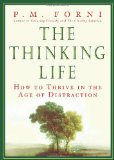
The Thinking Life

The Thinking Life: How to Thrive in the Age of Distraction by P.M. Forni (St Martin’s Press, 2011)

(kindle ed.), (amazon.co.uk – 17 Oct)

Book description from the publisher:

Professor Forni, founder of The Civility Initiative at Johns Hopkins, is America’s civility expert. In his first two books, Choosing Civility and The Civility Solution, he taught readers the rules of civil behavior and ways of responding to rudeness. Now, in The Thinking Life, he looks at the importance of thinking in our lives: how we do it, why we don’t do enough of it and why we need to do more of it.

In twelve short chapters, he gives readers a remedy for the Age of Distraction, an age fuelled by the internet, Blackberries and cellphones, all of which make constant demands on our attention, diverting it from one thing to another. After suggesting ways we can find time to think more, Forni shows readers how we can improve our abilities of:

—Attention
—Reflection
—Introspection
—Self-control
—Positive thinking
—Proactive thinking
—Effective decision-making strategies
—Creative thinking
—Problem-solving strategies

Just as he did with civility, he puts the importance of good thinking front and center in a book as simple and as profound as his earlier works.

See also: Author’s website, Google Books preview

Comments (0) - culture,mind,new books,psychology

new book – ‘Thinking About the Real World’ by John Searle (et al.)

September 12, 2011

Thinking About the Real World

Thinking About the Real World by John R. Searle et al. (Ontos Verlag, 2011)

(amazon.co.uk – Oct 2010)

Book description from the publisher:

John R Searle is one of the world’s leading philosophers. During his long and outstanding career, he has made groundbreaking and lasting contributions to the philosophy of language, to the philosophy of mind, as well as to the nature, structure, and functioning of social reality. This volume documents the 13th Munster Lectures on Philosophy with John R Searle. It includes not only 11 critical papers on Searle’s philosophy and Searle’s replies to the papers, but also an original article by John R Searle on his overall philosophical enterprise entitled “The Basic Reality and the Human Reality”. “I think Munster is probably unique among contemporary universities in its ability to produce such a high level of philosophical production from their philosophy students.” (John R Searle).

See also: Review at Notre Dame Philosophical Reviews, UC Berkeley courses available through iTunes U – Fall 2011: Philosophy of Language, Philosophy of Society

Comments (0) - culture,new books,reality

new book – ‘Mind and Brain: A Critical Appraisal of Cognitive Neuroscience’

September 8, 2011

Mind and Brain

Mind and Brain: A Critical Appraisal of Cognitive Neuroscience by William R. Uttal (MIT Press, 2011)

(amazon.co.uk)

Book description from the publisher:

Cognitive neuroscience explores the relationship between our minds and our brains, most recently by drawing on brain imaging techniques to align neural mechanisms with psychological processes. In Mind and Brain, William Uttal offers a critical review of cognitive neuroscience, examining both its history and modern developments in the field. He pays particular attention to the role of brain imaging–especially functional magnetic resonance imaging (fMRI)–in studying the mind-brain relationship. He argues that, despite the explosive growth of this new mode of research, there has been more hyperbole than critical analysis of what experimental outcomes really mean. With Mind and Brain, Uttal attempts a synoptic synthesis of this substantial body of scientific literature.

After an introductory discussion, he turns to his main theme: what neuroscience and psychology have contributed to each other. He considers specific empirical findings in such fields as sensation, perception, emotion and affect, learning and memory, and consciousness. For each field, he considers psychological and behavioral concerns that can help guide the neuroscientific discussion; work done before the advent of imaging systems; and what brain imaging has brought to recent research. Cognitive neuroscience, Uttal argues, is truly both cognitive and neuroscientific. Both approaches are necessary and neither is sufficient to make sense of the greatest scientific issue of all: how the brain makes the mind.

Comments (0) - cognitive science,mind,new books

new book – ‘Brainworks: The Mind-bending Science of How You See, What You Think, and Who You Are’ from National Geographic

September 6, 2011

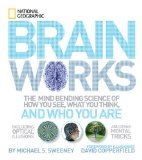
Brainworks

Brainworks: The Mind-bending Science of How You See, What You Think, and Who You Are by Michael S. Sweeney (National Geographic, 2011)

(amazon.co.uk – 13 Oct)

Book description from the publisher:

Admit it. When you hear the word “neuroscience,” you expect something abstract and remote, very complex, of little practical value. But this time…it’s personal.

In a highly anticipated, three-part series airing on the National Geographic Channel in Fall 2011, National Geographic’s Brainworks makes YOU the test subject in an array of astonishing challenges and experiments. Your brain will be stimulated, fooled, and ultimately amazed, as scientists and other experts show you how this three-pound blob of gray matter effectively makes you, you.

The television program brings together a crack team of scientists and researchers from a wide range of fields, including neurology, psychology, and opthamology. Awareness expert Dan Simons and memory expert Elizabeth Loftus are just two of the notables who lend their considerable brainpower to this unprecedented project. The program also draws on the know-how of those who traffic in brain tricks—illusionists such as David Copperfield and Apollo Robbins and artists such as color expert Beau Lotto—to bring each mind-bending illusion to life.

The captivating companion book further messes with your head through the visual illusions discovered and perfected by masters of fine art as well as through deceptively simple illustrations that are finely crafted by psychologists to highlight the way we take in and process the world around us.

In three sections—”Seeing,” “Thinking,” and “Being”—you’ll see for yourself why these visual illusions and experiments hoodwink the brain. You’ll find out how the structure of the eye influences what you see. And you’ll think of events that may not have actually happened, in order to learn how the mind can create a false memory.

Rather than simply displaying a collection of puzzlers or visual illusions, each chapter guides you through a series of perceptual and thought experiments firsthand and then walks you through your brain’s reaction in clear, user-friendly language—providing every reader with a compelling personal interest in finding out why his or her mind acts the way it does.

Smart, exciting, and deeply engaging, Brainworks pulls you in, manipulates your mind, and leaves you with a better understanding—as well as a richer appreciation—of the mental marvels that we take for granted.

More new releases for Tues 9/6 – The Big Idea: How Breakthroughs of the Past Shape the Future by Timothy Ferriss (National Geographic, 2011) — (amazon.co.uk – 13 Oct)

The Two-Second Advantage: How We Succeed by Anticipating the Future–Just Enough by Vivek Ranadive and Kevin Maney (Crown Business, 2011) — (kindle ed.)(amazon.co.uk )

Comments (0) - cognitive science,mind,new books

new book – ‘Duels and Duets: Why Men and Women Talk So Differently’

September 5, 2011

Duels and Duets

Duels and Duets: Why Men and Women Talk So Differently by John L. Locke (Cambridge University Press, 2011)

(amazon.co.uk)

Book description from the publisher:

Why do men and women talk so differently? And how do these differences interfere with communication between the sexes? In search of an answer to these and other questions, John Locke takes the reader on a fascinating journey, from human evolution through ancient history to the present, revealing why men speak as they do when attempting to impress or seduce women, and why women adopt a very different way of talking when bonding with each other, or discussing rivals. When men talk to men, Locke argues, they frequently engage in a type of ‘dueling’, locking verbal horns with their rivals in a way that enables them to compete for the things they need, mainly status and sex. By contrast, much of women’s talk sounds more like a verbal ‘duet’, a harmonious way of achieving their goals by sharing intimate thoughts and feelings in private.

See also: More on the book (author’s blog post on Cambridge Extra at Linguist List)

Comments (0) - language,new books,psychology