[ View menu ]

Archive

new book – ‘The Awakened Ones: Phenomenology of Visionary Experience’

January 18, 2012
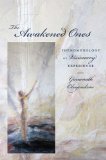
The Awakened Ones

The Awakened Ones: Phenomenology of Visionary Experience by Gananath Obeyesekere (Columbia University Press)

(amazon.co.uk – 1 Feb)

Product description from the publisher:

While a rational consciousness grasps many truths, Gananath Obeyesekere believes an even richer knowledge is possible through a bold confrontation with the stuff of visions and dreams. Spanning both Buddhist and European forms of visionary experience, he fearlessly pursues the symbolic, nonrational depths of such phenomena, reawakening the intuitive, creative impulses that power greater understanding.

Throughout his career, Obeyesekere has combined psychoanalysis and anthropology to illuminate the relationship between personal symbolism and religious experience. In this book, he begins with Buddha’s visionary trances wherein, over the course of four hours, he witnesses hundreds of thousands of his past births and eons of world evolution, renewal, and disappearance. He then connects this fracturing of empirical and visionary time to the realm of space, considering the experience of a female Christian penitent, who stares devotedly at a tiny crucifix only to see the space around it expand to mirror Christ’s suffering. Obeyesekere follows the unconscious motivations underlying rapture, the fantastical consumption of Christ’s body and blood, and body mutilation and levitation, bridging medieval Catholicism and the movements of early modern thought as reflected in William Blake’s artistic visions and poetic dreams. He develops the term “dream-ego” through a discussion of visionary journeys, Carl Jung’s and Sigmund Freud’s scientific dreaming, and the cosmic and erotic dream-visions of New Age virtuosos, and he defines the parameters of a visionary mode of knowledge that provides a more elastic understanding of truth. A career-culminating work, this volume translates the epistemology of Hindu and Buddhist thinkers for western audiences while revitalizing western philosophical and scientific inquiry.
Comments (0) - consciousness,culture,new books

new book – ‘The Happiness of Pursuit: What Neuroscience Can Teach Us About the Good Life’

January 17, 2012

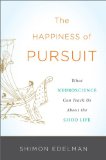
The Happiness of Pursuit

The Happiness of Pursuit: What Neuroscience Can Teach Us About the Good Life by Shimon Edelman (Basic Books)

(amazon.co.uk – 16 Feb 2012)

Product description from the publisher:

When fishing for happiness, catch and release. Remember these seven words—they are the keys to being happy. So says Shimon Edelman, an expert on psychology and the mind.

In The Happiness of Pursuit, Edelman offers a fundamental understanding of pleasure and joy via the brain. Using the concept of the mind as a computing device, he unpacks how the human brain is highly active, involved in patterned networks, and constantly learning from experience. As our brains predict the future through pursuit of experience, we are rewarded both in real time and in the long run. Essentially, as Edelman discovers, it’s the journey, rather than the destination, that matters.

The idea that cognition is computation—the brain is a machine—is nothing new of course. But, as Edelman argues, the mind is actually a bundle of ongoing computations, essentially, the brain being one of many possible substrates that can support them. Edelman makes the case for these claims by constructing a conceptual toolbox that offers readers a glimpse of the computations underlying the mind’s faculties: perception, motivation and emotions, action, memory, thinking, social cognition, learning and language. It is this collection of tools that enables us to discover how and why happiness happens.

An informative, accessible, and witty tour of the mind, The Happiness of Pursuit offers insights to a thorough understanding of what minds are, how they relate to each other and to the world, and how we can make the best of it all.

See also: Author’s website

Comments (0) - happiness,new books

new book – ‘The Poetry of Thought: From Hellenism to Celan’ by George Steiner

January 16, 2012

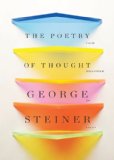
The Poetry of Thought

The Poetry of Thought: From Hellenism to Celan by George Steiner (New Directions, 2012)

(amazon.co.uk – 15 Jan, but not yet released as of 16 Jan)

Product description from the publisher:

From the distinguished polymath George Steiner comes a profound and illuminating vision of the inseparability of Western philosophy and its living language.
With his hallmark forceful discernment, George Steiner presents in The Poetry of Thought his magnum opus: an examination of more than two millennia of Western culture, staking out his claim for the essential oneness of great thought and great style. Sweeping yet precise, moving from essential detail to bracing illustration, Steiner spans the entire history of philosophy in the West as it entwines with literature, finding that, as Sartre stated, in all philosophy there is “a hidden literary prose.”

“The poetic genius of abstract thought,” Steiner believes, “is lit, is made audible. Argument, even analytic, has its drumbeat. It is made ode. What voices the closing movements of Hegel’s Phenomenology better than Edith Piaf’s non de non, a twofold negation which Hegel would have prized? This essay is an attempt to listen more closely.”

Comments (0) - culture,language,new books

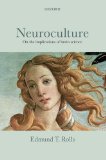
new book – ‘Neuroculture: On the Implications of Brain Science’

January 14, 2012

Neuroculture

Neuroculture: On the Implications of Brain Science by Edmund T. Rolls (Oxford University Press, USA, 2012)

(amazon.co.uk)

Product description from the publisher:

Why do we have emotions? What are the bases of social behaviour? What is the relationship between the mind and the brain? How, and why, do we appreciate art? How do we make decisions? Are there biological foundations to ethical behaviour? Why do people follow religions, or believe in life after death?

These wide-ranging, but important questions are just some of those considered in this exploration of the field of neuroscience, and how it can crucially inform our knowledge across a range of seemingly unrelated disciplines.
‘Neuroculture’ considers the implications of our modern understanding of how the brain works, how it was shaped by evolution, and how it can help us understand many mental issues central to everyday life.

The book starts with a look at emotions and how they are important in our behaviour. It then considers social behaviour, looking at the adaptive differences between men and women. The next chapter considers emotion and rationality, and the mechanisms of decision making. In the following chapter, the author looks at philosophical issues, considering the relationship between the mind and brain, and considering whether the hardware/software distinction in a computer might tell us something about mind-brain interactions. The following chapter considers neuroaesthetics – the biological foundations of our appreciation of art – including visual art, literature, and music. Is art a useless ornament? Is music, to quote Steven Pinker, really just ‘auditory cheesecake’?
After this, the author looks at the field of neuroeconomics – how neuroscience is informing us about how we make economic choices. The wide-ranging chapters that follow consider neuroethics – the biological foundations of ethical behaviour, neuropsychiatry – the connection between neural functioning and psychiatric disorders, neuroreligion – the possible biological foundations of religious belief, and neuropolitics – how our knowledge of the emotion and rational reasoning systems might help us develop strategies to solve political problems.

Written to appeal to students and researchers across the biological sciences and humanities, Neuroculture will be fascinating reading for those in neuroscience, psychology, biology, medicine, economics, animal behaviour, psychiatry, philosophy, the arts – indeed anyone interested in why we behave as we do.

See also: Author’s website

Comments (1) - cognitive science,culture,mind,new books

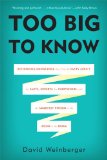
new from David Weinberger – ‘Too Big to Know: Rethinking Knowledge Now That the Facts Aren’t the Facts, Experts Are Everywhere, and the Smartest Person in the Room Is the Room’

January 6, 2012

Too Big to Know

A new book from the author of Everything Is Miscellaneous: Too Big to Know: Rethinking Knowledge Now That the Facts Aren’t the Facts, Experts Are Everywhere, and the Smartest Person in the Room Is the Room by David Weinberger (Basic Books, 2012)

(kindle ed.), (amazon.co.uk)

Product description from the publisher:

We used to know how to know. We got our answers from books or experts. We’d nail down the facts and move on. But in the Internet age, knowledge has moved onto networks. There’s more knowledge than ever, of course, but it’s different. Topics have no boundaries, and nobody agrees on anything.

Yet this is the greatest time in history to be a knowledge seeker . . . if you know how. In Too Big to Know, Internet philosopher David Weinberger shows how business, science, education, and the government are learning to use networked knowledge to understand more than ever and to make smarter decisions than they could when they had to rely on mere books and experts.

This groundbreaking book shakes the foundations of our concept of knowledge—from the role of facts to the value of books and the authority of experts—providing a compelling vision of the future of knowledge in a connected world.

See also: Book website, Author interview with Andrew Keen on TechCrunch, excerpt at The Atlantic, UC Berkeley lecture audio


Comments (0) - culture,new books