[ View menu ]

Archive

new book – ‘Consciousness: Confessions of a Romantic Reductionist’ by Christof Koch

March 19, 2012

Consciousness

Consciousness: Confessions of a Romantic Reductionist by Christof Koch (MIT Press, 2012)

(kindle ed.), (amazon.co.uk)

Book description from the publisher:

What links conscious experience of pain, joy, color, and smell to bioelectrical activity in the brain? How can anything physical give rise to nonphysical, subjective, conscious states? Christof Koch has devoted much of his career to bridging the seemingly unbridgeable gap between the physics of the brain and phenomenal experience. This engaging book–part scientific overview, part memoir, part futurist speculation–describes Koch’s search for an empirical explanation for consciousness. Koch recounts not only the birth of the modern science of consciousness but also the subterranean motivation for his quest–his instinctual (if “romantic”) belief that life is meaningful.

Koch describes his own groundbreaking work with Francis Crick in the 1990s and 2000s and the gradual emergence of consciousness (once considered a “fringy” subject) as a legitimate topic for scientific investigation. Present at this paradigm shift were Koch and a handful of colleagues, including Ned Block, David Chalmers, Stanislas Dehaene, Giulio Tononi, Wolf Singer, and others. Aiding and abetting it were new techniques to listen in on the activity of individual nerve cells, clinical studies, and brain-imaging technologies that allowed safe and noninvasive study of the human brain in action.

Koch gives us stories from the front lines of modern research into the neurobiology of consciousness as well as his own reflections on a variety of topics, including the distinction between attention and awareness, the unconscious, how neurons respond to Homer Simpson, the physics and biology of free will, dogs, Der Ring des Nibelungen, sentient machines, the loss of his belief in a personal God, and sadness. All of them are signposts in the pursuit of his life’s work–to uncover the roots of consciousness.

See also: Author’s homepage

“The Neurobiology and Mathematics of Consciousness” at Singularity Summit 2011

Comments (0) - consciousness,new books

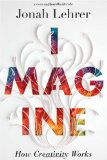
new book – ‘Imagine: How Creativity Works’ by Jonah Lehrer

Imagine

Imagine: How Creativity Works by Jonah Lehrer (Houghton Mifflin Harcourt)

(kindle ed.), (amazon.co.uk – 19 Apr 2012)

Book description from the publisher:

Did you know that the most creative companies have centralized bathrooms? That brainstorming meetings are a terrible idea? That the color blue can help you double your creative output?

From the New York Times best-selling author of How We Decide comes a sparkling and revelatory look at the new science of creativity. Shattering the myth of muses, higher powers, even creative “types,” Jonah Lehrer demonstrates that creativity is not a single gift possessed by the lucky few. It’s a variety of distinct thought processes that we can all learn to use more effectively.

Lehrer reveals the importance of embracing the rut, thinking like a child, daydreaming productively, and adopting an outsider’s perspective (travel helps). He unveils the optimal mix of old and new partners in any creative collaboration, and explains why criticism is essential to the process. Then he zooms out to show how we can make our neighborhoods more vibrant, our companies more productive, and our schools more effective.

You’ll learn about Bob Dylan’s writing habits and the drug addictions of poets. You’ll meet a Manhattan bartender who thinks like a chemist, and an autistic surfer who invented an entirely new surfing move. You’ll see why Elizabethan England experienced a creative explosion, and how Pixar’s office space is designed to spark the next big leap in animation.

Collapsing the layers separating the neuron from the finished symphony, Imagine reveals the deep inventiveness of the human mind, and its essential role in our increasingly complex world.

Google books preview:

Book trailer:

See also: Author’s website

Comments (0) - cognitive science,new books,psychology

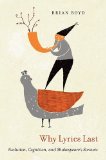
new book – ‘Why Lyrics Last: Evolution, Cognition, and Shakespeare’s Sonnets’ by Brian Boyd

March 18, 2012

Why Lyrics Last

Why Lyrics Last: Evolution, Cognition, and Shakespeare’s Sonnets by Brian Boyd (Harvard University Press, 2012)

(amazon.co.uk)

Book description from the publisher:

In “Why Lyrics Last”, the internationally acclaimed critic Brian Boyd turns an evolutionary lens on the subject of lyric verse. He finds that lyric making, though it presents no advantages for the species in terms of survival and reproduction, is “universal across cultures because it fits constraints of the human mind.” An evolutionary perspective – especially when coupled with insights from aesthetics and literary history – has much to tell us about both verse and the lyrical impulse.

Boyd places the writing of lyrical verse within the human disposition “to play with pattern,” and in an extended example he uncovers the many patterns to be found within Shakespeare’s Sonnets. Shakespeare’s bid for readership is unlike that of any sonneteer before him: he deliberately avoids all narrative, choosing to maximize the openness of the lyric and demonstrating the power that verse can have when liberated of story.

In eschewing narrative, Shakespeare plays freely with patterns of other kinds: words, images, sounds, structures; emotions and moods; argument and analogy; and natural rhythms, in daily, seasonal, and life cycles. In the originality of his stratagems, and in their sheer number and variety, both within and between sonnets, Shakespeare outdoes all competitors. A reading of the Sonnets informed by evolution is primed to attend to these complexities and better able to appreciate Shakespeare’s remarkable gambit for immortal fame.

Comments (0) - cognitive science,culture,human evolution,new books

kindle ebook deals – ‘Vision Revolution’ by Mark Changizi and more!

March 16, 2012

Vision Revolution

The Vision Revolution: How the Latest Research Overturns Everything We Thought We Knew About Human Vision by Mark Changizi is currently only $1.79 in the US kindle edition. (Prices subject to change, so be sure to doublecheck before you buy.)

Book description from the publisher:

In The Vision Revolution: How the Latest Research Overturns Everything We Thought We Knew About Human Vision, Mark Changizi, prominent neuroscientist and vision expert, addresses four areas of human vision and provides explanations for why we have those particular abilities, complete with a number of full-color illustrations to demonstrate his conclusions and to engage the reader. Written for both the casual reader and the science buff hungry for new information, The Vision Revolution is a resource that dispels commonly believed perceptions about sight and offers answers drawn from the field’s most recent research.

Changizi focuses on four “why” questions:
1. Why do we see in color?
2. Why do our eyes face forward?
3. Why do we see illusions?
4. Why does reading come so naturally to us?

Sex and War
Currently $2.69 for the Kindle edition:
Sex and War: How Biology Explains Warfare and Terrorism and Offers a Path to a Safer World by Thomas Hayden and Malcolm Potts

Book description from the publisher:

As news of war and terror dominates the headlines, scientist Malcolm Potts and veteran journalist Thomas Hayden take a step back to explain it all. In the spirit of Guns, Germs and Steel, Sex and War asks the basic questions: Why is war so fundamental to our species? And what can we do about it?

Malcolm Potts explores these questions from the frontlines, as a witness to war-torn countries around the world. As a scientist and obstetrician, Potts has worked with governments and aid organizations globally, and in the trenches with women who have been raped and brutalized in the course of war. Combining their own experience with scientific findings in primatology, genetics and anthropology, Potts and Hayden explain war’s pivotal position in the human experience and how men in particular evolved under conditions that favored gang behavior, rape and organized aggression. Drawing on these new insights, they propose a rational plan for making warfare less frequent and less brutal in the future.

Anyone interested in understanding human nature, warfare, and terrorism at their most fundamental levels will find Sex and War to be an illuminating work, and one that might change the way they see the world.
Why We Read Fiction

As noted here earlier, Why We Read Fiction: Theory of Mind and the Novel (Theory and Interpretation of Narrative) by Lisa Zunshine is (still) only $1.99 for the kindle.

Book description from the publisher:

Why We Read Fiction offers a lucid overview of the most exciting area of research in contemporary cognitive psychology known as “Theory of Mind” and discusses its implications for literary studies. It covers a broad range of fictional narratives, from Richardson’s Clarissa, Dostoyevski’s Crime and Punishment, and Austen’s Pride and Prejudice to Woolf’s Mrs. Dalloway, Nabokov’s Lolita, and Hammett’s The Maltese Falcon. Zunshine’s surprising new interpretations of well-known literary texts and popular cultural representations constantly prod her readers to rethink their own interest in fictional narrative. Written for a general audience, this study provides a jargon-free introduction to the rapidly growing interdisciplinary field known as cognitive approaches to literature and culture.
Evolution

FT Press Science frequently offers free ebooks for the Kindle: currently Evolution: A View from the 21st Century (FT Press Science).

Book description from the publisher:

This is the eBook version of the printed book.

James A. Shapiro proposes an important new paradigm for understanding biological evolution, the core organizing principle of biology. Shapiro introduces crucial new molecular evidence that tests the conventional scientific view of evolution based on the neo-Darwinian synthesis, and shows why this view is inadequate to today’s evidence. He then presents a compelling alternative view of the evolutionary process that reflects the shift in life sciences towards a more information- and systems-based approach.

Shapiro integrates advances in symbiogenesis, epigenetics, and saltationism into a unified approach that views evolutionary change as an active cell process, regulated epigenetically and capable of making rapid large changes by horizontal DNA transfer, inter-specific hybridization, whole genome doubling, symbiogenesis, or massive genome restructuring.

Evolution: A View from the 21st Century marshals extensive evidence in support of a fundamental reinterpretation of evolutionary processes, including more than 1,100 references to the scientific literature. Shapiro’s work will generate extensive discussion throughout the biological community, and may significantly change your own thinking about how life has evolved. It also has major implications for evolutionary computation, information science, and the growing synthesis of the physical and biological sciences.

Also, in case you missed it, each month Amazon features “100 Kindle books for $3.99 or less”. Highlights for March include:

Contingency, Irony, and Solidarity by Richard Rorty for $3.99

What Is Intelligence? by James R. Flynn for $3.99

Your Brain on Food: How Chemicals Control Your Thoughts and Feelings by Gary Wenk for $1.99

Don’t Be Such a Scientist: Talking Substance in an Age of Style by Randy Olson for $1.99
Comments (0) - Uncategorized

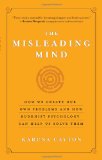
new book – ‘The Misleading Mind: How We Create Our Own Problems and How Buddhist Psychology Can Help Us Solve Them’

March 15, 2012

The Misleading Mind

The Misleading Mind: How We Create Our Own Problems and How Buddhist Psychology Can Help Us Solve Them by Karuna Cayton (New World Library, 2012)

(kindle ed.), (amazon.co.uk)

Book description from the publisher:

Buddhism asserts that we each have the potential to free ourselves from the prison of our problems. As practiced for more than twenty-six hundred years, the process involves working with, rather than against, our depression, anxiety, and compulsions. We do this by recognizing the habitual ways our minds perceive and react — the way they mislead. The lively exercises and inspiring real-world examples Cayton provides can help you transform intractable problems and neutralize suffering by cultivating a radically liberating self-understanding.

Google books preview:

See also: Author Q & A, book website

Comments (0) - happiness,meditation,mind,new books,psychology