June 3, 2012
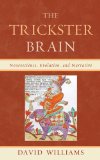
The Trickster Brain: Neuroscience, Evolution, and Narrative by David Williams (Lexington Books)
(amazon.co.uk – 1 Aug 2012)
Book description from the publisher:
Until recently, scientific and literary cultures have existed side-by-side but most often in parallel universes, without connection. The Trickster Brain: Neuroscience, Evolution, and Nature by David Williams addresses the premise that humans are a biological species stemming from the long process of evolution, and that we do exhibit a universal human nature, given to us through our genes. From this perspective, literature is shown to be a product of our biological selves. By exploring central ideas in neuroscience, evolutionary biology, linguistics, music, philosophy, ethics, religion, and history, Williams shows that it is the circuitry of the brain’s hard-wired dispositions that continually create similar tales around the world: “archetypal” stories reflecting ancient tensions that arose from our evolutionary past and the very construction of our brains. The book asserts that to truly understand literature, one must look at the biological creature creating it. By using the lens of science to examine literature, we can see how stories reveal universal aspects of the biological mind. The Trickster character is particularly instructive as an archetypal character who embodies a raft of human traits and concerns, for Trickster is often god, devil, musical, sexual, silver tongued, animal, and human at once, treading upon the moral dictates of culture.
Williams brings together science and the humanities, demonstrating a critical way of approaching literature that incorporates scientific thought.
See also: Excerpt at author’s website
Comments (0)
- culture,human evolution,mind,psychology
June 1, 2012
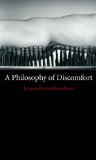
A Philosophy of Discomfort by Jacques Pezeu-Massabuau (Reaktion Books, 2012)
(amazon.co.uk)
Book description from the publisher:
A hard chair. An embarrassing conversation. A mosquito bite. All these provoke in us a sense of discomfort, whether an irksome sensation or an experience of unpleasantness. While we normally define “discomfort” simply as a lack of comfort, it is unclear which came first—comfort or the lack of it.
A Philosophy of Discomfort explores comfort and discomfort as historical and philosophical concepts, viewing these ideas as a constant push and pull of opposing forces. Arguing that comfort is a relative state that changes as our concept of well-being evolves, Jacques Pezeu-Massabuau observes our notions of comfort over time, with particular consideration to examples of housing and interiors—in Japanese housing, the Moroccan casbah, and modern city apartments, some aspects of discomfort, or the physical lack of well-being, are tolerated and accepted. Despite the human instinct to avoid discomfort, Pezeu-Massabuau contends that people must recognize the uncomfortable as necessary to existence and suggests they learn to use discomfort as another kind of pleasure, a new hedonism, or simply a new way to achieve well-being. Unraveling the myths of modern comfort, this book serves as a guide to integrating disorder into our daily lives.
Comments (0)
- new books
May 31, 2012
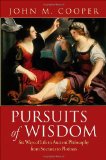
Pursuits of Wisdom: Six Ways of Life in Ancient Philosophy from Socrates to Plotinus by John M. Cooper (Princeton University Press, 2012)
(kindle ed.), (amazon.co.uk)
Book description from the publisher:
This is a major reinterpretation of ancient philosophy that recovers the long Greek and Roman tradition of philosophy as a complete way of life–and not simply an intellectual discipline. Distinguished philosopher John Cooper traces how, for many ancient thinkers, philosophy was not just to be studied or even used to solve particular practical problems. Rather, philosophy–not just ethics but even logic and physical theory–was literally to be lived. Yet there was great disagreement about how to live philosophically: philosophy was not one but many, mutually opposed, ways of life. Examining this tradition from its establishment by Socrates in the fifth century BCE through Plotinus in the third century CE and the eclipse of pagan philosophy by Christianity, Pursuits of Wisdom examines six central philosophies of living–Socratic, Aristotelian, Stoic, Epicurean, Skeptic, and the Platonist life of late antiquity.
The book describes the shared assumptions that allowed these thinkers to conceive of their philosophies as ways of life, as well as the distinctive ideas that led them to widely different conclusions about the best human life. Clearing up many common misperceptions and simplifications, Cooper explains in detail the Socratic devotion to philosophical discussion about human nature, human life, and human good; the Aristotelian focus on the true place of humans within the total system of the natural world; the Stoic commitment to dutifully accepting Zeus’s plans; the Epicurean pursuit of pleasure through tranquil activities that exercise perception, thought, and feeling; the Skeptical eschewal of all critical reasoning in forming their beliefs; and, finally, the late Platonist emphasis on spiritual concerns and the eternal realm of Being.
Pursuits of Wisdom is essential reading for anyone interested in understanding what the great philosophers of antiquity thought was the true purpose of philosophy–and of life.
Comments (0)
- new books
May 30, 2012
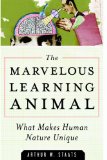
The Marvelous Learning Animal: What Makes Human Nature Unique by Arthur W. Staats (Prometheus, 2012)
(amazon.co.uk – 28 Apr)
Book description from the publisher:
What makes us human? In recent decades, researchers have focused on innate tendencies and inherited traits as explanations for human behavior, especially in light of human genome research. Renowned psychologist Arthur W. Staats thinks this trend is misleading. As he shows in great detail in this engaging, highly informative book, what makes our species unique is our marvelous ability to learn, an ability that no other primate possesses. Staats argues that the immensity of human learning has not been understood.
The author notes that evolution has endowed us with extremely versatile bodies and a brain of one hundred billion neurons, making us especially suited for a wide range of sophisticated learning. Already in childhood, human beings begin learning complex repertoires—language, sports, value systems, music, science, rules of behavior, and many other aspects of culture. These repertoires build on one another in special ways, and our brains develop in response to the learning experiences we receive from those around us and from what we read and hear and see. When humans gather in society, the cumulative effect of building learning upon learning is enormous.
Staats presents a new way of understanding humanness—in human evolution, in the behavioral nature of the human body, in child development, in personality, and in abnormal behavior—a unified conception that provides new ways of solving human problems and lays the foundations for new areas of science.
See also: Author’s faculty webpage
Comments (0)
- human evolution,new books,psychology
May 25, 2012

America the Philosophical by Carlin Romano (Knopf, 2012)
(kindle ed.), (amazon.co.uk)
Book description from the publisher:
A bold, insightful book that rejects the myth of America the Unphilosophical, arguing that America today towers as the most philosophical culture in the history of the world, an unprecedented marketplace of truth and argument that far surpasses ancient Greece or any other place one can name.
With verve and keen intelligence, Carlin Romano—Pulitzer Prize finalist, award-winning book critic, and professor of philosophy—takes on the widely held belief that ours is an anti–intellectual society. Instead, while providing a richly reported overview of American thought, Romano argues that ordinary Americans see through phony philosophical justifications faster than anyone else, and that the best of our thinkers abandon artificial academic debates for fresh intellectual enterprises, such as cyberphilosophy. Along the way, Romano seeks to topple philosophy’s most fiercely admired hero, Socrates, asserting that it is Isocrates, the nearly forgotten Greek philosopher who rejected certainty, whom Americans should honor as their intellectual ancestor.
America the Philosophical introduces readers to a nation whose existence most still doubt: a dynamic, deeply stimulating network of people and places drawn together by shared excitement about ideas. From the annual conference of the American Philosophical Association, where scholars tack wiseguy notes addressed to Spinoza on a public bulletin board, to the eruption of philosophy blogs where participants discuss everything from pedagogy to the philosophy of science to the nature of agency and free will, Romano reveals a world where public debate and intellectual engagement never stop. And readers meet the men and women whose ideas have helped shape American life over the previous few centuries, from well-known historical figures like William James and Ralph Waldo Emerson, to modern cultural critics who deserve to be seen as thinkers (Kenneth Burke, Edward Said), to the iconoclastic African American, women, Native American, and gay mavericks (Cornel West, Susan Sontag, Anne Waters, Richard Mohr) who have broadened the boundaries of American philosophy.
Smart and provocative, America the Philosophical is a rebellious tour de force that both celebrates our country’s unparalleled intellectual energy and promises to bury some of our most hidebound cultural clichés.
Google Books preview:
See also: “Is America Philosophical?”, adapted from the book’s introduction, in the Chronicle of Higher Education, May 20, 2012
Comments (0)
- culture,new books