An engrossing examination of the science behind the little-known world of sleep.
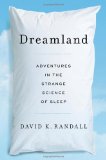
Like many of us, journalist David K. Randall never gave sleep much thought. That is, until he began sleepwalking. One midnight crash into a hallway wall sent him on an investigation into the strange science of sleep.
In Dreamland, Randall explores the research that is investigating those dark hours that make up nearly a third of our lives. Taking readers from military battlefields to children’s bedrooms, Dreamland shows that sleep isn’t as simple as it seems. Why did the results of one sleep study change the bookmakers’ odds for certain Monday Night Football games? Do women sleep differently than men? And if you happen to kill someone while you are sleepwalking, does that count as murder?
This book is a tour of the often odd, sometimes disturbing, and always fascinating things that go on in the peculiar world of sleep. You’ll never look at your pillow the same way again.
A fascinating exploration of the history of memory and human civilization
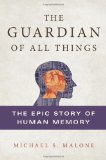
Memory makes us human. No other animal carries in its brain so many memories of such complexity nor so regularly revisits those memories for happiness, safety, and the accomplishment of complex tasks. Human civilization continues because we are able to pass along memories from one person to another, from one generation to the next.
The Guardian of All Things is a sweeping scientific history that takes us on a 10,000-year-old journey replete with incredible ideas, inventions, and transformations. From cave drawings to oral histories to libraries to the internet, The Guardian of All Things is the history of how humans have relentlessly pursued new ways to preserve and manage memory, both within the human brain and as a series of inventions external to it. Michael S. Malone looks at the story of memory, both human and mechanical, and the historic turning points in that story that have not only changed our relationship to memory, but have also changed our human fabric. Full of anecdotes, history, and advances of civilization and technology, The Guardian of All Things is a lively, epic journey along a trajectory of history no other book has ever described, one that will appeal to the curious as well as the specialist.
Peter Goldie explores the ways in which we think about our lives–our past, present, and future–in narrative terms. The notion of narrative is highly topical, and highly contentious, in a wide range of fields including philosophy, psychology and psychoanalysis, historical studies, and literature. The Mess Inside engages with all of these areas of discourse, and steers a path between the sceptics who are dismissive of the idea of narrative as having any worthwhile use at all, and those who argue that our very selfhood is somehow constituted by a narrative.
After introducing the notion of narrative, Goldie discusses the way we engage with the past in narrative terms. This involves an exploration of the essentially perspectival nature of narrative thinking, which gains support from much recent empirical work on memory. Drawing on literary examples and on work in psychology, Goldie considers grief as a case study of this kind of narrative thinking, extending to a discussion of the crucial notion of ‘closure’. Turning to narrative thinking about our future, Goldie discusses the many structural parallels between our imaginings of the future and our memories of the past, and the role of our emotions in response to what we imagine in thinking about our future in the light of our past. This is followed by a second case study–an exploration of self-forgiveness.
In this ground-breaking book, Goldie supports scepticism about the idea that there is such a thing as a narrative self, but argues that having a narrative sense of self, quite distinct from any metaphysical notion of selfhood, is at the heart of what it is to think of ourselves, and others, as having a narratable past, present, and future.
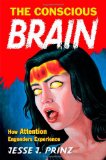
The problem of consciousness continues to be a subject of great debate in cognitive science. Synthesizing decades of research, The Conscious Brain advances a new theory of the psychological and neurophysiological correlates of conscious experience.
Prinz’s account of consciousness makes two main claims: first consciousness always arises at a particular stage of perceptual processing, the intermediate level, and, second, consciousness depends on attention. Attention changes the flow of information allowing perceptual information to access memory systems. Neurobiologically, this change in flow depends on synchronized neural firing. Neural synchrony is also implicated in the unity of consciousness and in the temporal duration of experience.
Prinz also explores the limits of consciousness. We have no direct experience of our thoughts, no experience of motor commands, and no experience of a conscious self. All consciousness is perceptual, and it functions to make perceptual information available to systems that allows for flexible behavior.
Prinz concludes by discussing prevailing philosophical puzzles. He provides a neuroscientifically grounded response to the leading argument for dualism, and argues that materialists need not choose between functional and neurobiological approaches, but can instead combine these into neurofunctional response to the mind-body problem.
The Conscious Brain brings neuroscientific evidence to bear on enduring philosophical questions, while also surveying, challenging, and extending philosophical and scientific theories of consciousness. All readers interested in the nature of consciousness will find Prinz’s work of great interest.