“A brother is as easily forgotten as an umbrella.”—James Joyce, Ulysses
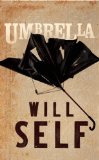
Radical and uncompromising, Umbrella is a tour de force from one of England’s most acclaimed contemporary writers, and Self’s most ambitious novel to date. Moving between Edwardian London and a suburban mental hospital in 1971, Umbrella exposes the twentieth century’s technological searchlight as refracted through the dark glass of a long term mental institution. While making his first tours of the hospital at which he has just begun working, maverick psychiatrist Zachary Busner notices that many of the patients exhibit a strange physical tic: rapid, precise movements that they repeat over and over. One of these patients is Audrey Dearth, an elderly woman born in the slums of West London in 1890. Audrey’s memories of a bygone Edwardian London, her lovers, involvement with early feminist and socialist movements, and, in particular, her time working in an umbrella shop, alternate with Busner’s attempts to treat her condition and bring light to her clouded world. Busner’s investigations into Audrey’s illness lead to discoveries about her family that are shocking and tragic.
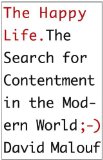
By Australia’s greatest contemporary author, an elegant, succinct meditation on what makes for a happy life. ;-)
“Happiness surely is among the simplest of human emotions and the most spontaneous,” says David Malouf. But what exactly are we looking for when we chase happiness? At this particular moment in history, privileged, industrialized nations have lessened much of what makes us unhappy: widespread poverty, illness, famine. Yet we are still unfulfilled, turning increasingly to yoga, church, Match.com, drugs, clinical therapy and retail therapy. What is at the root of our collective stress, and how can we find our way to contentment?
Drawing on mythology, philosophy, art and literature, Malouf traces our conception of happiness throughout history, distilling centuries of thought into a lucid narrative. He discusses the creation myths of ancient Greece and the philosophical schools of Athens, analyzes Thomas Jefferson’s revolutionary declaration that “the pursuit of happiness” is a right, explores the celebration of sensual delight in Rembrandt and Rubens and offers a perceptive take on a modern society growing larger and more impersonal.
With wisdom and insight, Malouf investigates that simplest, most spontaneous of feelings and urges us to do the same.
From the author of the giant #1 New York Times bestseller Inside of a Dog comes an equally smart, delightful, and startling exploration of how we perceive and discover our world.
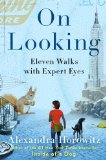
Alexandra Horowitz’s brilliant On Looking: Eleven Walks with Expert Eyes shows us how to see the spectacle of the ordinary—to practice, as Sir Arthur Conan Doyle put it, “the observation of trifles.” On Looking is structured around a series of eleven walks the author takes, mostly in her Manhattan neighborhood, with experts on a diverse range of subjects, including an urban sociologist, the well-known artist Maira Kalman, a geologist, a physician, and a sound designer. She also walks with a child and a dog to see the world as they perceive it. What they see, how they see it, and why most of us do not see the same things reveal the startling power of human attention and the cognitive aspects of what it means to be an expert observer.
As the million-plus readers of Inside of a Dog have discovered, Alexandra Horowitz is charmingly adept at explaining the mysteries of human perception. Trained as a cognitive scientist, she discovers a feast of fascinating detail, all explained with her generous humor and self-deprecating tone. On Looking presents the same engaging combination, this time in service to understanding how human beings encounter their daily worlds and each other.
Page by page, Horowitz shows how much more there is to see—if only we would really look. On Looking is nutrition for the considered life, serving as a provocative response to our relentlessly virtual consciousness. So turn off the phone and other electronic devices and be in the real world—where strangers communicate by geometry as they walk toward one another, where sounds reveal shadows, where posture can display humility, and the underside of a leaf unveils a Lilliputian universe—where, indeed, there are worlds within worlds within worlds.
Alexandra Horowitz’s On Looking confirms her place as one of today’s most illuminating observers of our infinitely complex world.
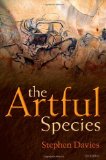
The Artful Species explores the idea that our aesthetic responses and art behaviors are connected to our evolved human nature. Our humanoid forerunners displayed aesthetic sensibilities hundreds of thousands of years ago and the art standing of prehistoric cave paintings is virtually uncontested.
In Part One, Stephen Davies analyses the key concepts of the aesthetic, art, and evolution, and explores how they might be related. He considers a range of issues, including whether animals have aesthetic tastes and whether art is not only universal but cross-culturally comprehensible.
Part Two examines the many aesthetic interests humans take in animals and how these reflect our biological interests, and the idea that our environmental and landscape preferences are rooted in the experiences of our distant ancestors. In considering the controversial subject of human beauty, evolutionary psychologists have traditionally focused on female physical attractiveness in the context of mate selection, but Davies presents a broader view which decouples human beauty from mate choice and explains why it goes more with social performance and self-presentation.
Part Three asks if the arts, together or singly, are biological adaptations, incidental byproducts of nonart adaptations, or so removed from biology that they rate as purely cultural technologies. Davies does not conclusively support any one of the many positions considered here, but argues that there are grounds, nevertheless, for seeing art as part of human nature. Art serves as a powerful and complex signal of human fitness, and so cannot be incidental to biology. Indeed, aesthetic responses and art behaviors are the touchstones of our humanity.