January 26, 2013
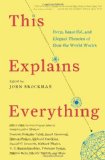
This Explains Everything: Deep, Beautiful, and Elegant Theories of How the World Works ed. by John Brockman (Harper Perennial, 2013)
(kindle ed.), (amazon.co.uk)
Book description from the publisher:
Drawn from the cutting-edge frontiers of science, This Explains Everything will revolutionize your understanding of the world.
What is your favorite deep, elegant, or beautiful explanation?
This is the question John Brockman, publisher of Edge.org (“The world’s smartest website”—The Guardian), posed to the world’s most influential minds. Flowing from the horizons of physics, economics, psychology, neuroscience, and more, This Explains Everything presents 150 of the most surprising and brilliant theories of the way of our minds, societies, and universe work.
Jared Diamond on biological electricity • Nassim Nicholas Taleb on positive stress • Steven Pinker on the deep genetic roots of human conflict • Richard Dawkins on pattern recognition • Nobel Prize-winning physicist Frank Wilczek on simplicity • Lisa Randall on the Higgs mechanism • BRIAN Eno on the limits of intuition • Richard Thaler on the power of commitment • V. S. Ramachandran on the “neural code” of consciousness • Nobel Prize winner ERIC KANDEL on the power of psychotherapy • Mihaly Csikszentmihalyi on “Lord Acton’s Dictum” • Lawrence M. Krauss on the unification of electricity and magnetism • plus contributions by Martin J. Rees • Kevin Kelly • Clay Shirky • Daniel C. Dennett • Sherry Turkle • Philip Zimbardo • Lee Smolin • Rebecca Newberger Goldstein • Seth Lloyd • Stewart Brand • George Dyson • Matt Ridley
See also: 2012 Annual Question at Edge.org
Comments (0)
- culture,new books,reality
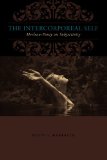
The Intercorporeal Self: Merleau-Ponty on Subjectivity by Scott L. Marratto (SUNY Press, 2013)
(kindle ed.), (amazon.co.uk)
Book description from the publisher:
An original interpretation of Merleau-Ponty on subjectivity, drawing from and challenging both the continental and analytic traditions. Challenging a prevalent Western idea of the self as a discrete, interior consciousness, Scott L. Marratto argues instead that subjectivity is a characteristic of the living, expressive movement establishing a dynamic intertwining between a sentient body and its environment. He draws on the work of the French philosopher Maurice Merleau-Ponty, contemporary European philosophy, and research in cognitive science and development to offer a compelling investigation into what it means to be a self.
“The Intercorporeal Self amounts to a kind of dialectic between Merleau-Ponty’s thought and naturalism as it functions within contemporary analytic thought and deconstruction as it appears in Derrida’s thought. Marratto constructs argumentation that shows that Merleau-Ponty’s thought cannot be reduced to naturalism and that it does not fall prey to the deconstructive critique. Consequently, Marratto, better than anyone else, shows the contribution that Merleau-Ponty makes to contemporary philosophy.This is an important book. I would even venture to say that it is a genuine work of philosophy.” — Leonard Lawlor, Sparks Professor of Philosophy, Penn State University
“Marratto brings Merleau-Ponty’s phenomenology into a mutually transformative dialogue with the latest trends in the embodied sciences of the mind. His book puts side by side notions of intercorporeality, habit, style, and auto-affection with Gestalt, ecological, sensorimotor, and enactive perspectives on perception and subjectivity. Marratto weaves together the threads of conceptual traditions that saw themselves as incompatible not so long ago. A significant contribution to current efforts toward reconceptualizing the lived body as the matrix of significance and expressive being-in-the-world, and subjectivity as self-affecting, self-initiated movement and intercorporeal attunement to the demands of other bodies.” — Ezequiel A. Di Paolo, coeditor of Enaction: Toward a New Paradigm for Cognitive Science
Google Books preview:
Comments (0)
- new books,self
January 23, 2013

Missing Out: In Praise of the Unlived Life by Adam Phillips (Farrar, Straus, and Giroux, 2013)
(kindle ed.), (amazon.co.uk)
Book description from the publisher:
A transformative book about the lives we wish we had and what they can teach us about who we are
All of us lead two parallel lives: the one we are actively living, and the one we feel we should have had or might yet have. As hard as we try to exist in the moment, the unlived life is an inescapable presence, a shadow at our heels. And this itself can become the story of our lives: an elegy to unmet needs and sacrificed desires. We become haunted by the myth of our own potential, of what we have in ourselves to be or to do. And this can make of our lives a perpetual falling-short.
But what happens if we remove the idea of failure from the equation? With his flair for graceful paradox, the acclaimed psychoanalyst Adam Phillips suggests that if we accept frustration as a way of outlining what we really want, satisfaction suddenly becomes possible. To crave a life without frustration is to crave a life without the potential to identify and accomplish our desires.
In this elegant, compassionate, and absorbing book, Phillips draws deeply on his own clinical experience as well as on the works of Shakespeare and Freud, of D. W. Winnicott and William James, to suggest that frustration, not getting it, and and getting away with it are all chapters in our unlived lives—and may be essential to the one fully lived.
Google Books preview:
Comments (0)
- new books,psychology
January 20, 2013
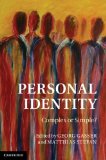
Personal Identity: Complex or Simple? ed. by Georg Gasser and Matthias Stefan (Cambridge University Press, 2012)
(kindle ed.), (amazon.co.uk)
Book description from the publisher:
We take it for granted that a person persists over time: when we make plans, we assume that we will carry them out; when we punish someone for a crime, we assume that she is the same person as the one who committed it. Metaphysical questions underlying these assumptions point towards an area of deep existential and philosophical interest. In this volume, leading metaphysicians discuss key questions about personal identity, including ‘What are we?’, ‘How do we persist?’, and ‘Which conditions guarantee our identity over time?’ They discuss whether personal identity is ‘complex’, whereby it is analyzable in terms of simpler relations such as physical or psychological features, or whether it is ‘simple’, namely something that cannot be analyzed in terms of more fundamental relations. Their essays offer an innovative discussion of this topic and will be of interest to a wide readership in metaphysics.
Comments (0)
- new books,self
January 16, 2013
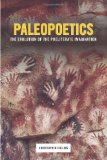
Paleopoetics: The Evolution of the Preliterate Imagination by Christopher Collins (Columbia University Press, 2013)
(kindle ed.), (amazon.co.uk)
Book description from the publisher:
Christopher Collins introduces an exciting new field of research that traverses evolutionary biology, anthropology, archaeology, cognitive psychology, linguistics, neuroscience, and literary study. Paleopoetics maps the selective processes that shaped the human genus millions of years ago and prepared the human brain to play, imagine, empathize, and engage in fictive thought as mediated by language. A manifestation of the “cognitive turn” in the humanities, this study calls for a broader, more integrated interpretation of the reading experience, one that restores our connection to the ancient methods of thought production still resonating within us.
Speaking with authority on the scientific aspects of cognitive poetics, Collins proposes reading literature using cognitive skills that predate language and writing. These include the brain’s capacity to perceive the visible world, store its images, and retrieve them later to form simulated mental events. Long before humans could share stories through speech, they perceived, remembered, and imagined their own inner narratives. Drawing on a wide range of evidence, Collins builds an evolutionary bridge between humans’ development of sensorimotor skills and their achievement of linguistic cognition, bringing current scientific perspective to such issues as the structure of narrative, the distinction between metaphor and metonymy, the relation of rhetoric to poetics, the relevance of performance theory to reading, the difference between orality and writing, and the nature of play and imagination.
Comments (0)
- Uncategorized