[ View menu ]

Archive

new book – ‘Zig Zag: The Surprising Path to Greater Creativity’ by Keith Sawyer

March 19, 2013
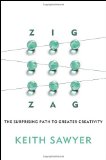
Zig Zag

Zig Zag: The Surprising Path to Greater Creativity by Keith Sawyer (Jossey-Bass, 2013)

(kindle ed.), (amazon.co.uk)

Book description from the publisher:

A science-backed method to maximize creative potential in any sphere of life

With the prevalence of computer technology and outsourcing, new jobs and fulfilling lives will rely heavily on creativity and innovation. Keith Sawyer draws from his expansive research of the creative journey, exceptional creators, creative abilities, and world-changing innovations to create an accessible, eight-step program to increasing anyone’s creative potential. Sawyer reveals the surprising secrets of highly creative people (such as learning to ask better questions when faced with a problem), demonstrates how to come up with better ideas, and explains how to carry those ideas to fruition most effectively.

This science-backed, step-by step method can maximize our creative potential in any sphere of life.

  • Offers a proven method for developing new ideas and creative problem-solving no matter what your profession
  • Includes an eight-step method, 30 practices, and more than 100 techniques that can be launched at any point in a creative journey
  • Psychologist, jazz pianist, and author Keith Sawyer studied with world-famous creativity expert Mihaly Csikszentmihalyi

Sawyer’s book offers a wealth of easy to apply strategies and ideas for anyone who wants to tap into their creative power.

Google Books preview:

See also: Author’s blog
Comments (0) - new books,psychology

new book – ‘Thought: A Very Short Introduction’ by Tim Bayne

March 16, 2013

Thought

Thought: A Very Short Introduction (Very Short Introductions) by Tim Bayne (Oxford University Press, USA)

(kindle ed.), (amazon.co.uk – Jan 2013)

Book description from the publisher:

There is no denying that thinking comes naturally to human beings and that thinking is indeed central to what it means to be human. But what are thoughts? How does the brain–billions of tiny neurons and synapses–accomplish thought? In this compelling Very Short Introduction, Tim Bayne offers a compact but wide-ranging account of the nature of thought, drawing upon philosophy, psychology, neuroscience, and anthropology. Bayne touches on a stimulating array of topics. Does thinking occur in public or is it a purely private affair? Do young children and non-human animals think? Is human thought the same everywhere, or are there culturally specific modes of thought? What is the relationship between thought and language? What kind of responsibility do we have for our thoughts? In what ways can the process of thinking go wrong? Beginning with questions about what thought is and what distinguishes it from other kinds of mental states, he explores the logical structures of thought as well as the mechanisms that make thought possible. In sum, this book provides an engaging survey of what we know–and what we don’t know–about one of the most central of human capacities.

Google Books preview:

Comments (0) - new books,philosophy of mind

$0.99 kindle ebook (short) on Amazon: ‘Writing, Dreams, and Consciousness’ by Kirsten Mortensen

March 13, 2013

Comments (2) - consciousness,language

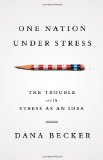
new book – ‘One Nation Under Stress: The Trouble with Stress as an Idea’ by Dana Becker

One Nation Under Stress

One Nation Under Stress: The Trouble with Stress as an Idea by Dana Becker (Oxford University Press, USA, 2013)

(amazon.co.uk)

Book description from the publisher:

Stress. Everyone is talking about it, suffering from it, trying desperately to manage it-now more than ever. From 1970 to 1980, 2,326 academic articles appeared with the word “stress” in the title. In the decade between 2000 and 2010 that number jumped to 21,750. Has life become ten times more stressful, or is it the stress concept itself that has grown exponentially over the past 40 years?

In One Nation Under Stress, Dana Becker argues that our national infatuation with the therapeutic culture has created a middle-class moral imperative to manage the tensions of daily life by turning inward, ignoring the social and political realities that underlie those tensions. Becker shows that although stress is often associated with conditions over which people have little control-workplace policies unfavorable to family life, increasing economic inequality, war in the age of terrorism-the stress concept focuses most of our attention on how individuals react to stress. A proliferation of self-help books and dire medical warnings about the negative effects of stress on our physical and emotional health all place the responsibility for alleviating stress-though yoga, deep breathing, better diet, etc.-squarely on the individual. The stress concept has come of age in a period of tectonic social and political shifts. Nevertheless, we persist in the all-American belief that we can meet these changes by re-engineering ourselves rather than tackling the root causes of stress.

Examining both research and popular representations of stress in cultural terms, Becker traces the evolution of the social uses of the stress concept as it has been transformed into an all-purpose vehicle for defining, expressing, and containing middle-class anxieties about upheavals in American society.

Google Books preview:

Comments (1) - culture,new books,psychology

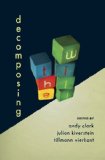
new book – ‘Decomposing the Will’ ed. by Andy Clark et al.

March 11, 2013

Decomposing the Will

Decomposing the Will (Philosophy of Mind Series), ed. by Andy Clark, Julian Kiverstein, and Tillmann Vierkant (Oxford University Press, USA, 2013)

(amazon.co.uk)

Book description from the publisher:

There is growing evidence from the science of human behavior that our everyday, folk understanding of ourselves as conscious, rational, responsible agents may be radically mistaken. The science, some argue, recommends a view of conscious agency as merely epiphenomenal: an impotent accompaniment to the whirring unconscious machinery (the inner zombie) that prepares, decides and causes our behavior. The new essays in this volume display and explore this radical claim, revisiting the folk concept of the responsible agent after abandoning the image of a central executive, and “decomposing” the notion of the conscious will into multiple interlocking aspects and functions.

Part 1 of this volume provides an overview of the scientific research that has been taken to support “the zombie challenge.” In part 2, contributors explore the phenomenology of agency and what it is like to be the author of one’s own actions. Part 3 then explores different strategies for using the science and phenomenology of human agency to respond to the zombie challenge.

Questions explored include: what distinguishes automatic behavior and voluntary action? What, if anything, does consciousness contribute to the voluntary control of behavior? What does the science of human behavior really tell us about the nature of self-control?

Table of Contents
1. Decomposing the WIll: Meeting the Zombie Challenge , Tillmann Vierkant, Julian Kiverstein, and Andy Clark
PART ONE The Zombie Challenge
2. The Neuroscience of Volition , Adina L. Roskies
3. Beyond Libet: Long-term Prediction of Free Choices from Neuroimaging Signals , John-Dylan Haynes
4. Vetoing and Consciousness , Alfred R. Mele
5. From Determinism to Resignation; and How to Stop It , Richard Holton

PART TWO The Sense of Agency
6. From the Fact to the Sense of Agency , Manos Tsakiris and Aikaterini Fotopoulou
7. Ambiguity in the Sense of Agency , Shaun Gallagher
8. There’s Nothing Life Being Free: Default Dispositions, Judgments of Freedom, and the Phenomenology of Coercion , Fabio Paglieri
9. Agency as a Marker of Consciousness , Tim Bayne

PART THREE The Function of Conscious Control: Conflict Resolution, Emotion, and Mental Actions

10. Voluntary Action and the Three Forms of Binding in the Brain , Ezequiel Morsella, Tara C. Dennehy, and John A. Bargh
11. Emotion Regulation and Free Will , Nico H. Frijda
12. Action Control by Implementation Intentions: The Role of Discrete Emotions , Sam J. Maglio, Peter M. Gollwitzer, and Gabriele Oettingen
13. Mental Action and the Threat of Automaticity , Wayne Wu
14. Mental Acts as Natural Kinds , Jo^”elle Proust

PART FOUR Decomposed Accounts of the Will
15. Managerial Control and Free Mental Agency , Tillmann Vierkant
16. Recomposing the Will: Distributed Motivation and Computer-Mediated Extrospection , Lars Hall, Petter Johansson, and David de Leon
17. Situationism and Moral Responsibility: Free Will in Fragments , Manuel Vargas

Comments (0) - cognitive science,consciousness,new books,philosophy of mind