out in paperback – ‘Thinking, Fast and Slow’ by Daniel Kahneman
April 2, 2013
out in paperback (amazon.com): Thinking, Fast and Slow by Daniel Kahneman amazon.com/gp/product/037… via @amazon
— Debbie A Foster (@mymindonbooks) April 2, 2013
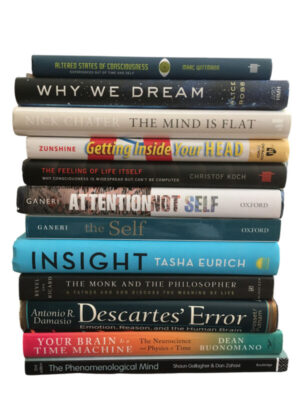
books on the mind, consciousness, cognitive science…
April 2, 2013
out in paperback (amazon.com): Thinking, Fast and Slow by Daniel Kahneman amazon.com/gp/product/037… via @amazon
— Debbie A Foster (@mymindonbooks) April 2, 2013
April 1, 2013
This month’s 100 Kindle books for $3.99 or less (Note: Amazon Says “Individual books may have additional territory restrictions, and not all deals are available in all territories. Amazon may modify the selection of books offered at any time.”) includes:
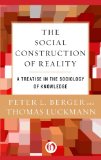
The Social Construction of Reality: A Treatise in the Sociology of Knowledge by Peter L. Berger and Thomas Luckmann for $2.99
Book description from the publisher:
The classic work that redefined the sociology of knowledge and has inspired a generation of philosophers and thinkersIn this seminal book, Peter L. Berger and Thomas Luckmann examine how knowledge forms and how it is preserved and altered within a society. Unlike earlier theorists and philosophers, Berger and Luckmann go beyond intellectual history and focus on commonsense, everyday knowledge—the proverbs, morals, values, and beliefs shared among ordinary people.When first published in 1966, this systematic, theoretical treatise introduced the term social construction,effectively creating a new thought and transforming Western philosophy.
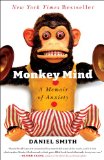
Monkey Mind: A Memoir of Anxiety by Daniel Smith for $2.99
Book description from the publisher:
Anxiety once paralyzed Daniel Smith over a roast beef sandwich, convincing him that a choice between ketchup and barbeque sauce was as dire as that between life and death. It has caused him to chew his cuticles until they bled, wear sweat pads in his armpits, and confess his sexual problems to his psychotherapist mother. It has dogged his days, threatened his sanity, and ruined his relationships.
In Monkey Mind, Smith articulates what it is like to live with anxiety, defanging the disease with humor, traveling through its demonic layers, and evocatively expressing its self-destructive absurdities and painful internal coherence. With honesty and wit, he exposes anxiety as a pudgy, weak-willed wizard behind a curtain of dread and tames what has always seemed to him, and to the tens of millions of others who suffer from anxiety, a terrible affliction.
Aaron Beck, the most influential doctor in modern psychotherapy, says that “Monkey Mind does for anxiety what William Styron’s Darkness Visible did for depression.” Neurologist and bestselling writer Oliver Sacks says, “I read Monkey Mind with admiration for its bravery and clarity. . . . I broke out into explosive laughter again and again.” Here, finally, comes relief and recognition to all those who want someone to put what they feel, or what their loved ones feel, into words.
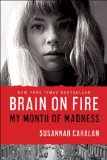
Brain on Fire: My Month of Madness by Susannah Cahalan for $2.99
Book description from the publisher:
One day in 2009, twenty-four-year-old Susannah Cahalan woke up alone in a strange hospital room, strapped to her bed, under guard, and unable to move or speak. A wristband marked her as a “flight risk,” and her medical records—chronicling a month-long hospital stay of which she had no memory at all—showed hallucinations, violence, and dangerous instability. Only weeks earlier, Susannah had been on the threshold of a new, adult life: a healthy, ambitious college grad a few months into her first serious relationship and a promising career as a cub reporter at a major New York newspaper. Who was the stranger who had taken over her body? What was happening to her mind? In this swift and breathtaking narrative, Susannah tells the astonishing true story of her inexplicable descent into madness and the brilliant, lifesaving diagnosis that nearly didn’t happen. A team of doctors would spend a month—and more than a million dollars—trying desperately to pin down a medical explanation for what had gone wrong. Meanwhile, as the days passed and her family, boyfriend, and friends helplessly stood watch by her bed, she began to move inexorably through psychosis into catatonia and, ultimately, toward death. Yet even as this period nearly tore her family apart, it offered an extraordinary testament to their faith in Susannah and their refusal to let her go.
Then, at the last minute, celebrated neurologist Souhel Najjar joined her team and, with the help of a lucky, ingenious test, saved her life. He recognized the symptoms of a newly discovered autoimmune disorder in which the body attacks the brain, a disease now thought to be tied to both schizophrenia and autism, and perhaps the root of “demonic possessions” throughout history.
Far more than simply a riveting read and a crackling medical mystery, Brain on Fire is the powerful account of one woman’s struggle to recapture her identity and to rediscover herself among the fragments left behind. Using all her considerable journalistic skills, and building from hospital records and surveillance video, interviews with family and friends, and excerpts from the deeply moving journal her father kept during her illness, Susannah pieces together the story of her “lost month” to write an unforgettable memoir about memory and identity, faith and love. It is an important, profoundly compelling tale of survival and perseverance that is destined to become a classic.
March 30, 2013
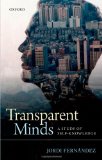
Transparent Minds: A Study of Self-Knowledge by Jordi Fernandez (Oxford University Press, USA, 2013)
Book description from the publisher:
We all seem to be capable of telling what our current states of mind are. At any given moment, we know, for example, what we believe, and what we want. But how do we know that? In Transparent Minds, Jordi Fernandez explains our knowledge of our own propositional attitudes. Drawing on the so-called “transparency” of belief, he proposes that we attribute beliefs and desires to ourselves based on our grounds for those beliefs and desires. The book argues that this view explains our privileged access to those propositional attitudes. Three applications are drawn from the model of self-knowledge that emerges: a solution to Moore’s paradox, an account of the thought-insertion delusion, and an explanation of self-deception. The puzzles raised by all three phenomena can be resolved, Fernandez argues, if we construe them as failures of self-knowledge. The resulting picture of self-knowledge challenges the traditional notion that it is a matter of introspection. For the main tenet of Transparent Minds is that we come to know what we believe and desire by “looking outward,” and attending to the states of affairs which those beliefs and desires are about.
See also: Author’s website
March 28, 2013
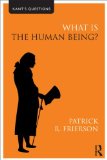
What is the Human Being? (Kant’s Questions) by Patrick R. Frierson (Routledge, 2013)
Book description from the publisher:
Philosophers, anthropologists and biologists have long puzzled over the question of human nature. It is also a question that Kant thought about deeply and returned to in many of his writings. In this lucid and wide-ranging introduction to Kant’s philosophy of human nature – which is essential for understanding his thought as a whole – Patrick R. Frierson assesses Kant’s theories and examines his critics.
He begins by explaining how Kant articulates three ways of addressing the question ‘what is the human being?’: the transcendental, the empirical, and the pragmatic. He then considers some of the great theorists of human nature who wrestle with Kant’s views, such as Hegel, Marx, Darwin, Nietzsche, and Freud; contemporary thinkers such as E.O.Wilson and Daniel Dennett, who have sought biological explanations of human nature; Thomas Kuhn, Michel Foucault, and Clifford Geertz, who emphasize the diversity of human beings in different times and places; and existentialist philosophers such as Sartre and Heidegger.
He argues that whilst these approaches challenge and enrich Kant’s views in significant ways, all suffer from serious weaknesses that Kant’s anthropology can address. Taking a core insight of Kant’s – that human beings are fundamentally free but finite – he argues that it is the existentialists, particularly Sartre, who are the most direct heirs of his transcendental anthropology.
The final part of the book is an extremely helpful overview of the work of contemporary philosophers, particularly Christine Korsgaard and Jürgen Habermas. Patrick R. Frierson explains how these philosophers engage with questions of naturalism, historicism, and existentialism while developing Kantian conceptions of the human being.
Including chapter summaries and annotated further reading, What is the Human Being? is an outstanding introduction to some fundamental aspects of Kant’s thought and a judicious assessment of leading theories of human nature. It is essential reading for all students of Kant and the philosophy of human nature, as well as those in related disciplines such as anthropology, politics and sociology.
March 26, 2013
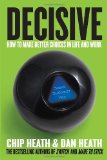
Decisive: How to Make Better Choices in Life and Work by Chip Heath and Dan Heath (Crown Business, 2013)
Chip and Dan Heath, the bestselling authors of Switch and Made to Stick, tackle one of the most critical topics in our work and personal lives: how to make better decisions.
Research in psychology has revealed that our decisions are disrupted by an array of biases and irrationalities: We’re overconfident. We seek out information that supports us and downplay information that doesn’t. We get distracted by short-term emotions. When it comes to making choices, it seems, our brains are flawed instruments. Unfortunately, merely being aware of these shortcomings doesn’t fix the problem, any more than knowing that we are nearsighted helps us to see. The real question is: How can we do better?In Decisive, the Heaths, based on an exhaustive study of the decision-making literature, introduce a four-step process designed to counteract these biases. Written in an engaging and compulsively readable style, Decisive takes readers on an unforgettable journey, from a rock star’s ingenious decision-making trick to a CEO’s disastrous acquisition, to a single question that can often resolve thorny personal decisions.
Along the way, we learn the answers to critical questions like these: How can we stop the cycle of agonizing over our decisions? How can we make group decisions without destructive politics? And how can we ensure that we don’t overlook precious opportunities to change our course?
Decisive is the Heath brothers’ most powerful—and important—book yet, offering fresh strategies and practical tools enabling us to make better choices. Because the right decision, at the right moment, can make all the difference.
See also: Authors’ website