December 17, 2007
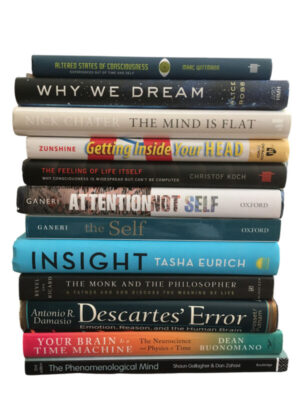
ReadMe is a MetaFilter Wiki page collecting (and organizing) all the book-related topics from Ask MetaFilter, usually book recommendations on specific topics.
For example, filed on the wiki under “Science & Math: consciousness” – there are two entries: 1 (“recommend books about consciousness”) and 2 (“what to read after Dennett’s Consciousness Explained?”)
Also “recent books on cognitive science”
**********
Another good source of book lists is the site Lists of Bests, where I found “Mindpapers: 100 most cited works in the Philosophy of Mind”.
Comments (0)
- book search,cognitive science,consciousness,philosophy of mind
December 15, 2007
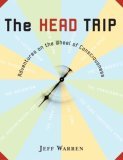 I’m looking forward to reading The Head Trip: Adventures on the Wheel of Consciousness
 by Jeff Warren, especially after reading this review in the SF Chronicle, which concludes:
Reality, in other words, may be more malleable than we’d like to think. Pain may cease to be a part of it for the hypnotized surgery patient. Thunderclaps may fade to whispers for the man in a meditative trance. The only constant is our mind, but as Warren discovers on his mental journeys, “there’s just no telling what it will get up to.”
[The review actually appeared in the Sunday 12/16/07 Chronicle.]
More on The Head Trip at Google Book Search
Comments (0)
- consciousness,new books
December 14, 2007
The “Library Problem” sounds like some kind of logic puzzle, but it’s actually the title of a wonderfully detailed post from Hackito Ergo Sum about organizing a home library, with lots of comments. This post was yesterday’s “Library Link of the Day” (12/12/07).
For the record I’ve used both LibraryThing and ReaderWare and can recommend both – ReaderWare is fine if you want a self-contained database on your computer; I’ve mentioned LibraryThing many times here – it’s a great web-based cataloging solution with lots of extra features, plus a good source of book information even if you don’t want to catalog your books there.

Comments (0)
- reading
December 12, 2007
ReadWriteWeb (that can be a tonguetwister if I try to say it out loud!) posted about the Human Brain Cloud, a “massively multiplayer word association game.” I especially like the “view the cloud” tab, where you can type in a word to see what associations it has. The site sometimes gets overloaded, so if you get an error message, just try again later.
The same ReadWriteWeb post also mentions an interesting study on ‘Google and the Mind: Predicting Fluency with PageRank’:
ABSTRACT—Human memory and Internet search engines face a shared computational problem, needing to retrieve stored pieces of information in response to a query. We explored whether they employ similar solutions, testing whether we could predict human performance on a fluency task using PageRank, a component of the Google search engine. In this task, people were shown a letter of the alphabet and asked to name the first word beginning with that letter that came to mind. We show that PageRank, computed on a semantic network constructed from word-association data, outperformed word frequency and the number of words for which a word is named as an associate as a predictor of the words that people produced in this task. We identify two simple process models that could support this apparent correspondence between human memory and Internet search, and relate our results to previous rational models of memory.
Siva Vaidyanathan at the “Googlization of Everything” was not that impressed by the study though.
Comments (0)
- mind