January 18, 2008
Big Brain: The Origins and Future of Human Intelligence by Gary Lynch and Richard Granger (Palgrave-MacMillan)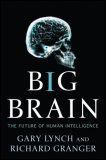
Our big brains, our language ability, and our intelligence make us uniquely human. But barely 10,000 years ago (a mere blip in evolutionary time) human-like creatures called “Boskops” flourished in South Africa. They possessed extraordinary features: forebrains roughly 50% larger than ours, and estimated IQs to match–far surpassing our own. Many of these huge fossil skulls have been discovered over the last century, but most of us have never heard of this scientific marvel.
Prominent neuroscientists Gary Lynch and Richard Granger compare the contents of the Boskop brain and our own brains today, and arrive at startling conclusions about our intelligence and creativity. Connecting cutting-edge theories of genetics, evolution, language, memory, learning, and intelligence, Lynch and Granger show the implications of large brains for a broad array of fields, from the current state of the art in Alzheimer’s and other brain disorders, to new advances in brain-based robots that see and converse with us, and the means by which neural prosthetics– replacement parts for the brain–are being designed and tested. The authors demystify the complexities of our brains in this fascinating and accessible book, and give us tantalizing insights into our humanity–its past, and its future.
Comments (1)
- cognitive science,mind,new books
January 17, 2008
Benoit Hardy-Vallée of the University of Toronto Department of Philosophy has posted the first chapter of a free e-book, ‘The Philosophy of Social Cognition.’ The chapter topic is “The Other Minds.”
Comments (0)
- cognitive science,philosophy of mind
January 16, 2008
Some additions to the list in the sidebar – books on the self published 2007-2008.
2008
Andre Masson and the Surrealist Self by Clark V Poling (New Haven, Conn.; London: Yale University Press, 2008) forthcoming – April 2008
Belief about the Self: A Defense of the Property Theory of Content by Neil Feit (Oxford; New York: Oxford University Press, 2008) forthcoming – June 2008
Crossing Horizons: World, Self, and Language in Indian and Western Thought by Shlomo Biderman (New York: Columbia University Press, 2008) available
Cult of the Will: Nervousness and the Forging of a Modern Self in Germany, 1890-1914 by Michael A. Cowan (University Park, Pa.: Pennsylvania State University Press, 2008) forthcoming – June 2008
The Phenomenal Self by Barry Dainton (Oxford: Oxford University Press, 2008) forthcoming – May 2008
2007
Concepts of the Self (Key Concepts) 2nd ed. by Anthony Elliott (Cambridge: Polity Press, 2007)
Feeling, Being and the Sense of Self: A New Perspective on Identity, Affect and Narcissistic Disorders by Marcus West (London: Karnac, 2007)
Narrative and Understanding Persons (Royal Institute of Philosophy Supplement) ed. by Daniel D. Hutto (Cambridge; New York: Cambridge University Press, 2007)
Self and Social Change by Matthew Adams (Los Angeles; London: Sage, 2007)
Self-Knowing Agents by Lucy O’Brien (Oxford; New York: Oxford University Press, 2007)
Subjectivity: Ethnographic Investigations (Ethnographic Studies in Subjectivity) ed. by João Gulherme Biehl, Byron Good, Arthur Kleinman (Berkeley: University of California Press, 2007)
Comments (0)
- new books,self
January 15, 2008
By a roundabout way I came across this book: Re-Engineering Philosophy for Limited Beings: Piecewise Approximations to Reality by William C. Wimsatt (Harvard U Press, 2007) – reviewed at Notre Dame Philosophical Reviews and at Metapsychology
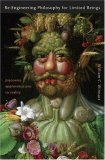
Harvard University Press page & excerpt
In an interview Wimsatt says:
“Complex systems are messy …And human beings make errors trying to understand them. That’s OK. The goal should not be to eliminate errors, but to recognize and metabolize them.”
That is because, Wimsatt explains, “humans and organisms are engineered to be error-tolerant but still reliable. We learn, and re-engineer to do better. Evolved systems are complex and chaotic, but nonetheless ordered and robust.”
Comments (1)
- philosophy of mind,reality
Maybe these two books go together! (although we had ‘The Answer ‘ before ‘The Riddle’ was posed…)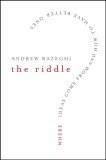
The Riddle: Where Ideas Come From and How to Have Better Ones by Andrew Razeghi, recently published by Jossey-Bass.
From the book description:
Science has shown that it’s possible to create conditions under which the mind is more prepared to have insights, or “a-ha! moments.” In this fascinating book, Andrew Razeghi examines the precursors to creative insight and offers clear-cut methods for making “Eureka moments” routine practice rather than lucky accidents. Combining the latest scientific research, interviews with current innovators, and studies of history’s most creative minds, he dissects the creative process and presents a practical approach for inspiring innovation.
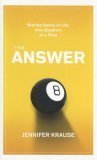
The Answer: Making Sense of Life, One Question at a Time by Jennifer Krause
By examining seven thought-provoking questions, “The Answer” offers an unexpected approach to discovering the truths, wisdom, and insights that will transform our lives in sustainable ways. By trusting questions as a driving, natural, and nourishing force in life, we can begin to trust ourselves to find the answers that are right for us.
Comments (0)
- new books