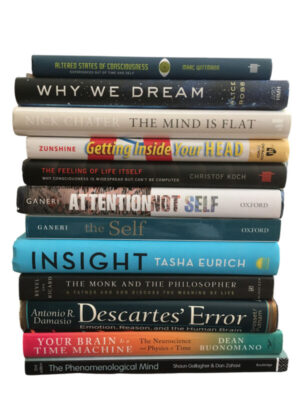
100 most influential works in cognitive science – Cognitive Science Millennium Project
July 10, 2007
Center for Cognitive Sciences, University of Minnesota has a list of the 100 most influential cognitive science works from the 20th century.
Here are the top five:
- Syntactic Structures
by Noam Chomsky (1957, 2nd ed. 2002)
- Vision: A Computational Investigation into the Human Representation and Processing of Visual Information
by David Marr (1982)
- “Computing machinery and intelligence” by A.M. Turing (1950) (Mind, 59, 433-460)
- The Organization of Behavior: A Neuropsychological Theory by D.O. Hebb (1949, 2002)
- Parallel Distributed Processing: Explorations in the Microstructure of Cognition : Foundations (Parallel Distributed Processing)
by D.E. Rumelhart, J.L. McClelland (1986)
 by Mark Johnson is coming soon from the University of Chicago Press, with a scheduled release date of July 15 (according to Amazon.com).
  Johnson is co-author with George Lakoff of
  and
and  . Johnson is also the author of
  .
.
 , has recently published
  .
.

 by Liam Durcan (neurologist at a war crimes trial)
 by Richard Powers (Capgras syndrome)
 by Steven Hall (“conceptual shark” attack)
 by Dan Lloyd (consciousness theory plus murder mystery)
 by Lawrence Shainberg (brain damage, brain surgery)
 by Ian McEwan (recommended in
  )
)