“Bias and Belief – Key References”
February 1, 2008
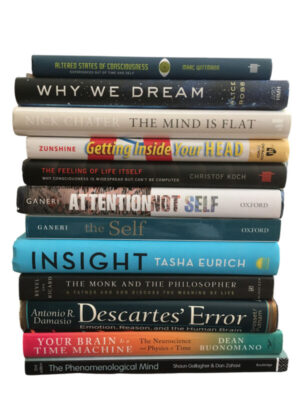
Bias and Belief wiki has a page of Key References, listing books for non-specialists and for specialists on cognitive biases. Many of the books have separate wiki pages with summaries or reviews.
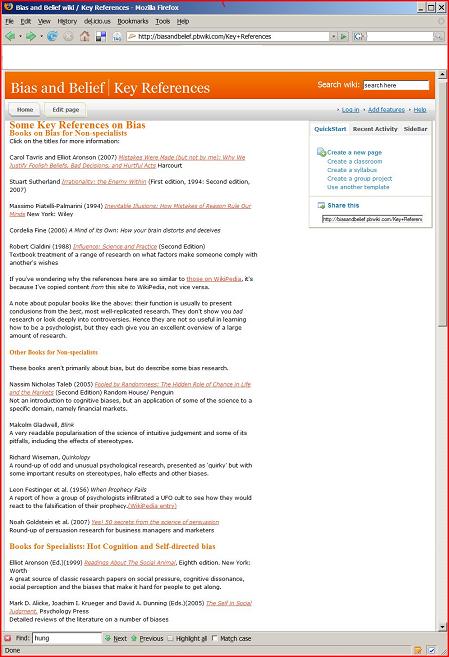
books on the mind, consciousness, cognitive science…
February 1, 2008
Bias and Belief wiki has a page of Key References, listing books for non-specialists and for specialists on cognitive biases. Many of the books have separate wiki pages with summaries or reviews.
January 30, 2008
 Today I attended a lecture by Dr. Paul Ekman (see also Wikipedia article) on the UC Berkeley campus. Dr. Ekman spoke about his early research showing the universality of facial expressions of emotion, then demonstrated a computer-based system for training people to recognize microexpressions (brief expressions that indicate concealed emotion), and discussed work in progress on facial expressions warning of dangerous intent.
He said “Emotions do not reveal their source,” so fear can be detected but not the reason, the target or the trigger for the emotion.
Something to look forward to next fall – a new book based on a dialog between Ekman and the Dalai Lama; I had written down the title as ‘Emotional Awareness’ but on his website the title is shown as ‘Steps Towards Emotional Balance’ (and not even at the pre-order stage on Amazon yet.)
January 28, 2008
In On Being Certain: Believing You Are Right Even When You’re Not, neurologist Robert Burton challenges the notions of how we think about
what we know. He shows that the feeling of certainty we have when we “know” something comes from sources beyond our control and knowledge. In fact, certainty is a mental sensation, rather than evidence of fact. Because this “feeling of knowing” seems like confirmation of knowledge, we tend to think of it as a product of reason. But an increasing body of evidence suggests that feelings such as certainty stem from primitive areas of the brain, and are independent of active, conscious reflection and reasoning. The feeling of knowing happens to us; we cannot make it happen.
January 27, 2008
One of the new books I want to highlight is From Neurons to Notions: Brains, Mind and Meaning (coming soon in the US, already available in the UK) by Chris Nunn, a psychiatrist and an editor of the Journal of Consciousness Studies.
From the book description:
Anyone interested in exploring the dynamics of mind and memory, how we experience time, and how ideas seem to have a life of their own, will enjoy this highly readable and enjoyable account written by a specialist in consciousness studies. Chris Nunn builds a picture of our minds suitable for the new century, a picture that is rapidly developing in ways very different from predominant twentieth-century views. Along the way, he offers an understanding of how our minds behave during sleep, how the craze for alien abduction came about, and what our sense of beauty may be based on. Final chapters extend these ideas to cover near-death and mystical experiences, among other topics. Nunn’s account ranges over theories and research evidence of the last one hundred and fifty years, and brings us right up to date with the views of modern brain scientists.
The Author’s website has a Table of Contents and Introduction.
Nunn is also the author of De La Mettrie’s Ghost: The Story of Decisions (Macmillan, 2005) and Awareness: What It Is, What It Does (Routledge, 1995 – “Search Inside” available at Amazon).
Comments (0) - cognitive science,consciousness,mind,new books
January 18, 2008
Big Brain: The Origins and Future of Human Intelligence by Gary Lynch and Richard Granger (Palgrave-MacMillan)
Our big brains, our language ability, and our intelligence make us uniquely human. But barely 10,000 years ago (a mere blip in evolutionary time) human-like creatures called “Boskops” flourished in South Africa. They possessed extraordinary features: forebrains roughly 50% larger than ours, and estimated IQs to match–far surpassing our own. Many of these huge fossil skulls have been discovered over the last century, but most of us have never heard of this scientific marvel.
Prominent neuroscientists Gary Lynch and Richard Granger compare the contents of the Boskop brain and our own brains today, and arrive at startling conclusions about our intelligence and creativity. Connecting cutting-edge theories of genetics, evolution, language, memory, learning, and intelligence, Lynch and Granger show the implications of large brains for a broad array of fields, from the current state of the art in Alzheimer’s and other brain disorders, to new advances in brain-based robots that see and converse with us, and the means by which neural prosthetics– replacement parts for the brain–are being designed and tested. The authors demystify the complexities of our brains in this fascinating and accessible book, and give us tantalizing insights into our humanity–its past, and its future.