September 4, 2008
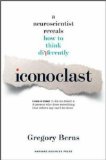
Iconoclast: A Neuroscientist Reveals How to Think Differently by Gregory Burns (Harvard Business Press, 2008) is indicated as “In Stock” at Amazon even though the publication date is listed for later this month. Amazon has “Search Inside” for this book so an excerpt is available. There is also a preview available through the publisher’s website.
Product Description
No organization can survive without iconoclasts — innovators who single-handedly upturn conventional wisdom and manage to achieve what so many others deem impossible.
Though indispensable, true iconoclasts are few and far between. In Iconoclast, neuroscientist Gregory Berns explains why. He explores the constraints the human brain places on innovative thinking, including fear of failure, the urge to conform, and the tendency to interpret sensory information in familiar ways.
Through vivid accounts of successful innovators ranging from glass artist Dale Chihuly to physicist Richard Feynman to country/rock trio the Dixie Chicks, Berns reveals the inner workings of the iconoclast’s mind with remarkable clarity. Each engaging chapter goes on to describe practical actions we can each take to understand and unleash our own potential to think differently — such as seeking out new environments, novel experiences, and first-time acquaintances.
Packed with engaging stories, science-based insights, potent practices, and examples from a startling array of disciplines, this engaging book will help you understand how iconoclasts think and equip you to begin thinking more like an iconoclast yourself.
Comments (0)
- cognitive science,new books
August 21, 2008

Too bad we’ll have to wait until October to find out What Should We Do with Our Brain? by Catherine Malabou.
Product description:
Recent neuroscience, in replacing the old model of the brain as a single centralized locus of control, has emphasized a feature of the brain called plasticity, whereby our brain develops and changes throughout an entire lifetime. Through this plasticity, our brain exists as a historical product; it develops in interaction with the environment, through human experience. Hence there is a thin frontier between the organization of the nervous system and the political and social organization conditioning and conditioned by that experience. The new way of speaking about the brain is a mirror image of the capitalist world in which we now live. “Plasticity,” in connection with such an image, can have two meanings. In its neo-liberal meaning, “plasticity” amounts to “flexibility” — in economics and management theory, “flexible” has become a buzzword. The plastic brain might thus represent just another style of power which, although less centralized, is still a means of control. But in this book, Catherine Malabou proposes a more radical meaning for plasticity, one that not only adapts itself to existing circumstances, but forms a margin of freedom to intervene, to change the circumstances. Such an understanding of this concept opens up a transformative aspect of the neurosciences, opposed to their aspect of domination and control. In insisting on this proximity between the neurosciences and the social sciences, Malabou applies to the brain Marx’s well-known phrase about history: people make their own brain, but they do not know it. This book is a call to such knowledge.
Comments (0)
- cognitive science,new books
August 19, 2008
The Walrus has a review article on evolutionary psychology, discussing or citing a number of books starting with Darwin’s The Expression of the Emotions in Man and Animals and including What Science Offers the Humanities: Integrating Body and Culture by Edward Slingerland (Cambridge University Press, 2008), plus The Literary Animal: Evolution and the Nature of Narrative ed. by Jonathan Gottschall and David Sloan Wilson (Northwestern University Press, 2005).
The Walrus article concludes by citing recent research by Takahiko Masuda:
When presented with a smiling face against a background of contrary expressions, the Japanese, unlike the North Americans, had significant doubts about whether the face truly represented “happiness.” Much more than the North Americans, the Japanese took context into account and concluded that, despite the smiley face, an individual surrounded by unhappy people might not feel all that happy. Like the display rules Ekman had formulated from his own analysis of American and Japanese cultures, Masuda’s work points to what might be termed “context rules” that affect the actual experiencing of emotion.
Comments (1)
- cognitive science,culture
August 13, 2008
“Computer science helps psychiatrist Niall McLaren explain mental disorders”
excerpt:
Dr McLaren says, ‘Like computer processing, a substantial part of human mental life consists of the silent, rapid manipulation of information.
‘Normal mental function falls quite readily into two distinct realms, the phenomenal or experiential, and the psychological or knowledge-based.
‘The differences between what we know and what we experience is exclusive: knowledge is acquired gradually and can be conveyed to another person, whereas the phenomenal contents arrive immediately and are wholly private experiences.”
…
Dr McLaren says, ‘So my theory is that the mind has two irreducibly mental components, cognition and conscious experience, which together account for the whole of mental life.”
Dr. McLaren is the author of Humanizing Madness: Psychiatry and the Cognitive Neurosciences.
Comments (0)
- cognitive science,consciousness,mind
August 10, 2008

Daniel J. Levitin, author of This Is Your Brain on Music: The Science of a Human Obsession, has a new book coming out this month (Aug. 19 from Dutton) —The World in Six Songs: How the Musical Brain Created Human Nature, one of Amazon’s Best Books of August in nonfiction.
From the book website:
“What was the first song that humans sang and why did music become an integral part of human life from the beginning? Levitin tells the story of the co-evolution of music and of the human brain, how each one influenced the development of the other over tens of thousands of years. An unprecedented blend of science and art, Daniel Levitin’s best-selling debut, This Is Your Brain on Music (translated into 8 languages), changed the way we think about how music gets in our heads. Now in what is being called a tour de force by leading scientists, he shows how six specific forms of music played a pivotal role in creating human culture and society as we know it. Levitin masterfully weaves together the story of human evolution, music, anthropology, psychology and biology from the dawn of homo sapiens to the present.”
Comments (0)
- cognitive science,culture,new books