October 20, 2008
The Overflowing Brain: Information Overload and the Limits of Working Memory by Torkel Klingberg (Oxford University Press, 2008) (“Search Inside the book” available at Amazon).
Product Description
As the pace of technological change accelerates, we are increasingly experiencing a state of information overload. Statistics show that we are interrupted every three minutes during the course of the work day. Multitasking between email, cell-phone, text messages, and four or five websites while listening to an iPod forces the brain to process more and more information at greater and greater speeds. And yet the human brain has hardly changed in the last 40,000 years.
Are all these high-tech advances overtaxing our Stone-Age brains or is the constant flood of information good for us, giving our brains the daily exercise they seem to crave? In The Overflowing Brain, cognitive scientist Torkel Klingberg takes us on a journey into the limits and possibilities of the brain. He suggests that we should acknowledge and embrace our desire for information and mental challenges, but try to find a balance between demand and capacity. Klingberg explores the cognitive demands, or “complexity,” of everyday life and how the brain tries to meet them. He identifies different types of attention, such as stimulus-driven and controlled attention, but focuses chiefly on “working memory,” our capacity to keep information in mind for short periods of time. Dr Klingberg asserts that working memory capacity—long thought to be static and hardwired in the brain—can be improved by training, and that the increasing demands on working memory may actually have a constructive effect: as demands on the human brain increase, so does its capacity.
The book ends with a discussion of the future of brain development and how we can best handle information overload in our everyday lives. Klingberg suggests how we might find a balance between demand and capacity and move from feeling overwhelmed to deeply engaged.
See also: Author’s web page
Comments (0)
- cognitive science,mind
October 10, 2008
A Natural History of Seeing: The Art and Science of Vision by Simon Ings (W.W. Norton, 2008) was published originally in the UK under the title ‘The Eye: A Natural History‘
Product Description
The science, history, philosophy, and mythology of how and why we see the way we do.
We spend about one-tenth of our waking hours completely blind. Only one percent of what we see is in focus at any one time. There is no direct fossil evidence for the evolution of the eye. In graceful, accessible prose, novelist and science writer Simon Ings sets out to solve these and other mysteries of seeing.
A Natural History of Seeing delves into both the evolution of sight and the evolution of our understanding of sight. It gives us the natural science—the physics of light and the biology of animals and humans alike—while also addressing Leonardo’s theories of perception in painting and Homer’s confused and strangely limited sense of color. Panoramic in every sense, it reaches back to the first seers (and to ancient beliefs that vision is the product of mysterious optic rays) and forward to the promise of modern experiments in making robots that see.
See also: Author’s website and blog.
Comments (0)
- cognitive science,new books
September 30, 2008
Andy Clark‘s new book Supersizing the Mind: Embodiment, Action, and Cognitive Extension (Philosophy of the Mind), mentioned as a forthcoming title last March in David Chalmers’s blog, is now available. The foreword by Chalmers is online.
Product Description
When historian Charles Weiner found pages of Nobel Prize-winning physicist Richard Feynman’s notes, he saw it as a “record” of Feynman’s work. Feynman himself, however, insisted that the notes were not a record but the work itself. In Supersizing the Mind, Andy Clark argues that our thinking doesn’t happen only in our heads but that “certain forms of human cognizing include inextricable tangles of feedback, feed-forward and feed-around loops: loops that promiscuously criss-cross the boundaries of brain, body and world.” The pen and paper of Feynman’s thought are just such feedback loops, physical machinery that shape the flow of thought and enlarge the boundaries of mind. Drawing upon recent work in psychology, linguistics, neuroscience, artificial intelligence, robotics, human-computer systems, and beyond, Supersizing the Mind offers both a tour of the emerging cognitive landscape and a sustained argument in favor of a conception of mind that is extended rather than “brain-bound.” The importance of this new perspective is profound. If our minds themselves can include aspects of our social and physical environments, then the kinds of social and physical environments we create can reconfigure our minds and our capacity for thought and reason.
Oxford University Press has the Table of Contents.
It’s unclear how this book relates to Clark’s earlier Natural Born Cyborgs, but it appears to be a more academic/philosophical treatment of the extended-mind concept.
Comments (1)
- cognitive science,new books,philosophy of mind
September 9, 2008
Barry C. Smith discusses neuroscience topics — such as blindsight, mirror neurons, and alien hand syndrome — in relation to philosophy at Philosophy Bites.
Comments (0)
- cognitive science,philosophy of mind
September 6, 2008
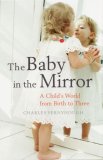
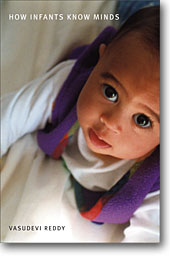
“Babies and the sticky mitten test: how babies of only three months can learn to have a theory of mind” by Alison Gopnik in the Times Literary Supplement (Sept. 3, 2008) reviews Charles Fernyhough’s The Baby in the Mirror and Vasudevi Reddy’s How Infants Know Minds. (The TLS article spells the first author’s name “Ferneyhough” but the book cover shows it as “Fernyhough.”)
Gopnik:
Ferneyhough’s book is a memoir of his daughter’s early childhood, interspersed with information about developmental psychology. Reddy’s book is essentially academic. She explicitly argues that we should reject the idea of an objective developmental science in favour of a more engaged “second-person” approach. Both books provide exceptionally sensitive, careful and thoughtful descriptions of the everyday lives of babies, particularly the authors’ own babies. Reddy’s book is full of eloquent and informative descriptions of the playful way that even young infants tease, act coy, and generally muck about with their parents. Ferneyhough is primarily a novelist, and his book is an elegantly written, warm, thoughtful, novelistic account of his first three years with his daughter Athena.
Childhood is central to many memoirs and novels, but good descriptions of very early childhood, good stories about babies, are surprisingly rare. Perhaps it is because becoming a parent is so emotionally overwhelming that it undermines the detachment that is necessary for either literature or science. Both Reddy and, especially, Ferneyhough do a lovely job of conveying what life with a baby is like. Neither book, however, is very effective at conveying what the science of cognitive development is like.
The article goes on to describe some recent research in cognitive development, including the “sticky mitten test”…
Comments (1)
- cognitive science