[ View menu ]

Archive for 'cognitive science'

Guardian review: “In search of the God neuron”

December 27, 2008

Steven Rose reviews four books in today’s Guardian (27 Dec 2008):

Rose (author of The 21st Century Brain: Explaining, Mending and Manipulating the Mind) reminds us that “it is not brains that have concepts or acquire knowledge. It is people, using their brains” and concludes:

If humans do have an evolved sense of morality, or indeed of beauty or romantic love, the evidence shows that in practice our standards are remarkably flexible. Under these circumstances, to seek for their neurobiological correlates may be on a par with hunting the crock of gold at the end of the rainbow. With the difference that the gold could at least be put to practical use.

Comments (0) - cognitive science,mind

Guest post – Jason Pomerantz reviews ‘My Stroke of Insight’

December 26, 2008

Jason Pomerantz shares his review of My Stroke of Insight below. (See also: more of Jason’s reviews)

[If anyone else would like to chime in, please get in touch using the contact form in the sidebar. Reviews or other thoughts are welcome: What are you reading now? What was your favorite book in 2008? Do you have a “top 10 list”?]My Stroke of Insight
It’s hard to give a book a bad review when the person who wrote it is so obviously deserving of sympathy and admiration. Unfortunately, I have no choice with My Stroke of Insight, by Jill Bolte Taylor.

After years of training and working as a brain researcher, Ms. Taylor suffered a major stroke. Enough of her brain remained functional during the event that she was able to consciously decide to study what was happening to her, from the inside. After surgery and eight years of effort she managed to make a full recovery and fulfill her determination to tell her story.

When I learned of this book, I was fascinated. I was looking forward to reading a scientific discussion of the mind/body problem – the nature of consciousness and its relationship to the physical matter of our brain – from a unique perspective.

Ms. Taylor did deliver some of that, particularly at the start. She very effectively describes what she felt and experienced as various parts of her brain shut down. Those sections are fascinating.

Unfortunately, far more of the book is dominated by a New Age haze. It’s filled with discussions of positive and negative energy and our connectedness with the universe. It preaches endlessly that, if only we would all listen to the trillions of molecular geniuses that make up our bodies there would be world harmony and we’d spend our time hugging each other. Something like that, anyway. My mind sort of drifted.

The stroke that afflicted Taylor disabled the left side of her brain. As anyone with even a passing familiarity to neuroscience has heard explained a thousand times each side of our brains serve very different functions. The left more-or-less controls our linguistic and analytical selves, the right our intuitive and holistic. In an ordinarily functioning brain the two hemispheres are connected by a thick bunch of neurons called the ‘corpus callosum’, so much so that we perceive ourselves as one unitary being.

When her left side went out, Taylor’s consciousness became completely dominated by her right brain. She no longer thought in words and she lost the distinction between her body and the rest of the universe. Further, according to Taylor, the left brain controls our ability to weave individual moments of perception together into coherent narratives. Without it, she felt herself completely living in individual moments of time, focused intensely on the now.

If all of that sounds familiar, it’s because what one person calls symptoms, another calls Nirvana. Through a freak medical event Taylor achieved, almost instantly, exactly what mystics and meditators spend lifetimes seeking.

Taylor does a good job conveying her own ambiguity at the experience. She quickly grasps the value of her new state of being: A joy at her sense of oneness with the universe. But she also understands the tragedy of the loss of her rational self, particularly her inability to communicate with others.

It’s an inherently gripping story and parts held me rapt. But then, somewhere around the middle of the book, Taylor takes off the lab coat of a scientist and puts on the robes of a yogi. We hear far less about neurons and MRI’s and cognitive systems and far more about peace, love and understanding and universal compassion and we are all made of star stuff. All noble sentiments, but also very, very dull.

Taylor clearly touched something and she desperately wants us all to share the positive aspects of her experience. But the fuzzy, crunchy granola tendencies of her writing make it all lost in a hippy-dippy fog.

Another odd problem is that, for a brain scientist, Taylor exhibits a bizarre amount of mind/body confusion: She is constantly listening to her brain, and talking to her brain, and ordering her brain around. It all begs the question, what exactly is doing the listening and the talking and the ordering? My left side would like to suggest that it would have been far more clear for her to write that one part of her brain was listening to, talking to and ordering around other parts. But, I suppose, that would have lessened the right brain poetry.

My Stoke of Insight is the rare book that manages to be scientific and New Age at the same time. I’m only sorry there wasn’t more science and less New Age.

On a related note…

For a more consistently interesting discussion of the problem of multiple minds struggling with each other in our brains, read First Person Plural, by Paul Bloom, published in The Atlantic. (Bloom can also be seen in a fascinating Blogging Heads Diavlog with Will Wilkinson.)

[Reprinted with permission from http://www.fiddleandburn.com/me/#6]

Comments (3) - cognitive science,consciousness,mind

new book: ‘Buyology’

November 1, 2008

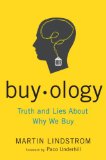
Buyology: Truth and Lies About Why We Buy by Martin Lindstrom (Doubleday Business, 2008)

Product Description
How much do we know about why we buy? What truly influences our decisions in today’s message-cluttered world? An eye-grabbing advertisement, a catchy slogan, an infectious jingle? Or do our buying decisions take place below the surface, so deep within our subconscious minds, we’re barely aware of them?

In BUYOLOGY, Lindstrom presents the astonishing findings from his groundbreaking, three-year, seven-million-dollar neuromarketing study, a cutting-edge experiment that peered inside the brains of 2,000 volunteers from all around the world as they encountered various ads, logos, commercials, brands, and products. His startling results shatter much of what we have long believed about what seduces our interest and drives us to buy. Among his finding:

Gruesome health warnings on cigarette packages not only fail to discourage smoking, they actually make smokers want to light up.

Despite government bans, subliminal advertising still surrounds us – from bars to highway billboards to supermarket shelves.

“Cool” brands, like iPods trigger our mating instincts.

Other senses – smell, touch, and sound – are so powerful, they physically arouse us when we see a product.

Sex doesn’t sell. In many cases, people in skimpy clothing and suggestive poses not only fail to persuade us to buy products – they often turn us away .

Companies routinely copy from the world of religion and create rituals – like drinking a Corona with a lime – to capture our hard-earned dollars.

Filled with entertaining inside stories about how we respond to such well-known brands as Marlboro, Nokia, Calvin Klein, Ford, and American Idol, BUYOLOGY is a fascinating and shocking journey into the mind of today’s consumer that will captivate anyone who’s been seduced – or turned off – by marketers’ relentless attempts to win our loyalty, our money, and our minds. Includes a foreword by Paco Underhill.

The author’s website has chapter summaries and more.

“Buyology Roundup” at Neuromarketing collects reactions to the book.

Comments (0) - cognitive science,culture,new books

Neuroscience news at Silobreaker

October 29, 2008

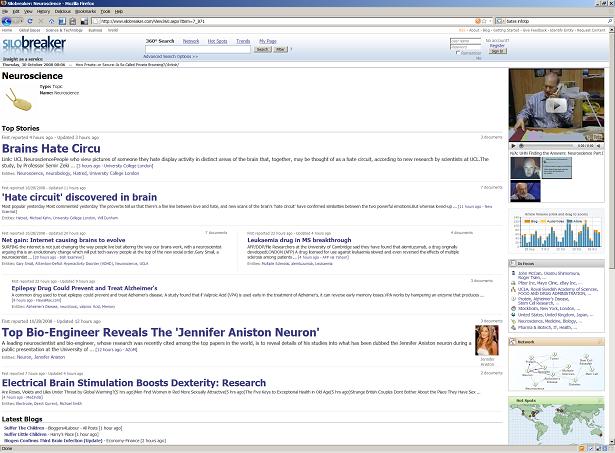
The current InfoTip from information broker Mary Ellen Bates features Silobreaker, which is primarily a news site, but they do have a neuroscience news page. (Too bad there’s a typo on the top story right now but maybe I will be able to update the screenshot later.) As Bates mentions, there are some interesting data visualization tools on the right sidebar, including displays of article volume, media trends, and a network of related concepts.

Comments (0) - cognitive science

new book: ‘Creating Scientific Concepts’

October 24, 2008

Creating Scientific Concepts (Bradford Books) by Nancy Nersessian (MIT Press, 2008) (“Search Inside” the book available at Amazon)

Product Description
How do novel scientific concepts arise? In Creating Scientific Concepts, Nancy Nersessian seeks to answer this central but virtually unasked question in the problem of conceptual change. She argues that the popular image of novel concepts and profound insight bursting forth in a blinding flash of inspiration is mistaken. Instead, novel concepts are shown to arise out of the interplay of three factors: an attempt to solve specific problems; the use of conceptual, analytical, and material resources provided by the cognitive-social-cultural context of the problem; and dynamic processes of reasoning that extend ordinary cognition.

Focusing on the third factor, Nersessian draws on cognitive science research and historical accounts of scientific practices to show how scientific and ordinary cognition lie on a continuum, and how problem-solving practices in one illuminate practices in the other. Her investigations of scientific practices show conceptual change as deriving from the use of analogies, imagistic representations, and thought experiments, integrated with experimental investigations and mathematical analyses. She presents a view of constructed models as hybrid objects, serving as intermediaries between targets and analogical sources in bootstrapping processes. Extending these results, she argues that these complex cognitive operations and structures are not mere aids to discovery, but that together they constitute a powerful form of reasoning—model-based reasoning—that generates novelty. This new approach to mental modeling and analogy, together with Nersessian’s cognitive-historical approach, makes Creating Scientific Concepts equally valuable to cognitive science and philosophy of science.

See also: Author’s webpage

Comments (1) - cognitive science,new books