[ View menu ]

Archive for 'cognitive science'

coming soon – ‘Play: How It Shapes the Brain, Opens the Imagination and Invigorates the Soul’

March 3, 2009
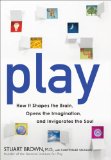
play

Play: How It Shapes the Brain, Opens the Imagination, and Invigorates the Soul by Dr. Stuart Brown and Christopher Vaughan (Avery, 2009) should be available on March 5.

Product Description
From a leading expert, a groundbreaking book on the science of play, and its essential role in fueling our intelligence and happiness throughout our lives.

We’ve all seen the happiness in the face of a child while playing in the school yard. Or the blissful abandon of a golden retriever racing with glee across a lawn. This is the joy of play. By definition, play is purposeless and all-consuming. And, most important, it’s fun.

As we become adults, taking time to play feels like a guilty pleasure—a distraction from “real” work and life. But as Dr. Stuart Brown illustrates, play is anything but trivial. It is a biological drive as integral to our health as sleep or nutrition. In fact, our ability to play throughout life is the single most important factor in determining our success and happiness.

Dr. Brown has spent his career studying animal behavior and conducting more than six thousand “play histories” of humans from all walks of life—from serial murderers to Nobel Prize winners. Backed by the latest research, Play explains why play is essential to our social skills, adaptability, intelligence, creativity, ability to problem solve, and more. Play is hardwired into our brains—it is the mechanism by which we become resilient, smart, and adaptable people.

Beyond play’s role in our personal fulfillment, its benefits have profound implications for child development and the way we parent, education and social policy, business innovation, productivity, and even the future of our society. From new research suggesting the direct role of three-dimensional-object play in shaping our brains to animal studies showing the startling effects of the lack of play, Brown provides a sweeping look at the latest breakthroughs in our understanding of the importance of this behavior. A fascinating blend of cutting-edge neuroscience, biology, psychology, social science, and inspiring human stories of the transformative power of play, this book proves why play just might be the most important work we can ever do.

Dr. Stuart Brown is the founder of the National Institute for Play. A sample chapter is available at the book’s website.

Thanks to Eric from Open Learning for the book suggestion!

Comments (0) - cognitive science,culture,new books,psychology

neurofiction: ‘Passage’ by Connie Willis

February 22, 2009

Passage

Passage by Connie Willis (Bantam, 2001, 2002) is a “neurofictional” account of scientific research on near-death experiences. Willis is usually classified as a science fiction writer, but here that would be in the sense of “fiction about science.” The premise is that a researcher has found a psychoactive drug that simulates the near-death experience. He enlists psychologist Joanna Lander to interview research subjects but she soon volunteers to take the drug herself and this intensifies her quest to discover the meaning of the experience.

The back of the book has a rather odd blurb from Newsday that calls Willis “a true heir to John Donne, Kurt Godel and Preston Sturges….” so try to imagine that combination in a novel! I found the story compelling and consumed the whole 780 pages over about three days.

Comments (0) - cognitive science,consciousness,fiction

new book – ‘Predicative Minds: The Social Ontogeny of Propositional Thinking’

February 20, 2009

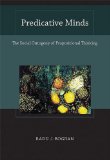
Predicative Minds

Predicative Minds: The Social Ontogeny of Propositional Thinking (Bradford Books) by Radu Bogdan (MIT Press, 2009)

Product Description
The predicative mind singles out and represents an item in order to attribute to it a property, a relation, an action, an evaluation; it thinks, and says, of a house that it is big, of a car that it is to the left of the house, of a cat that it is about to jump, of a hypothesis that it is plausible. The capacity to predicate appears to be neither innate nor learned, yet it is universal among humans. Puzzling in evolutionary, developmental, and philosophical terms, the mental competence for predication still awaits a coherent and plausible explanation. In this exploration of the predicative roots of human thinking, Radu Bogdan takes up the challenge.

Bogdan argues that predication is not only an outcome of development but also a by-product of uniquely human features of development, many of them social in nature and unrelated to representation, cognition, and thinking. Humans develop predicative minds for disparate reasons, which bear initially on physiological coregulation, affective and manipulative communication, and the socially shared acquisition of words. Once developed, the competence for predication in turn redesigns human thinking and communication. Predication is at the heart of conscious, deliberate, explicit, and language-based human thinking, and it is the fuel of higher mental activities. Understanding the uniqueness and representational power of the human mind, Bogdan contends, requires an explanation of why and how predication came to be.

Comments (0) - cognitive science,new books,philosophy of mind

new book – ‘Why We Make Mistakes’

February 16, 2009

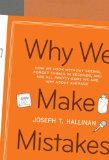
Why We Make Mistakes

Why We Make Mistakes: How We Look Without Seeing, Forget Things in Seconds, and Are All Pretty Sure We Are Way Above Average by Joseph T. Hallinan (Broadway, 2009).

According to Amazon, this book is being released tomorrow, but my local Barnes & Noble had it on the shelves yesterday.

Book Description
We forget our passwords. We pay too much to go to the gym. We think we’d be happier if we lived in California (we wouldn’t), and we think we should stick with our first answer on tests (we shouldn’t). Why do we make mistakes? And could we do a little better?

We human beings have design flaws. Our eyes play tricks on us, our stories change in the retelling, and most of us are fairly sure we’re way above average. In Why We Make Mistakes, journalist Joseph T. Hallinan sets out to explore the captivating science of human error–how we think, see, remember, and forget, and how this sets us up for wholly irresistible mistakes.

In his quest to understand our imperfections, Hallinan delves into psychology, neuroscience, and economics, with forays into aviation, consumer behavior, geography, football, stock picking, and more. He discovers that some of the same qualities that make us efficient also make us error prone. We learn to move rapidly through the world, quickly recognizing patterns–but overlooking details. Which is why thirteen-year-old boys discover errors that NASA scientists miss—and why you can’t find the beer in your refrigerator.

Why We Make Mistakes is enlivened by real-life stories–of weathermen whose predictions are uncannily accurate and a witness who sent an innocent man to jail–and offers valuable advice, such as how to remember where you’ve hidden something important. You’ll learn why multitasking is a bad idea, why men make errors women don’t, and why most people think San Diego is west of Reno (it’s not).

Why We Make Mistakes will open your eyes to the reasons behind your mistakes–and have you vowing to do better the next time.

The book’s website has excerpts, links, and a blog.

Here’s a review, from Cheryl Truman on books.

Comments (1) - cognitive science,new books,psychology

new book – Doing without Concepts

February 11, 2009

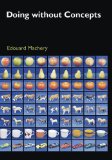
Doing Without Concepts

Doing without Concepts by Edouard Machery (Oxford University Press, 2009).

Publisher’s description:

Over recent years, the psychology of concepts has been rejuvenated by new work on prototypes, inventive ideas on causal cognition, the development of neo-empiricist theories of concepts, and the inputs of the budding neuropsychology of concepts. But our empirical knowledge about concepts has yet to be organized in a coherent framework.

In Doing without Concepts, Edouard Machery argues that the dominant psychological theories of concepts fail to provide such a framework and that drastic conceptual changes are required to make sense of the research on concepts in psychology and neuropsychology. Machery shows that the class of concepts divides into several distinct kinds that have little in common with one another and that for this very reason, it is a mistake to attempt to encompass all known phenomena within a single theory of concepts. In brief, concepts are not a natural kind. Machery concludes that the theoretical notion of concept should be eliminated from the theoretical apparatus of contemporary psychology and should be replaced with theoretical notions that are more appropriate for fulfilling psychologists’ goals. The notion of concept has encouraged psychologists to believe that a single theory of concepts could be developed, leading to useless theoretical controversies between the dominant paradigms of concepts. Keeping this notion would slow down, and maybe prevent, the development of a more adequate classification and would overshadow the theoretical and empirical issues that are raised by this more adequate classification. Anyone interested in cognitive science’s emerging view of the mind will find Machery’s provocative ideas of interest.

See also: “Concepts and Experimental Philosophy” and “Doing Without Concepts” at Brains

Comments (1) - cognitive science,new books,philosophy of mind