April 5, 2009

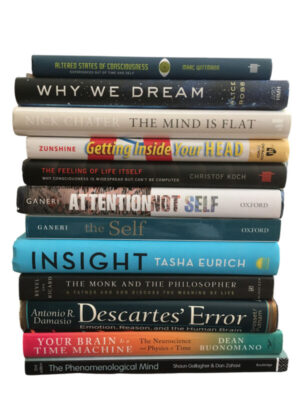
Wednesday Is Indigo Blue: Discovering the Brain of Synesthesia by Richard E. Cytowic and David M. Eagleman (MIT Press, 2009)
Product description from the publisher:
A person with synesthesia might feel the flavor of food on her fingertips, sense the letter J as shimmering magenta or the number 5 as emerald green, hear and taste her husband’s voice as buttery golden brown. Synesthetes rarely talk about their peculiar sensory gift—believing either that everyone else senses the world exactly as they do, or that no one else does. Yet synesthesia occurs in one in twenty people, and is even more common among artists. One famous synesthete was novelist Vladimir Nabokov, who insisted as a toddler that the colors on his wooden alphabet blocks were “all wrong.” His mother understood exactly what he meant because she, too, had synesthesia. Nabokov’s son Dmitri, who recounts this tale in the afterword to this book, is also a synesthete—further illustrating how synesthesia runs in families.
In Wednesday Is Indigo Blue, pioneering researcher Richard Cytowic and distinguished neuroscientist David Eagleman explain the neuroscience and genetics behind synesthesia’s multisensory experiences. Because synesthesia contradicted existing theory, Cytowic spent twenty years persuading colleagues that it was a real—and important—brain phenomenon rather than a mere curiosity. Today scientists in fifteen countries are exploring synesthesia and how it is changing the traditional view of how the brain works.
Cytowic and Eagleman argue that perception is already multisensory, though for most of us its multiple dimensions exist beyond the reach of consciousness. Reality, they point out, is more subjective than most people realize. No mere curiosity, synesthesia is a window on the mind and brain, highlighting the amazing differences in the way people see the world.
See also: Dr. Cytowic’s website, Dr. Eagleman’s website

Eagleman is also the author of a recent fictional work: Sum: Forty Tales from the Afterlives (which has a Kindle edition).
Comments (1)
- cognitive science,fiction,new books
March 31, 2009
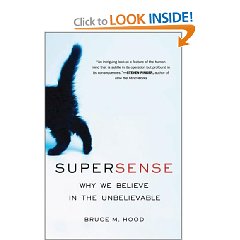
SuperSense: Why We Believe in the Unbelievable by cognitive scientist Bruce M. Hood (HarperOne, 2009) is due out on April 7. Amazon has a video introduction from the author, plus a pdf of the first chapter.
Product Description from the publisher:
The majority of the world’s population is religious or believes in supernatural phenomena. In the United States, nine out of every ten adults believe in God, and a recent Gallup poll found that about three out of four Americans believe in some form of telepathy, déjà vu, ghosts, or past lives. Where does such supernatural thinking come from? Are we indoctrinated by our parents, churches, and media, or do such beliefs originate somewhere else? In SuperSense, award-winning cognitive scientist Bruce M. Hood reveals the science behind our beliefs in the supernatural.
Superstitions are common. Many of us cross our fingers, knock on wood, step around black cats, and avoid walking under ladders. John McEnroe refused to step on the white lines of a tennis court between points. Wade Boggs insisted on eating a chicken dinner before every Boston Red Sox game. President Barack Obama played a game of basketball the morning of his victory in the Iowa primary and continued the tradition on every subsequent election day.
Supernatural thinking includes loftier beliefs as well, such as the sentimental value we place on photos of loved ones, wedding rings, and teddy bears. It also includes spiritual beliefs and the hope for an afterlife. But in this modern, scientific age, why do we hold on to these behaviors and beliefs?
It turns out that belief in things beyond what is rational or natural is common to humans and appears very early in childhood. In fact, according to Hood, this “super sense” is something we’re born with to develop and is essential to the way we learn to understand the world. We couldn’t live without it!
Our minds are designed from the very start to think there are unseen patterns, forces, and essences inhabiting the world, and it is unlikely that any effort to get rid of supernatural beliefs, or the superstitious behaviors that accompany them, will be successful. These common beliefs and sacred values are essential in binding us together as a society because they help us to see ourselves connected to each other at a deeper level.
See also: Author’s blog
Comments (1)
- cognitive science,new books
March 24, 2009

Adam’s Tongue: How Humans Made Language, How Language Made Humans by Derek Bickerton (Hill & Wang, 2009)
Product description from the publisher:
How language evolved has been called “the hardest problem in science.” In Adam’s Tongue, Derek Bickerton—long a leading authority in this field—shows how and why previous attempts to solve that problem have fallen short. Taking cues from topics as diverse as the foraging strategies of ants, the distribution of large prehistoric herbivores, and the construction of ecological niches, Bickerton produces a dazzling new alternative to the conventional wisdom. Language is unique to humans, but it isn’t the only thing that sets us apart from other species—our cognitive powers are qualitatively different. So could there be two separate discontinuities between humans and the rest of nature? No, says Bickerton; he shows how the mere possession of symbolic units—words—automatically opened a new and different cognitive universe, one that yielded novel innovations ranging from barbed arrowheads to the Apollo spacecraft. Written in Bickerton’s lucid and irreverent style, this book is the first that thoroughly integrates the story of how language evolved with the story of how humans evolved. Sure to be controversial, it will make indispensable reading both for experts in the field and for every reader who has ever wondered how a species as remarkable as ours could have come into existence.
See also: review at New Scientist
Comments (0)
- cognitive science,culture,human evolution,language,new books
March 23, 2009
This book slipped by and I forgot to feature it before now: Others in Mind: Social Origins of Self-Consciousness by Philippe Rochat (Cambridge University Press, 2009)
Product description from the publisher:
Why are we so prone to guilt and embarrassment? Why do we care so much about how others see us, about our reputation? What are the origins of such afflictions? It is because we are members of a species that evolved the unique propensity to reflect upon themselves as the object of thoughts, an object of thoughts that is potentially evaluated by others. But, Philippe Rochat’s argument goes, this propensity comes from a basic fear: the fear of rejection, of being socially “banned” and ostracized. Others in Mind is about self-consciousness, how it originates and how it shapes our lives. Self-consciousness is arguably the most important and revealing of all psychological problems.
More information from the publisher, including an excerpt.
Comments (0)
- cognitive science,consciousness,culture,new books,self
March 11, 2009
Visual Thinking for Design by Colin Ware (Morgan Kauffman-Elsevier, 2008)
p. 12 “What we end up actually perceiving is the result of information about the world strongly biased according to what we are attempting to accomplish.”
Ware discusses aspects of visual perception as they relate to design, based on a model of visual thinking as an active process.
According to this new view, visual thinking is a process that has the allocation of attention as its very essence. … This new understanding leads to a revision of our thinking about the nature of visual consciousness. It is more accurate to say that we are conscious of the field of information to which we have rapid access rather than that we are immediately conscious of the world. (p. 3)
An implication for graphic design is that information display should be designed to support visual queries.
I was interested in the contrast drawn between design for narrative vs design for information seeking:
Information seekers have highly individual cognitive threads that are shaped moment-to-moment by the specific demands of the cognitive process of solving a problem. This process is internally driven. Conversely, the audience of a narrative presentation will, if they are attending, have cognitive threads that are much more similar to each other, although still far from identical because of the variety of their prior experiences. (p. 138)
Summing up near the end of the book (p. 172):
The active vision model has four broad implications for design.
1. To support the pattern-finding capability of the brain; that is, to turn information structures into patterns.
2. To optimize the cognitive process as a nested set of activities.
3. To take the economics of cognition into account, considering the cost of learning new tools and ways of seeing.
4. To think about attention at many levels and design for the cognitive thread.
A review at EagerEyes.org has a more detailed chapter-by-chapter summary.
See also: Author’s website
Comments (0)
- cognitive science