April 23, 2009
In Two Minds: Dual Processes and Beyond edited by Jonathan Evans and Keith Frankish (Oxford University Press, 2009)

(link for UK)
Product description from the publisher:
This book explores the idea that we have two minds – one that is automatic, unconscious, and fast, the other controlled, conscious, and slow. In recent years there has been great interest in so-called dual-process theories of reasoning and rationality. According to dual process theories, there are two distinct systems underlying human reasoning – an evolutionarily old system that is associative, automatic, unconscious, parallel, and fast, and a more recent, distinctively human system that is rule-based, controlled, conscious, serial, and slow. Within the former, processes are held to be innate and to use heuristics which evolved to solve specific adaptive problems. In the latter, processes are taken to be learned, flexible, and responsive to rational norms.
Despite the attention these theories are attracting, there is still poor communication between dual-process theorists themselves, and the substantial bodies of work on dual processes in cognitive psychology and social psychology remain isolated from each other. This book brings together leading researchers on dual-processes to summarize the state of the art, highlight key issues, present different perspectives, explore implications, and provide a stimulus to further work.
It includes new ideas about the human mind both by contemporary philosophers interested in broad theoretical questions about mental architecture and by psychologists specialising in traditionally distinct and isolated fields. For all those in the cognitive sciences, this is a book that will advance dual-process theorizing, promote interdisciplinary communication, and encourage further applications of dual-process approaches.
Comments (0)
- cognitive science,new books,philosophy of mind
April 19, 2009

Memory and the Computational Brain: Why Cognitive Science will Transform Neuroscience (Blackwell/Maryland Lectures in Language and Cognition) by C.R. Gallistel and Adam Philip King (Wiley-Blackwell, 2009)
Product Description
Memory and the Computational Brain offers a provocative argument that goes to the heart of neuroscience, proposing that the field can and should benefit from the recent advances of cognitive science and the development of information theory over the course of the last several decades.
* A provocative argument that impacts across the fields of linguistics, cognitive science, and neuroscience, suggesting new perspectives on learning mechanisms in the brain
* Proposes that the field of neuroscience can and should benefit from the recent advances of cognitive science and the development of information theory
* Suggests that the architecture of the brain is structured precisely for learning and for memory, and integrates the concept of an addressable read/write memory mechanism into the foundations of neuroscience
* Based on lectures in the prestigious Blackwell-Maryland Lectures in Language and Cognition, and now significantly reworked and expanded to make it ideal for students and faculty
Comments (0)
- cognitive science,new books
April 16, 2009
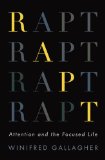
Rapt: Attention and the Focused Life by Winifred Gallagher (Penguin, 2009) also has a Kindle edition.
Product Description from the publisher:
Winifred Gallagher revolutionizes our understanding of attention and the creation of the interested life
In Rapt, acclaimed behavioral science writer Winifred Gallagher makes the radical argument that the quality of your life largely depends on what you choose to pay attention to and how you choose to do it. Gallagher grapples with provocative questions—Can we train our focus? What’s different about the way creative people pay attention? Why do we often zero in on the wrong factors when making big decisions, like where to move?—driving us to reconsider what we think we know about attention.
Gallagher looks beyond sound bites on our proliferating BlackBerries and the increased incidence of ADD in children to the discoveries of neuroscience and psychology and the wisdom of home truths, profoundly altering and expanding the contemporary conversation on attention and its power. Science’s major contribution to the study of attention has been the discovery that its basic mechanism is an either/or process of selection. That we focus may be a biological necessity— research now proves we can process only a little information at a time, or about 173 billion bits over an average life—but the good news is that we have much more control over our focus than we think, which gives us a remarkable yet underappreciated capacity to influence our experience. As suggested by the expression “pay attention,” this cognitive currency is a finite resource that we must learn to spend wisely. In Rapt, Gallagher introduces us to a diverse cast of characters—artists and ranchers, birders and scientists—who have learned to do just that and whose stories are profound lessons in the art of living the interested life. No matter what your quotient of wealth, looks, brains, or fame, increasing your satisfaction means focusing more on what really interests you and less on what doesn’t. In asserting its groundbreaking thesis—the wise investment of your attention is the single most important thing you can do to improve your well-being—Rapt yields fresh insights into the nature of reality and what it means to be fully alive.
Comments (0)
- cognitive science,consciousness,mind,new books
April 15, 2009
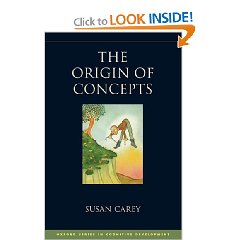
The Origin of Concepts by Susan Carey (Oxford University Press, 2009)
Product Description from the publisher:
Only human beings have a rich conceptual repertoire with concepts like tort, entropy, Abelian group, mannerism, icon and deconstruction. How have humans constructed these concepts? And once they have been constructed by adults, how do children acquire them? While primarily focusing on the second question, in The Origin of Concepts, Susan Carey shows that the answers to both overlap substantially.
Carey begins by characterizing the innate starting point for conceptual development, namely systems of core cognition. Representations of core cognition are the output of dedicated input analyzers, as with perceptual representations, but these core representations differ from perceptual representations in having more abstract contents and richer functional roles. Carey argues that the key to understanding cognitive development lies in recognizing conceptual discontinuities in which new representational systems emerge that have more expressive power than core cognition and are also incommensurate with core cognition and other earlier representational systems. Finally, Carey fleshes out Quinian bootstrapping, a learning mechanism that has been repeatedly sketched in the literature on the history and philosophy of science. She demonstrates that Quinian bootstrapping is a major mechanism in the construction of new representational resources over the course of children’s cognitive development.
Carey shows how developmental cognitive science resolves aspects of long-standing philosophical debates about the existence, nature, content, and format of innate knowledge. She also shows that understanding the processes of conceptual development in children illuminates the historical process by which concepts are constructed, and transforms the way we think about philosophical problems about the nature of concepts and the relations between language and thought.
Comments (0)
- cognitive science,new books
April 11, 2009
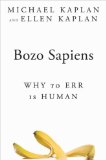
Bozo Sapiens: Why to Err is Human by Michael Kaplan and Ellen Kaplan (Bloomsbury Press, 2009) is due out next week (4/14) according to Amazon, but was available in my local bookstore today, joining the crowd of recent books on this popular topic of human error.
Product description from the publisher:
A dazzling new work of popular science and psychology for readers who enjoyed Blink, Stumbling on Happiness, or The Black Swan.
The New York Times called the Kaplans’ look at probability in everyday life, Chances Are, “a dizzying, exhilarating ride.” Now they take readers on a new fun-house tour, exploring the burgeoning science of why humans make mistakes.
Our species, it appears, is hardwired to get things wrong in myriad different ways. Why did recipients of a loan offer accept a higher rate of interest when a pretty woman’s face was printed on the flyer? Why did one poll on immigration find the most despised aliens were ones from a group that did not exist? What made four of the air force’s best pilots fly their planes, in formation, straight into the ground? Why does giving someone power make him more likely to chew with his mouth open and pick his nose? And why is your sister going out with that biker dude?
In fact, our cognitive, logical, and romantic failures may be a fair price for our extraordinary success as a species; they are the necessary cost of our adaptability. Michael and Ellen Kaplan swoop effortlessly across neurochemistry, behavioral economics, and evolutionary biology, among other disciplines, to answer, with both clarity and wit, the questions above, and larger ones about what it means to be human.
Comments (1)
- cognitive science,new books,psychology