August 22, 2009
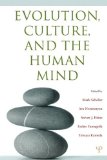
Evolution, Culture, and the Human Mind is forthcoming from Psychology Press, with a prospective release date of Aug. 25. Editors are Mark Schaller, Ara Norenzayan, Steven J. Heine, Toshio Yamagishi, and Tatsuya Kameda.
(link for UK)
Product description from the publisher:
An enormous amount of scientific research compels two fundamental conclusions about the human mind: The mind is the product of evolution; and the mind is shaped by culture. These two perspectives on the human mind are not incompatible, but, until recently, their compatibility has resisted rigorous scholarly inquiry. Evolutionary psychology documents many ways in which genetic adaptations govern the operations of the human mind. But evolutionary inquiries only occasionally grapple seriously with questions about human culture and cross-cultural differences. By contrast, cultural psychology documents many ways in which thought and behavior are shaped by different cultural experiences. But cultural inquires rarely consider evolutionary processes. Even after decades of intensive research, these two perspectives on human psychology have remained largely divorced from each other. But that is now changing — and that is what this book is about.
Evolution, Culture, and the Human Mind is the first scholarly book to integrate evolutionary and cultural perspectives on human psychology. The contributors include world-renowned evolutionary, cultural, social, and cognitive psychologists. These chapters reveal many novel insights linking human evolution to both human cognition and human culture – including the evolutionary origins of cross-cultural differences. The result is a stimulating introduction to an emerging integrative perspective on human nature.
Comments (1)
- cognitive science,culture,mind,new books,psychology
August 21, 2009
Cognition and Perception: How Do Psychology and Neural Science Inform Philosophy? (Bradford Books) by Athanassios Raftopoulos (MIT Press, 2009)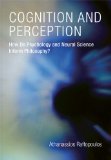
(link for UK)
Product description from the publisher:
In Cognition and Perception, Athanassios Raftopoulos discusses the cognitive penetrability of perception and claims that there is a part of visual processes (which he calls “perception”) that results in representational states with nonconceptual content; that is, a part that retrieves information from visual scenes in conceptually unmediated, “bottom-up,” theory-neutral ways. Raftopoulos applies this insight to problems in philosophy of science, philosophy of mind, and epistemology, and examines how we access the external world through our perception as well as what we can know of that world.
To show that there is a theory-neutral part of existence, Raftopoulos turns to cognitive science and argues that there is substantial scientific evidence. He then claims that perception induces representational states with nonconceptual content and examines the nature of the nonconceptual content. The nonconceptual information retrieved, he argues, does not allow the identification or recognition of an object but only its individuation as a discrete persistent object with certain spatiotemporal properties and other features. Object individuation, however, suffices to determine the referents of perceptual demonstratives. Raftopoulos defends his account in the context of current discussions on the issue of the theory-ladenness of perception (namely the Fodor-Churchland debate), and then discusses the repercussions of his thesis for problems in the philosophy of science. Finally, Raftopoulos claims that there is a minimal form of realism that is defensible. This minimal realism holds that objects, their spatiotemporal properties, and such features as shape, orientation, and motion are real, mind-independent properties in the world.
Table of contents & sample chapters available at MIT Press
Comments (0)
- cognitive science,new books,philosophy of mind
July 27, 2009
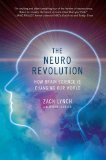
The Neuro Revolution: How Brain Science Is Changing Our World by Zack Lynch with Byron Laursen (St Martin’s Press, 2009).
Product description from the publisher:
History has already progressed through an agricultural revolution, an industrial revolution, and an information revolution. The Neuro Revolution foretells a fast approaching fourth epoch, one that will radically transform how we all work, live and play.
Neurotechnology—brain imaging and other new tools for both understanding and influencing our brains—is accelerating the pace of change almost everywhere, from financial markets to law enforcement to politics to advertising and marketing, artistic expression, warfare, and even religious belief.
The Neuro Revolution introduces you to the brilliant people leading this worldwide transformation, taking you into their laboratories, boardrooms and courtrooms for a unique, insider’s glimpse into the startling future now appearing at our doorstep. From foolproof lie detectors to sure-fire investment strategies to super-enhanced religious and aesthetic experiences, the insights and revelations within The Neuro Revolution will foster wonder, debate, and in some cases consternation. Above all, though, they need to be understood by those who will be most affected—all of us.
See also: website for the book
Comments (0)
- cognitive science,new books
July 21, 2009
Alternate Minds: Cognitive Science Fiction and Philosophy is a cool new blog from Pete Mandik, who describes its aim:
…to explore science fictional permutations of the concept of mind (and related concepts such as intelligence, perception, selfhood). By entertaining speculative scenarios wherein the target concepts are bent almost beyond recognition, we gain insights into the nature of mind and catch glimpses of new possibilities. Initial investigations will be clustered around seven key themes: Virtual Minds, Infinite Minds, Group Minds, Time-traveling Minds, Hyper-spatial Minds, Quantum Minds, and Anti-Minds.
Comments (0)
- cognitive science,fiction,philosophy of mind