January 30, 2008
 Today I attended a lecture by Dr. Paul Ekman (see also Wikipedia article) on the UC Berkeley campus. Dr. Ekman spoke about his early research showing the universality of facial expressions of emotion, then demonstrated a computer-based system for training people to recognize microexpressions (brief expressions that indicate concealed emotion), and discussed work in progress on facial expressions warning of dangerous intent.
He said “Emotions do not reveal their source,” so fear can be detected but not the reason, the target or the trigger for the emotion.
Something to look forward to next fall – a new book based on a dialog between Ekman and the Dalai Lama; I had written down the title as ‘Emotional Awareness’ but on his website the title is shown as ‘Steps Towards Emotional Balance’ (and not even at the pre-order stage on Amazon yet.)
link to video interview from 2004
Comments (0)
- cognitive science,psychology
January 28, 2008
In On Being Certain: Believing You Are Right Even When You’re Not, neurologist Robert Burton challenges the notions of how we think about 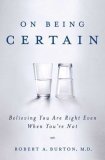 what we know. He shows that the feeling of certainty we have when we “know” something comes from sources beyond our control and knowledge. In fact, certainty is a mental sensation, rather than evidence of fact. Because this “feeling of knowing” seems like confirmation of knowledge, we tend to think of it as a product of reason. But an increasing body of evidence suggests that feelings such as certainty stem from primitive areas of the brain, and are independent of active, conscious reflection and reasoning. The feeling of knowing happens to us; we cannot make it happen.
Comments (0)
- cognitive science,new books,psychology
January 26, 2008
The Scent of Desire: Discovering Our Enigmatic Sense of Smell is a book I probably would not have thought to read, except that I saw it on the library’s new book shelves.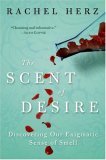 “Full of fascinating facts,” as one of the back-cover blurbs states, this is a good popular survey of the science and psychology of the sense of smell. Author Rachel Herz clearly has a passionate interest in her subject that is well conveyed through her writing.
Among the things I learned:
- There is an interconnection between emotion and the sense of smell – Herz suggests that in humans the emotions evolved out of the olfactory system.
- Memories triggered by scents are not necessarily more accurate than other memories, but they tend to be more emotionally intense.
- Women are attracted to the scent of men who are most dissimilar to them in major histocompatibility complex (MHC) genes, enabling them to select mates that strengthen the immune systems of their offspring. This preference is altered by taking birth control pills, however, raising the possibility that women who marry while on the pill may have difficulties later when they decide to have children.
- Aroma preferences and aversions appear to be learned; no odors have been found to be universally disliked across all cultures.
- It is difficult to change the response to a scent once an initial association has been made.
- Dogs have been trained to find whale scat to aid in research on the marine mammals’ population decline.
Comments (2)
- psychology
January 20, 2008
The Logic of Life: The Rational Economics of an Irrational World by Tim Harford (author video on the Amazon page).
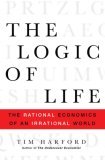
In this deftly reasoned book, Harford argues that life is logical after all. Under the surface of everyday insanity, hidden incentives are at work, and Harford shows these incentives emerging in the most unlikely places.
Using tools ranging from animal experiments to supercomputer simulations, an ambitious new breed of economist is trying to unlock the secrets of society. The Logic of Life is the first book to map out the astonishing insights and frustrating blind spots of this new economics in a way that anyone can enjoy.
This book reminds me of Freakonomics and has gotten an endorsement from the Freakonomics blog.
The Oregonian has an interview with the author.
Author’s website
Comments (0)
- culture,new books,psychology