Jesse Prinz at bloggingheads.tv
July 27, 2008
Jesse Prinz, author of The Emotional Construction of Morals talks to Will Wilkinson at Bloggingheads.tv.
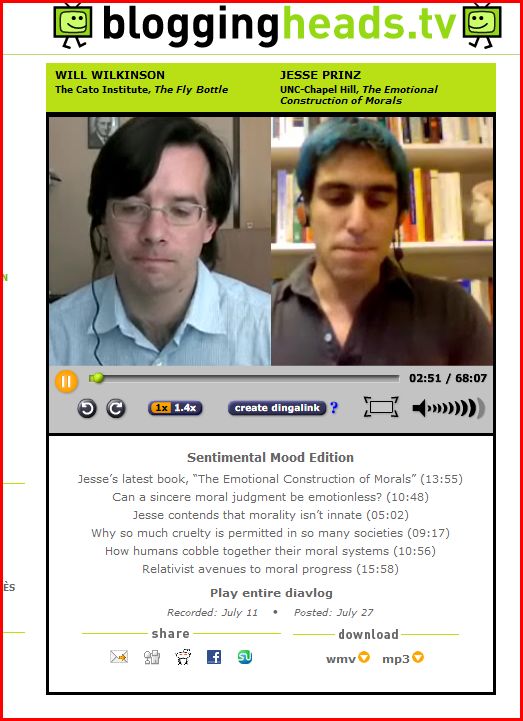
It takes them a few minutes to get rolling…
More on Jesse Prinz (with links to papers)
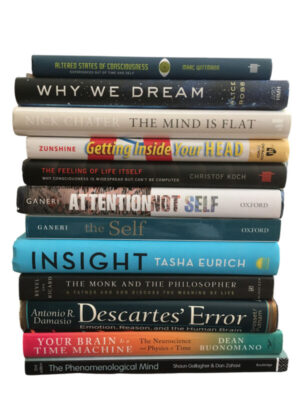
books on the mind, consciousness, cognitive science…
July 27, 2008
Jesse Prinz, author of The Emotional Construction of Morals talks to Will Wilkinson at Bloggingheads.tv.
It takes them a few minutes to get rolling…
More on Jesse Prinz (with links to papers)
July 22, 2008
July 12, 2008
The Science of Fear: Why We Fear the Things We Shouldn’t–and Put Ourselves in Greater Danger by Canadian journalist Daniel Gardner is coming soon, with a release date of July 17. In Canada, the UK and Australia it has been published with the title ‘Risk: The Science and Politics of Fear.’
From the publisher’s description:
From terror attacks to the war on terror, real estate bubbles to the price of oil, sexual predators to poisoned food from China, our list of fears is ever-growing. And yet, we are the safest and healthiest humans in history. Irrational fear seems to be taking over, often with tragic results. For example, in the months after 9/11, when people decided to drive instead of fly—believing they were avoiding risk—road deaths rose by more than 1,500.
In this fascinating, lucid, and thoroughly entertaining examination of how humans process risk, journalist Dan Gardner had the exclusive cooperation of Paul Slovic, the world renowned risk-science pioneer, as he reveals how our hunter gatherer brains struggle to make sense of a world utterly unlike the one that made them. Filled with illuminating real world examples, interviews with experts, and fast-paced, lean storytelling, The Science of Fear shows why it is truer than ever that the worst thing we have to fear is fear itself.
See also: “Terrorism is hard,” review of Gardner’s book at Ottawa Citizen (July 12, 2008)
The Unthinkable: Who Survives When Disaster Strikes – and Why (Crown, 2008)
From the publisher’s description:
Amanda Ripley, an award-winning journalist for Time magazine who has covered some of the most devastating disasters of our age, set out to discover what lies beyond fear and speculation. In this magnificent work of investigative journalism, Ripley retraces the human response to some of history’s epic disasters, from the explosion of the Mont Blanc munitions ship in 1917–one of the biggest explosions before the invention of the atomic bomb–to a plane crash in England in 1985 that mystified investigators for years, to the journeys of the 15,000 people who found their way out of the World Trade Center on September 11, 2001. Then, to understand the science behind the stories, Ripley turns to leading brain scientists, trauma psychologists, and other disaster experts, formal and informal, from a Holocaust survivor who studies heroism to a master gunfighter who learned to overcome the effects of extreme fear.
Finally, Ripley steps into the dark corners of her own imagination, having her brain examined by military researchers and experiencing through realistic simulations what it might be like to survive a plane crash into the ocean or to escape a raging fire.
Ripley comes back with precious wisdom about the surprising humanity of crowds, the elegance of the brain’s fear circuits, and the stunning inadequacy of many of our evolutionary responses. Most unexpectedly, she discovers the brain’s ability to do much, much better, with just a little help.
The Unthinkable escorts us into the bleakest regions of our nightmares, flicks on a flashlight, and takes a steady look around. Then it leads us home, smarter and stronger than we were before.
See also:Author’s website
July 7, 2008
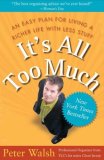
I know it sounds strange, but if you start by focusing on the clutter, you will never get organized. Getting truly organized is rarely about “the stuff.”
This is the bottom line: If your stuff and the way it is organized is getting you to your goals… fantastic. But if it’s impeding your vision for the the life you want, then why is it in your home? Why is it in your life? Why do you cling to it? For me, this is the only starting point in dealing with clutter.
(excerpt from It’s All Too Much)
When Kevin Kelly and Merlin Mann both rave about a book, it must be worth checking out, so as long as there’s still room to squeeze in one more book onto those overcrowded shelves, we’ll need to take a look at It’s All Too Much: How to Declutter Your Life by Peter Walsh.
Kevin Kelly’s Cool Tools review of ‘It’s All Too Much: How To Declutter Your Life‘ by Peter Walsh
Merlin Mann at 43folders: “My war on clutter” and “Review of It’s All Too Much…”
Peter Walsh interview at Unclutterer
The Only 127 Things You Need: A Guide To Life’s Essentials, the book excerpted in a recent post here, includes advice on controlling clutter from Peter Walsh.
Walsh also appears on Clean Sweep cable TV program.
July 3, 2008
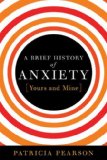
A Brief History of Anxiety…Yours and Mine by Patricia Pearson (Bloomsbury USA, 2008) is partly a memoir of the author’s experience of “generalized anxiety disorder” and partly an examination of anxiety as a social and psychological phenomenon, flavored with lots of wry humor, as evidenced by the opening sentence:
Given my druthers, I would prefer not to be afraid of the following: phone bills, ovarian cancer, black bears, climate change, walking on golf courses at night, being blundered into by winged insects; unseemly heights, running out of gas, having the mole on my back that I can feel, but not see, secretly morph into a malignant melanoma.
One of the books Pearson often refers to is Landscapes of fear by Yi-Fu Tuan (Pantheon Book, 1979)
See also Pearson’s Post (author’s website) and “Hall of Phobias”
New York Times review
interview at Enter Stage Right