[ View menu ]

Archive for 'psychology'

new book – ‘Psychology: Pythagoras to Present’

June 27, 2009

New from MIT Press: Psychology: Pythagoras to Present (Bradford Books) by John C. Malone, Professor of Psychology at the University of Tennessee, Knoxville.
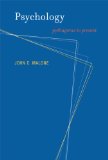
Psychology: Pythagoras to Present

Product description from the publisher:

Certain ideas have preoccupied thinkers since ancient times: the nature of mind, the sources of knowledge and belief, the nature of the self, ethics and the best way to lead our lives, the question of free will. In this book, John Malone examines these ideas in the writings of thinkers from antiquity to the present day and argues for their importance not just as precursors of modern views but as ideas that are frequently better than current ones. We can get good advice, he writes, from the writings of the best thinkers of the past. Pythagoras, Thales, Plato, Protagoras, Aristotle, Diogenes, and Epictetus all offer tried and tested ideas on how we should lead our lives and on the treatment of psychopathology—as do Berkeley, Hume, John Stuart Mill, Johann Friedrich Herbart, Wilhelm Wundt, William James, Sigmund Freud, and B. F. Skinner.

Malone begins with the naturalistic and mystical strains of early Greek thought, moves on to Platonism and the world of Forms (and considers parallels between the thought of Plato and Freud), and discusses “Ancient Self-Help Therapies” (including Epicureanism). He investigates the psychological insights of Enlightenment thinkers including Francis Bacon and Galileo, Locke’s and Kant’s theories of experience, and Darwin’s evolutionary thinking. He charts the rise of modern psychology and the beginning of “biological psychology.” He examines the work of Wundt, Titchener, Freud, Peirce, and James, among others, and describes the ideas of behaviorism, Gestalt psychology, and cognitive science.

Malone’s history offers both breadth and depth, an engaging style and rigorous scholarship, demonstrating vividly the relevance of the great historical psychological thinkers.

A preview is available at the publisher’s website.
Comments (0) - new books,psychology

‘The Evolution of God’ – new book by Robert Wright

June 6, 2009

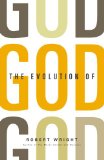
The Evolution of God

Robert Wright, author of Nonzero: The Logic of Human Destiny and The Moral Animal: Why We Are, the Way We Are: The New Science of Evolutionary Psychology, has just published The Evolution of God (Little, Brown, 2009)…

Product description from the publisher:

In this sweeping narrative that takes us from the Stone Age to the Information Age, Robert Wright unveils an astonishing discovery: there is a hidden pattern that the great monotheistic faiths have followed as they have evolved. Through the prisms of archaeology, theology, and evolutionary psychology, Wright’s findings overturn basic assumptions about Judaism, Christianity, and Islam, and are sure to cause controversy. He explains why spirituality has a role today, and why science, contrary to conventional wisdom, affirms the validity of the religious quest. And this previously unrecognized evolutionary logic points not toward continued religious extremism, but future harmony.

Nearly a decade in the making, The Evolution of God is a breathtaking re-examination of the past, and a visionary look forward.

The website for the book has excerpts and more.

Comments (0) - culture,new books,psychology

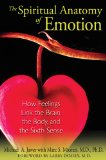
new book – ‘The Spiritual Anatomy of Emotion: How Feelings Link the Brain, the Body, and the Sixth Sense’

May 30, 2009

The Spiritual Anatomy of Emotion

The Spiritual Anatomy of Emotion: How Feelings Link the Brain, the Body, and the Sixth Sense by Michael Jawer with Dr. Marc Micozzi (Park Street Press/Inner Traditions, 2009)

Product description from the publisher:

A cutting-edge examination of feelings, not thoughts, as the gateway to understanding consciousness

• Contends that emotion is the greatest influence on personality development

• Offers a new perspective on immunity, stress, and psychosomatic conditions

• Explains how emotion is key to understanding out-of-body experience, apparitions, and other anomalous perceptions

Contemporary science holds that the brain rules the body and generates all our feelings and perceptions. Michael Jawer and Dr. Marc Micozzi disagree. They contend that it is our feelings that underlie our conscious selves and determine what we think and how we conduct our lives.

The less consciousness we have of our emotional being, the more physical disturbances we are likely to have–from ailments such as migraines, fibromyalgia, chronic fatigue, and post-traumatic stress to anomalous perceptions such as apparitions and involuntary out-of-body experiences. Using the latest scientific research on immunity, sensation, stress, cognition, and emotional expression, the authors demonstrate that the way we process our feelings provides a key to who is most likely to experience these phenomena and why. They explain that emotion is a portal into the world of extraordinary perception, and they provide the studies that validate the science behind telepathic dreams, poltergeists, and ESP. The Spiritual Anatomy of Emotion challenges the prevailing belief that the brain must necessarily rule the body. Far from being by-products of neurochemistry, the authors show that emotions are the key vehicle by which we can understand ourselves and our interactions with the world around us as well as our most intriguing–and perennially baffling–experiences.

See also: Website for the book for excerpts and more…

Comments (0) - consciousness,psychology

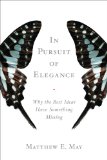
new book – ‘In Pursuit of Elegance: Why the Best Ideas Have Something Missing’

May 19, 2009

In Pursuit of Elegance
In Pursuit of Elegance: Why the Best Ideas Have Something Missing by Matthew May (Broadway Business, 2009)

Product description from the publisher:

What made the Sopranos finale one of the most-talked-about events in television history?

Why is sudoku so addictive and the iPhone so irresistible?

What do Jackson Pollock and Lance Armstrong have in common with theoretical physicists and Buddhist monks?

Elegance.

In this thought-provoking exploration of why certain events, products, and people capture our attention and imaginations, Matthew E. May examines the elusive element behind so many innovative breakthroughs in fields ranging from physics and marketing to design and popular culture. Combining unusual simplicity and surprising power, elegance is characterized by four key elements—seduction, subtraction, symmetry, and sustainability. In a compelling, story-driven narrative that sheds light on the need for elegance in design, engineering, art, urban planning, sports, and work, May offers surprising evidence that what’s “not there” often trumps what is.

In the bestselling tradition of The Tipping Point, Made to Stick, and The Black Swan, In Pursuit of Elegance will change the way you think about the world.

See also: book website

Comments (1) - consciousness,culture,happiness,new books,psychology,self

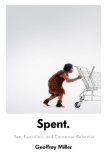
coming soon – ‘Spent: Sex, Evolution, and Consumer Behavior’

May 10, 2009

Spent
Spent: Sex, Evolution, and Consumer Behavior by evolutionary psychologist Geoffrey Miller is due out this Thurs. May 14 from Viking. (Here is the Kindle edition)

Product description from the publisher:

A leading evolutionary psychologist probes the hidden instincts behind our working, shopping, and spending

Evolutionary psychology—the compelling science of human nature—has clarified the prehistoric origins of human behavior and influenced many fields ranging from economics to personal relationships. In Spent Geoffrey Miller applies this revolutionary science’s principles to a new domain: the sensual wonderland of marketing and status seeking that we call American consumer culture. Starting with the basic notion that the goods and services we buy unconsciously advertise our biological potential as mates and friends, Miller examines the hidden factors that dictate our choices in everything from lipstick to cars, from the magazines we read to the music we listen to. With humor and insight, Miller analyzes an array of product choices and deciphers what our decisions say about ourselves, giving us access to a new way of understanding—and improving—our behaviors. Like Freakonomics or The Tipping Point, Spent is a bold and revelatory book that illuminates the unseen logic behind the chaos of consumerism and suggests new ways we can become happier consumers and more responsible citizens.

Miller’s previous book was The Mating Mind: How Sexual Choice Shaped the Evolution of Human Nature.

Comments (0) - new books,psychology