4 books coming next week
September 12, 2010
Here’s a Google search strategy that more or less works for finding new releases: site:www.amazon.com “will be released on September 14, 2010” [add favorite keyword]. Some of the books to be published next week:
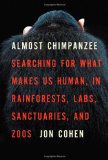
Almost Chimpanzee: Searching for What Makes Us Human, in Rainforests, Labs, Sanctuaries, and Zoos by Jon Cohen (Times Books, 2010)
Product description from the publisher:
The captivating story of how a band of scientists has redrawn the genetic and behavioral lines that separate humans from our nearest cousins
In the fall of 2005, a band of researchers cracked the code of the chimpanzee genome and provided a startling new window into the differences between humans and our closest primate cousins. For the past several years, acclaimed Science reporter Jon Cohen has been following the DNA hunt, as well as eye-opening new studies in ape communication, human evolution, disease, diet, and more.
In Almost Chimpanzee, Cohen invites us on a captivating scientific journey, taking us behind the scenes in cutting-edge genetics labs, rain forests in Uganda, sanctuaries in Iowa, experimental enclaves in Japan, even the Detroit Zoo. Along the way, he ferries fresh chimp sperm for a time-sensitive analysis, gets greeted by pant-hoots and chimp feces, and investigates an audacious attempt to breed a humanzee. Cohen offers a fresh and often frankly humorous insider’s tour of the latest research, which promises to lead to everything from insights about the unique ways our bodies work to shedding light on stubborn human-only problems, ranging from infertility and asthma to speech disorders.
And in the end, Cohen explains why it’s time to move on from Jane Goodall’s plea that we focus on how the two species are alike and turns to examining why our differences matter in vital ways—for understanding humans and for increasing the chances to save the endangered chimpanzee.
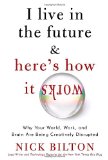
I Live in the Future & Here’s How It Works: Why Your World, Work, and Brain Are Being Creatively Disrupted by Nick Bilton (Crown Business, 2010)
Product description from the publisher:
Are we driving off a digital cliff and heading for disaster, unable to focus, maintain concentration, or form the human bonds that make life worth living? Are media and business doomed and about to be replaced by amateur hour?
The world, as Nick Bilton—with tongue-in-cheek—shows, has been going to hell for a long, long time, and what we are experiencing is the twenty-first-century version of the fear that always takes hold as new technology replaces the old. In fact, as Bilton shows, the digital era we are part of is, in all its creative and disruptive forms, the foundation for exciting and engaging experiences not only for business but society as well.
Both visionary and practical, I Live in the Future & Here’s How It Works captures the zeitgeist of an emerging age, providing the understanding of how a radically changed media world is influencing human behavior:
• With a walk on the wild side—through the porn industry—we see how this business model is leading the way, adapting product to consumer needs and preferences and beating piracy.
• By understanding how the Internet is creating a new type of consumer, the “consumnivore,” living in a world where immediacy trumps quality and quantity, we see who is dictating the type of content being created.
• Through exploring the way our brains are adapting, we gain a new understanding of the positive effect of new media narratives on thinking and action. One fascinating study, for example, shows that surgeons who play video games are more skillful than their nonplaying counterparts.
• Why social networks, the openness of the Internet, and handy new gadgets are not just vehicles for telling the world what you had for breakfast but are becoming the foundation for “anchoring communities” that tame information overload and help determine what news and information to trust and consume and what to ignore.
• Why the map of tomorrow is centered on “Me,” and why that simple fact means a totally new approach to the way media companies shape content.
• Why people pay for experiences, not content; and why great storytelling and extended relationships will prevail and enable businesses to engage with customers in new ways that go beyond merely selling information, instead creating unique and meaningful experiences.I Live in the Future & Here’s How It Works walks its own talk by creating a unique reader experience: Semacodes embedded in both print and eBook versions will take readers directly to Bilton’s website (www.NickBilton.com), where they can access videos of the author further developing his point of view and also delve into the research that was key to shaping the central ideas of the book. The website will also offer links to related content and the ability to comment on a chapter, allowing the reader to join the conversation.
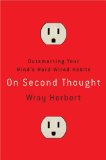
On Second Thought: Outsmarting Your Mind’s Hard-Wired Habits by Wray Herbert (Crown, 2010)
Product description from the publisher:
Our lives are composed of millions of choices, ranging from trivial to life-changing and momentous. Luckily, our brains have evolved a number of mental shortcuts, biases, and tricks that allow us to quickly negotiate this endless array of decisions. We don’t want to rationally deliberate every choice we make, and thanks to these cognitive rules of thumb, we don’t need to.
Yet these hard-wired shortcuts, mental wonders though they may be, can also be perilous. They can distort our thinking in ways that are often invisible to us, leading us to make poor decisions, to be easy targets for manipulators…and they can even cost us our lives.
The truth is, despite all the buzz about the power of gut-instinct decision-making in recent years, sometimes it’s better to stop and say, “On second thought . . .”
The trick, of course, lies in knowing when to trust that instant response, and when to question it. In On Second Thought, acclaimed science writer Wray Herbert provides the first guide to achieving that balance. Drawing on real-world examples and cutting-edge research, he takes us on a fascinating, wide-ranging journey through our innate cognitive traps and tools, exposing the hidden dangers lurking in familiarity and consistency; the obstacles that keep us from accurately evaluating risk and value; the delusions that make it hard for us to accurately predict the future; the perils of the human yearning for order and simplicity; the ways our fears can color our very perceptions . . . and much more.
Along the way, Herbert reveals the often-bizarre cross-connections these shortcuts have secretly ingrained in our brains, answering such questions as why jury decisions may be shaped by our ancient need for cleanliness; what the state of your desk has to do with your political preferences; why loneliness can literally make us shiver; how drawing two dots on a piece of paper can desensitize us to violence… and how the very typeface on this page is affecting your decision about whether or not to buy this book.
Ultimately, On Second Thought is both a captivating exploration of the workings of the mind and an invaluable resource for anyone who wants to learn how to make smarter, better judgments every day.
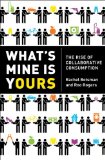
What’s Mine Is Yours: The Rise of Collaborative Consumption by Rachel Botsman and Roo Rogers (HarperBusiness, 2010)
Product description from the publisher:
WHAT’S MINE IS YOURS is about Collaborative Consumption, a new, emerging economy made possible by online social networks and fueled by increasing cost consciousness and environmental necessity. Collaborative Consumption occurs when people participate in organized sharing, bartering, trading, renting, swapping, and collectives to get the same pleasures of ownership with reduced personal cost and burden, and lower environmental impact.
The book addresses three growing models of Collaborative Consumption: Product Service Systems, Communal Economies, and Redistribution Markets. The first, Product Service Systems, reflects the increasing number of people from all different backgrounds and across ages who are buying into the idea of using the service of the product-what it does for them-without owning it. Examples include Zipcar and Ziploc, and these companies are disrupting traditional industries based on models of individual ownership. Second, in what the authors define as Communal Economies, there is a growing realization that as individual consumers, we have relatively little in the way of bargaining power with corporations. A crowd of consumers, however, introduces a different, empowering dynamic. Online networks are bringing people together again and making them more willing to leverage the proverbial power of numbers. Examples of this second category include Etsy, an online market for handcrafts, or the social lending marketplace Zopa. The third model is Redistribution Markets, exemplified by worldwide networks such as Freecycle and Ebay as well as emerging forms of modern day bartering and “swap trading” such as Zwaggle, Swaptree, and Zunafish. Social networks facilitate consumer-to-consumer marketplaces that redistribute goods from where they are not needed to somewhere or someone where they are. This business model encourages reusing/reselling of old items rather them throwing them out, thereby reducing the waste and carbon emissions that go along with new production.
WHAT’S MINE IS YOURS describes how these three models come together to form a new economy of more sustainable consumerism. Collaborative Consumption started as a trend in conjunction with the emergence of shared collective content/information sites such as Wikipedia and Flickr and with the recent economic troubles and increasing environmental awareness, it is growing into an international movement. The authors predict it will be a fully fledged economy within the next five years.
In this book the authors travel among the quiet revolutionaries (consumers and companies) from all around the world. They explore how businesses will both prosper and fail in this environment, and, in particular, they examine how it has the potential to help create the mass sustainable change in consumer behaviors this planet so desperately needs. The authors themselves are environmentalists, but they are also entrepreneurs, parents, and optimistic citizens. This is a good news book about long-term positive change.